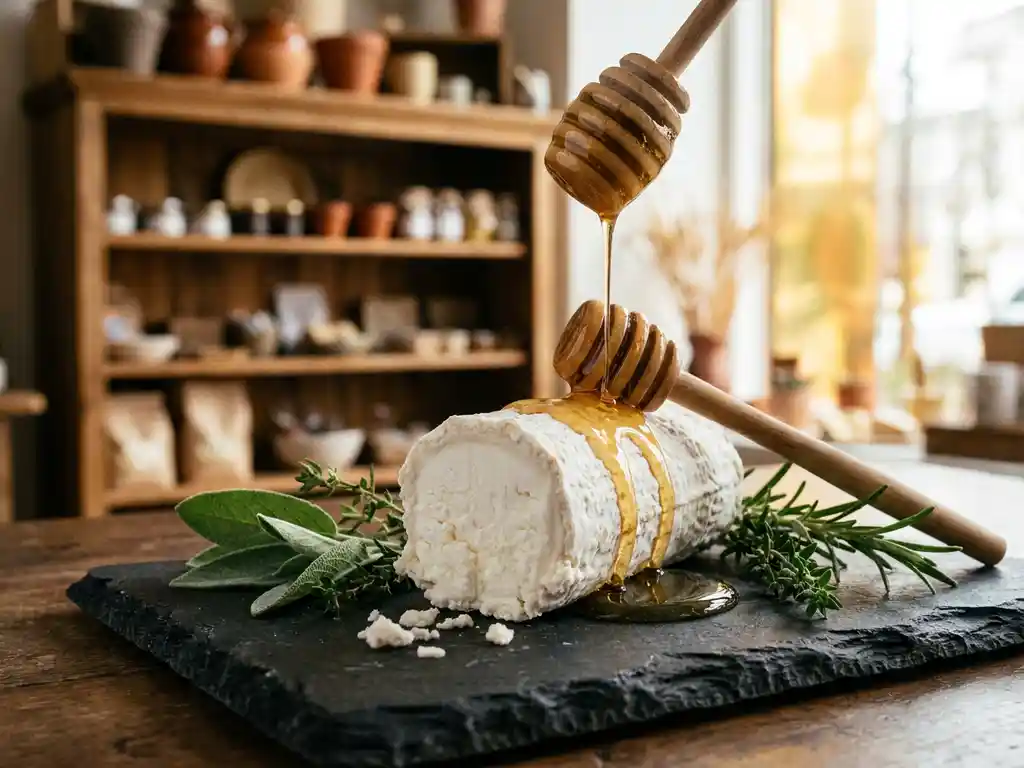
Private label goat cheese concepts give retail partners the opportunity to bring distinctive cheese products to market under their own brand name — without having to invest in production or cheesemaking expertise. The options range from fresh goat cheese logs and aged specialties to marinated varieties with herbs or truffle, fully tailored to the desired flavor profile, packaging format, and market positioning. In this article, we answer the most frequently asked questions about private label goat cheese for retail partners.
What sets a strong private label goat cheese concept apart from a generic product?
A strong private label goat cheese concept stands out from a generic product through a well-thought-out combination of flavor identity, packaging design, and technical specifications that connect with a specific target audience and retail position. Where a generic product focuses on price and volume, a strong concept builds brand value and recognition for the retailer.
The difference is in the details. A good private label goat cheese concept starts with a clear positioning: who is the product for, which segment does it sit in, and what makes it unique on the shelf? Think of a fresh goat cheese with a specific fat content and a soft, creamy texture that fits a premium product line, or an aged goat cheese log with a distinctive rind that suits an artisanal range.
Beyond flavor and texture, the following elements also play a key role:
- Consistent quality across all deliveries, so consumers always get the same product
- Distinctive ingredients such as herbs, spices, or flavor additions that give the product its own character
- Packaging format and presentation that match the retail channel and target audience
- Clean-label composition with natural ingredients, which is becoming increasingly important to today’s consumers
A generic product competes on price. A strong concept creates loyalty and margin.
Which goat cheese formats work best for private label retail?
The most suitable goat cheese formats for private label retail are fresh goat cheese logs, soft goat cheese blocks, marinated goat cheese in oil, and aged goat cheese specialties. Each format has specific advantages depending on the intended retail segment, shelf life, and consumer usage occasion.
Fresh and soft goat cheese formats
Fresh goat cheese logs are a classic and widely accessible format that works great in supermarkets and specialty stores. They have a recognizable profile, are versatile, and appeal to a broad audience. Soft goat cheese in a tub or block is well suited for private label because the format is easy to fit with custom labeling and packaging.
Marinated and aged specialties
Marinated goat cheese in herb oil or with spices such as red onion, truffle, or Provençal herbs is an ideal fit for a premium private label line. This format has a higher perceived value, a longer shelf life, and attracts consumers looking for something special. Aged goat cheese specialties — such as an aged goat cheese with a natural rind — are a great match for an artisanal or specialty retail concept.
When choosing a format, it’s smart to consider the logistics chain, the desired shelf presentation, and the expected turnover rate. Our goat cheese for retail includes multiple formats developed specifically for different retail contexts.
How much customization is possible when developing a private label goat cheese?
When developing a private label goat cheese, almost everything is open for discussion: from flavor profile and texture to fat content, packaging format, weight, and labeling. The degree of customization depends on the volume and production capabilities of the producer, but a specialized goat cheese maker typically offers a great deal of flexibility.
Specifically, the following aspects can be tailored:
- Flavor profile: mild or pronounced, with or without herbs, with specific flavor additions
- Texture: fresh and spreadable, firm, or aged with a rind
- Fat content and moisture content: adjusted for technical applications or consumer preference
- Weight and format: from small single-serve portions to larger foodservice units
- Packaging and label: fully aligned with the retail partner’s brand identity
- Ingredients: clean-label, organic, or with specific flavor additions
The more volume a retail partner orders, the more room there is for customization. With smaller volumes, it’s common to work from an existing base recipe with variations applied. It’s a good idea to talk with the producer early in the process about what’s technically feasible, so expectations are aligned from the start.
What requirements must private label goat cheeses meet for European retail?
Private label goat cheeses for European retail must comply with European food legislation, including requirements around food safety, labeling, traceability, and hygiene. The producer is responsible for manufacturing in line with these standards; the retailer is responsible for correct labeling under their own brand name.
The key requirements are:
- HACCP certification: the producer must be able to demonstrate that the production process meets the Hazard Analysis Critical Control Points system
- Labeling rules: the label must include the correct ingredient list, allergen information, best-before date, storage instructions, and country of origin in accordance with EU Regulation 1169/2011
- Traceability: every product must be traceable back to its raw material source, which is essential in the event of a recall
- Microbiological standards: goat cheese must comply with European standards for listeria, salmonella, E. coli, and others
- Certifications: depending on the retail channel, additional certification may be required, such as BRC, IFS, or an organic certification
For retailers exporting to multiple European countries, it’s worth checking whether the producer already has experience with the specific requirements of those markets. Local regulations can differ from the baseline standards in certain areas.
What does working with a private label goat cheese producer look like?
Working with a private label goat cheese producer typically follows a set of clear phases: an intake conversation about needs and specifications, product development and trial production, approval of the final product, and then ongoing delivery. A good producer actively contributes at every stage and is transparent about what’s possible and what isn’t.
A typical process looks like this:
- Intake and briefing: the retail partner shares their wishes regarding flavor, format, volume, and positioning
- Concept development: the producer develops one or more product concepts, including recipe and packaging proposal
- Trial production and evaluation: samples are produced and assessed for flavor, texture, and technical properties
- Adjustments and approval: based on feedback, changes are made until the product meets all requirements
- Commercial agreements: pricing, volume, lead times, and contract terms are finalized
- Ongoing delivery: once approved, regular production and delivery begins
The lead time from intake to first delivery varies, but you can generally count on a few weeks to a couple of months, depending on the complexity of the product and the certifications needed. A producer with extensive experience in private label goat cheese can speed up this process considerably, since existing recipes can serve as a starting point.
How we help with private label goat cheese concepts for retail partners
As a family business with years of experience producing goat cheese specialties under the Alphenaer brand, we offer retail partners a complete private label solution. We combine artisanal production with the flexibility and scale needed for a professional retail concept. Here’s what we offer:
- A wide range of base formats as a starting point, from fresh goat cheese logs to marinated specialties
- Custom flavor, texture, format, and packaging — tailored to your brand and target audience
- Production in compliance with European food safety standards and the required certifications
- Personal contact and short communication lines, so you always know where things stand
- Experience supplying retail, foodservice, and industry worldwide, both under our own brand and as private label
Want to find out what we can do for your private label goat cheese concept? Get in touch with DeJong Cheese and we’ll be happy to explore the possibilities in a no-obligation conversation.
Frequently Asked Questions
What is the minimum order volume to get started with a private label goat cheese concept?
The minimum order volume varies by producer, but the general rule is: the larger the volume, the more room there is for full customization. With smaller volumes, you typically work from an existing base recipe with adjustments applied — such as a different herb blend or custom packaging. It’s smart to discuss this early in the conversation with the producer, so expectations are clear on both sides and the concept stays financially viable.
How long does it take before my private label goat cheese is on the shelf?
The lead time from the first intake conversation to the actual shelf launch typically ranges from a few weeks to a couple of months. The complexity of the product, the number of tasting rounds, and the certifications required largely determine the timeline. Working with an experienced private label producer who already has existing recipes and approved production processes in place can significantly shorten the lead time.
Can I have my private label goat cheese produced organically?
Yes, organic production is possible in many cases, provided the producer holds a valid organic certification and works with certified organic goat’s milk. To display an organic label on the packaging, both the producer and the product must comply with the European organic production regulation (EU 2018/848). Bring this up early in the process, as organic certification places additional requirements on the raw material supply chain and production documentation.
What are common mistakes when developing a private label goat cheese concept?
One common mistake is leaving packaging and labeling too late: the technical requirements for labeling under EU Regulation 1169/2011 take more time than retailers often expect. Some retailers also underestimate the importance of clear positioning upfront — without a defined target audience and shelf strategy, it becomes hard to make decisions about flavor, format, and price. Finally, the shelf life of the chosen format in relation to the logistics chain is sometimes overlooked, which can lead to food waste or quality issues for the consumer.
How do I ensure consistent quality across multiple deliveries?
Consistent quality starts with clear product specifications agreed upon together with the producer — including flavor profile, texture, fat content, and microbiological standards. Ask the producer about their quality assurance and batch registration systems, so that if any deviations occur, you can quickly trace where the issue originated. Regular sensory and technical assessments of incoming deliveries — whether done in-house or through a third party — help catch quality differences early.
Can I sell my private label goat cheese internationally, outside the Netherlands?
Yes, private label goat cheese can be exported to other European countries and beyond, provided the producer meets the relevant certifications for those markets — such as BRC or IFS for British and international retail, or specific import requirements outside the EU. The labeling must be adapted to the language requirements and any additional regulations of the destination country. Ideally, choose a producer with proven export experience, so you can benefit from existing knowledge of market requirements and logistics routes.
What information should I prepare to make a product conversation as productive as possible?
The more concrete your briefing, the more efficient the development process. At a minimum, prepare the following: your intended target audience and retail segment, an indication of the desired flavor profile and format, your expected annual order volume, and any requirements around certifications or clean-label composition. If you already have reference products that match the positioning you have in mind, bring them along as inspiration — that can speed up concept development considerably.
Related Articles
- What are the best goat cheese options for ready-to-eat meals on an industrial scale?
- What are the benefits of a cheese producer that uses 70% wind energy?
- How to position goat cheese as premium product in foodservice?
- How to pair goat cheese with local ingredients?
- Goat cheese vs parmesan in pasta dishes?