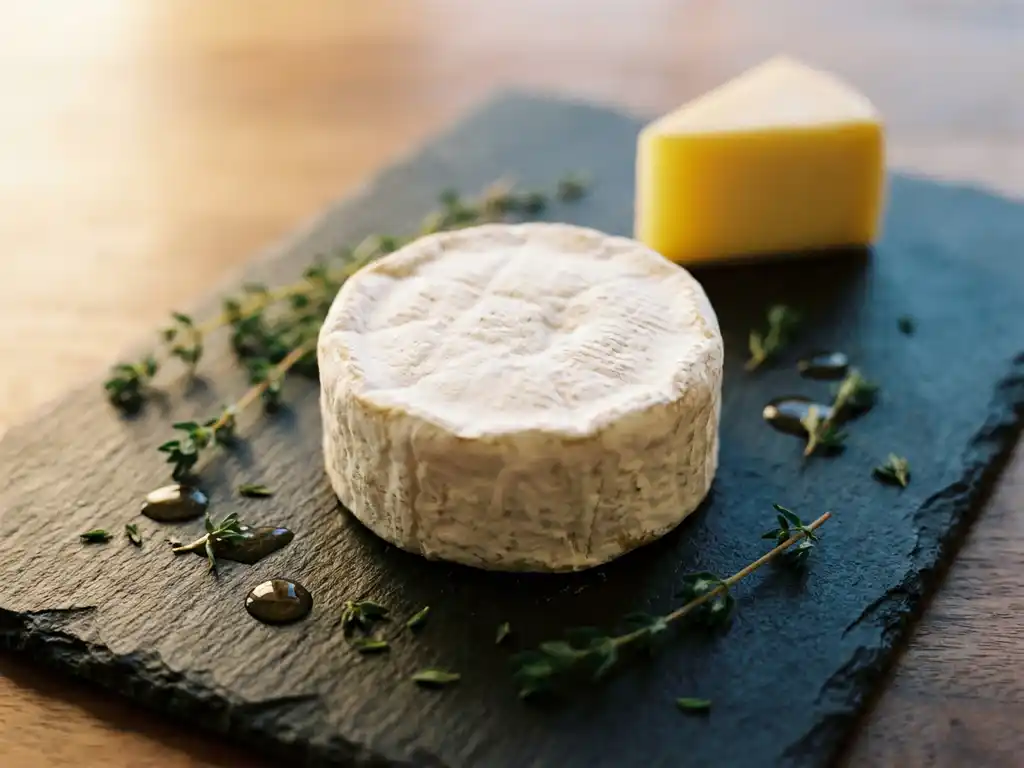
Goat cheese positions itself as a premium ingredient over cow’s milk cheese by focusing on its unique depth of flavor, distinctive fat profile, and artisanal origin — qualities that cow’s milk cheese simply can’t match. Where cow’s milk cheese is the standard, goat cheese brings character, traceability, and a story that resonates with consumers and buyers alike. In this article, we answer the most common questions about the technical and commercial differences between the two.
What makes goat cheese technically different from cow’s milk cheese?
Goat cheese differs from cow’s milk cheese at the level of milk composition itself. Goat’s milk contains smaller fat globules and a different fatty acid profile, with a higher concentration of medium-chain fatty acids such as capric acid and caprylic acid. This has a direct impact on texture, digestibility, and flavor in every application.
For product developers and buyers, this translates into a number of practical advantages:
- Finer emulsion: The smaller fat globules in goat’s milk create a creamier mouthfeel without the need for added emulsifiers.
- Lower pH: Fresh goat cheese has a naturally slightly acidic pH, which contributes to a longer shelf life and a sharper flavor profile in recipes.
- Different protein profile: Goat’s milk contains less alphas1-casein than cow’s milk, which affects the consistency and structure of the cheese — making it softer and more spreadable.
- White in color: Goat cheese contains no beta-carotene, so it stays white — even without additives. This is a functional advantage in products where color consistency matters.
For buyers in the food industry, this means goat cheese is a technically predictable ingredient with specific, reproducible properties — as long as production is consistent.
What flavor characteristics set goat cheese apart in a recipe?
Goat cheese has a bold, fresh, and slightly tangy flavor profile, with a distinctive goaty note that comes from its medium-chain fatty acids. That distinctiveness is exactly what makes goat cheese so valuable as a premium ingredient: it adds depth of flavor that cow’s milk cheese simply doesn’t have.
In recipes, goat cheese acts as a flavor enhancer with its own identity. Its mild acidity cuts through rich or fatty flavors, making it a great match for ingredients like:
- Truffle and mushrooms, where earthy notes are amplified
- Red onion and beets, where the sweetness gets a counterbalance
- Honey and nuts, where the combination of sweet and tangy creates balance
- Mediterranean herbs like thyme, rosemary, and basil
For product developers working on distinctive food concepts, this flavor profile is a strategic asset. Goat cheese already communicates craftsmanship and provenance on its own — no added flavorings or aromas needed. That makes it an ideal choice for clean-label products that want to feel authentic.
How does goat cheese behave when heated compared to cow’s milk cheese?
When heated, goat cheese behaves differently from cow’s milk cheese: it melts less readily, holds its structure better, and browns more slowly. This isn’t a drawback — it’s a functional property that can be used to your advantage in heated applications.
Cow’s milk cheeses like mozzarella or Gouda melt at higher temperatures into a fluid, stretchy mass. Goat cheese — especially fresh and soft varieties — keeps a creamy texture when heated and is less likely to fall apart. This has real practical implications for foodservice and industrial applications:
- On pizza: Soft goat cheese melts partially, keeps a creamy center, and delivers a visually appealing result without oil separation.
- In quiches and tarts: Goat cheese binds well with egg and cream without splitting at high oven temperatures.
- In warm sauces: Crumbled goat cheese partially dissolves and creates a creamy, slightly tangy sauce without extra thickeners.
- On grilled vegetables: Thanks to its higher heat stability, goat cheese holds its shape on the grill — reinforcing the premium visual effect.
For buyers using cheese in standardized production lines, choosing the right variety is key. Fresh soft goat cheese behaves very differently from an aged hard variety. We always recommend matching the cheese type to the specific heating temperature and preparation time of your application.
When is goat cheese the stronger choice as a premium ingredient?
Goat cheese is the stronger choice as a premium ingredient when a product wants to stand out on flavor, origin, or target audience. This is especially true for applications where authenticity, clean-label positioning, and a bold flavor profile are commercially relevant.
There are specific situations where goat cheese outperforms cow’s milk cheese as an ingredient choice:
- Premium retail products: Consumers associate goat cheese with craftsmanship and regional origin, which raises the perceived value of the end product.
- Trendy food concepts: Paired with truffle, za’atar, harissa, or other trending ingredients, goat cheese reinforces a premium and authentic character.
- Lactose-sensitive consumers: Goat’s milk contains less lactose than cow’s milk, making goat cheese appealing to a growing group of consumers.
- Foodservice with a story: Restaurants and caterers who want to communicate provenance and craftsmanship will find goat cheese to be an ingredient with a strong narrative.
- Private label differentiation: For retailers looking to position their own brand above the average, goat cheese offers a credible premium positioning.
Cow’s milk cheese remains the logical choice for volume, neutral flavor integration, and lower costs. But when the goal is to stand out, tell a story, or justify a higher consumer price, goat cheese as a premium goat cheese ingredient is the better strategic choice.
How do you communicate the premium value of goat cheese to the end consumer?
You communicate the premium value of goat cheese to consumers through three pillars: origin, craftsmanship, and flavor promise. In 2026, consumers want to know where their food comes from, how it’s made, and what to expect. Goat cheese delivers on all three.
Origin as a selling point
Traceability is no longer a bonus for modern consumers — it’s an expectation. By naming the origin of the goat’s milk and the production location on packaging or in marketing communications, you give the product a face. Terms like “artisanally made,” “traditional recipe,” or a reference to the region of production increase credibility and willingness to pay a higher price.
Flavor promise as a differentiator
Cow’s milk cheese is familiar. Goat cheese is special. Communicate that difference actively by using concrete flavor descriptions: “fresh and lightly tangy,” “creamy with a distinctive character,” or “perfectly balanced with honey and walnuts.” Specific flavor descriptions help consumers form an expectation — one that the product then delivers on.
For product developers working on retail concepts, the retail assortment page at DeJong Cheese is a great starting point to explore which goat cheese specialties are available for private label and co-branding.
How DeJong Cheese helps position goat cheese as a premium ingredient
At DeJong Cheese, we have specialized in fresh and soft goat cheese specialties under our Alphenaer brand since 1995. From Alphen, we supply retail, foodservice, and industrial customers worldwide — both under our own brand and as private label. Our added value goes beyond the cheese itself: we think along with our customers every step of the way.
Here’s what we offer buyers and product developers who want to position goat cheese as a premium ingredient:
- Consistent quality at volume: Our production processes are set up for reproducible specifications, so every delivery meets the agreed parameters for fat content, pH, texture, and flavor.
- Custom development: We work with you to develop new product concepts — from specific flavor profiles to custom packaging formats for foodservice or retail.
- Technical support: Our specialists advise on the right goat cheese variety for your specific application, whether it involves heating, spreadability, or flavor combinations.
- Private label options: For retailers and foodservice companies looking to build their own premium line, we offer flexible private label solutions.
- Reliable delivery: With a proven track record in international supply, we provide a stable supply chain that fits your production planning.
Want to know how we can strengthen your product with the right goat cheese specialty? Browse our offer for foodservice customers or get in touch with our team for a no-obligation conversation about the possibilities.
Frequently Asked Questions
What is the difference between fresh and aged goat cheese as an ingredient in product development?
Fresh goat cheese has a higher moisture content, a softer texture, and a milder, fresher flavor, while aged goat cheese has a more intense, complex flavor and a firmer structure. For applications where spreadability or creaminess is the priority, fresh goat cheese is the right choice. Aged varieties work better when you want a bold flavor impact with smaller quantities — for example in sauces or as a topping.
Is goat cheese suitable for large-scale industrial applications, or is it purely a niche ingredient?
Goat cheese is absolutely suitable for large-scale industrial applications, as long as you work with a supplier who can guarantee consistent specifications at volume. The key is defining clear parameters such as fat content, pH, and texture, so that every delivery is reproducible. Suppliers like DeJong Cheese are specifically set up to deliver goat cheese specialties at industrial scale without compromising on quality.
How do I handle the higher purchase price of goat cheese versus cow's milk cheese when pitching to retailers?
The higher purchase price of goat cheese is justified by the increased perceived value for the end consumer, which enables a higher retail price and better margins. Back this up in your pitch with concrete consumer data on the growing demand for artisanal and traceable products, and highlight the clean-label positioning that saves on marketing costs. Retailers understand that a premium ingredient like goat cheese structurally raises the shelf value of a private label line.
What are common mistakes product developers make when working with goat cheese in heated applications?
The most common mistake is doing a straight one-to-one swap of cow’s milk cheese for goat cheese without accounting for the different melting and binding properties. Goat cheese behaves differently at high temperatures and sometimes requires adjustments in heating time, temperature, or the ratio with other ingredients like egg or cream. A second common mistake is choosing a variety that is too aged for an application that calls for creaminess — resulting in an overpowering flavor and a grainy texture.
As a foodservice buyer, how can I quickly test whether goat cheese fits within my existing product line?
The fastest way is to request samples from a specialized supplier and test them under the specific preparation conditions of your production line — including the exact temperatures and preparation times you normally use. Also ask for technical specifications such as pH, fat content, and dry matter, so you can objectively compare and reproduce the results. DeJong Cheese offers technical support for these kinds of test processes and actively works with you to optimize the end result.
Is goat cheese also interesting for lactose-intolerant consumers, and how do I communicate this responsibly?
Goat’s milk naturally contains less lactose than cow’s milk, but goat cheese is in most cases not completely lactose-free and therefore cannot be labeled as such without laboratory confirmation of the specific batch. What you can responsibly communicate is that goat cheese is better tolerated by many people with mild lactose sensitivity, and that the smaller fat globules contribute to better digestibility. Always consult your supplier for the exact lactose values per product variety before placing any claims on the packaging.
Which certifications or quality marks strengthen the premium positioning of goat cheese on the packaging?
Certifications such as a Protected Designation of Origin (PDO), an organic certification, or an artisanal product mark significantly strengthen the credibility of a premium positioning and increase consumer willingness to pay a higher price. In addition, traceability claims — such as a reference to the specific region or the goat farm — are becoming increasingly effective as marketing tools in retail environments. Discuss with your supplier which certifications are available for the specific goat cheese variety you want to use, so that your marketing claims are always backed by the right documentation.
Related Articles
- How do you interpret a supplier's growth figures as an indicator of reliability?
- How does goat cheese support local sourcing strategies?
- What are the benefits of using goat cheese in meal salad production?
- Why is goat cheese a strong base for culinary innovation?
- How to make goat cheese and arugula salad?