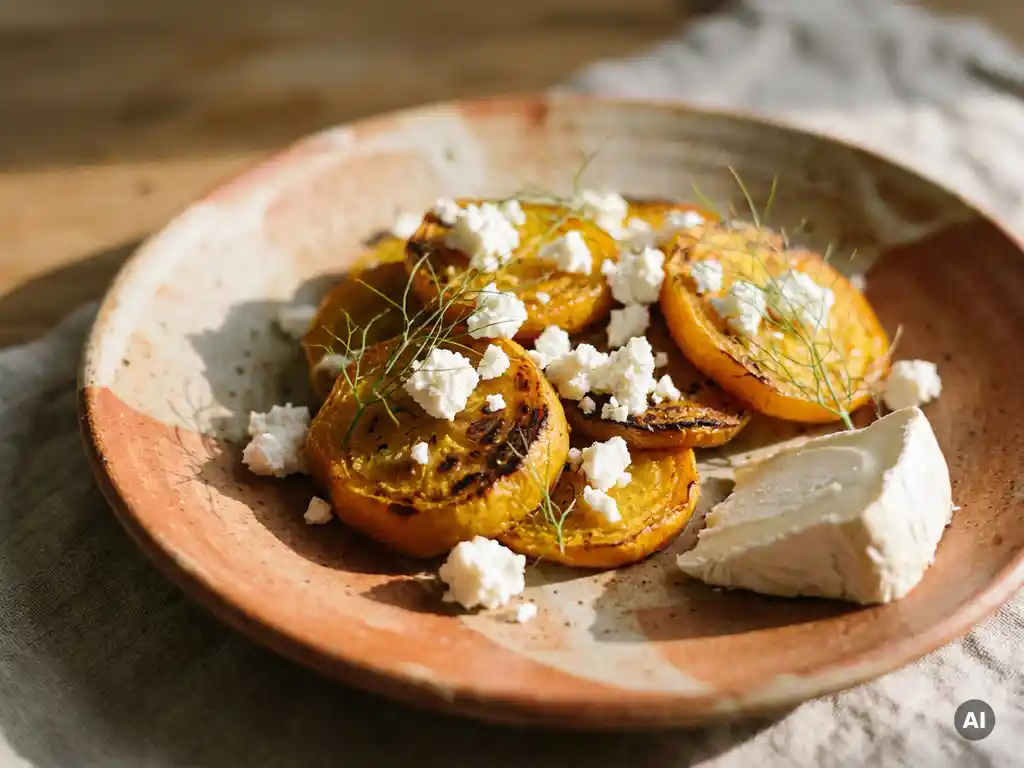
For roasted beet, goat cheese crumbles are the best choice, while fennel dishes often work better with goat cheese balls. The choice depends on the texture of the vegetable, the desired mouthfeel, and the role of the cheese in the dish. Below we answer the most frequently asked questions about these combinations.
Which goat cheese texture works best with roasted beet?
With roasted beet, goat cheese crumbles are the best match. The soft, slightly crumbly texture of fresh goat cheese in crumble form contrasts beautifully with the earthy sweetness and firm bite of roasted beet. The crumbles melt slightly on the warm beet and spread their creamy, mild flavor evenly across the dish.
Roasted beet has an intense, concentrated flavor profile due to the caramelization process. Crumbles of fresh goat cheese add a fresh, slightly tangy counterpart without overpowering the flavor of the beet. A goat cheese ball would quickly lose its shape on a warm beet and run, which is less desirable both visually and in terms of flavor experience.
For a cold beet salad or an amuse where presentation is key, a compact goat cheese ball can actually be the right choice. In that case, the temperature stays low enough to preserve the structure, and the ball provides an elegant, recognizable presentation.
How does fennel influence the choice between balls and crumbles?
Fennel has a delicate, anise-like flavor and a crunchy to soft texture, depending on whether you use it raw, blanched, or roasted. With fennel, you preferably choose goat cheese balls, because the compact shape keeps the mild flavor of the cheese concentrated and does not compete with the subtle fennel aromas.
Raw sliced fennel calls for a cheese that holds its own character alongside the fresh bite of the vegetable. A well-shaped ball of fresh goat cheese, optionally rolled in herbs or dried flowers, adds visual appeal and creates a flavor moment that is clearly distinct from the fennel. With roasted fennel, which becomes softer and sweeter, a light crumble can also work well as a finishing touch.
When do you choose goat cheese balls in a recipe?
Goat cheese balls are the best choice when presentation, portioning, and flavor concentration are important. They work great as a standalone element on a plate, in a salad where each portion gets a recognizable cheese moment, or as the base for a stuffed bite or amuse.
Balls are also ideal when you want to roll the goat cheese in additional ingredients such as chopped nuts, dried cranberries, fresh herbs, or coarse sea salt. The compact round shape helps the coating stick well and keeps the presentation neat. For product developers working on premium retail or foodservice concepts, balls are also easier to portion and package.
- Elegant plate or buffet presentation
- Dishes where cheese plays a standalone role
- Recipes where coating or seasoning of the cheese is desired
- Cold preparations where the structure needs to remain stable
When are crumbles the better choice for processing?
Goat cheese crumbles are the better choice when the cheese is used as a flavor enhancer and texture accent throughout a dish, rather than as a standalone element. They distribute evenly over warm vegetables, grains, or pasta dishes and melt slightly without disappearing completely.
In industrial or foodservice applications, crumbles also offer practical advantages: they are easy to dose, mix effortlessly into sauces or fillings, and provide a consistent flavor experience per portion. For product developers who want to integrate goat cheese into ready-made meals, quiches, wraps, or vegetable preparations, crumbles are functional and versatile.
- Warm dishes where the cheese may melt slightly
- Dishes with multiple ingredients where cheese is one of the flavors
- Industrial processing and foodservice applications
- Recipes where even distribution of flavor is desired
Which goat cheese specialties pair well with truffle or herbs?
Fresh goat cheese pairs excellently with truffle, thyme, rosemary, chives, and black pepper. The mild, slightly tangy flavor base of fresh goat cheese serves as a neutral canvas on which powerful flavors like truffle or aromatic herbs can shine without overpowering each other.
Truffle and goat cheese are a particularly successful combination: the earthy, umami-rich flavor of truffle is softened by the creamy freshness of the cheese, resulting in a balanced flavor profile that sells well in both luxury retail and fine dining. Aged goat cheese specialties offer a more intense flavor base and handle stronger herbs like thyme or lavender better than fresh varieties.
For product developers working with foodservice concepts, combinations with red onion, honey, walnuts, or fig are also popular. These ingredients enhance the sweet-tangy balance of goat cheese and fit with current trends around artisanal and clean-label products.
How we help you choose the right goat cheese texture
At DeJong Cheese, we understand that the choice between balls and crumbles is not just a matter of preference, but a deliberate product development decision. Drawing on our family tradition since 1995 and our expertise in fresh and soft goat cheese specialties under the Alphenaer brand, we are happy to think along with your concept.
What we offer for product developers like you:
- Fresh goat cheese in balls and crumbles, available in custom formats and weights
- Goat cheese specialties with truffle, herbs, or other ingredients based on your recipe
- Private label options for both retail and foodservice
- Personal advice on which texture and flavor profile best suits your product concept
- Flexibility in recipe and packaging for small and large volumes
Want to know which goat cheese specialties best match your latest concept? Get in touch and we will be happy to think along with you.
Frequently Asked Questions
Can I make goat cheese crumbles myself from a ball of fresh goat cheese?
Yes, you can easily do this by crumbling a chilled ball of fresh goat cheese with your fingers or a fork. Make sure the cheese is well chilled from the refrigerator, as it crumbles more easily and holds its texture. Do keep in mind that homemade crumbles are slightly more irregular in shape than industrially produced crumbles, which can give a rustic effect in some recipes but is less suitable for standardized foodservice applications.
How do I best store goat cheese balls and crumbles to prevent quality loss?
Store both balls and crumbles in a sealed package in the refrigerator at 4–7 °C. Crumbles dry out faster than balls, so use them preferably within one to two days after opening. Balls in oil or brine keep longer and retain their structure better, which also makes them more suitable for longer shelf life requirements in retail concepts.
Which goat cheese texture works best in warm oven dishes or quiches?
For warm oven dishes and quiches, crumbles are by far the most functional choice. They distribute evenly through the mixture, melt slightly in the heat, and provide a consistent flavor experience in every bite. Balls can lose their shape in the oven and melt unevenly, which can disrupt both the texture and the portioning.
Are there other vegetables where the choice between balls and crumbles is just as important as with beet and fennel?
Absolutely. With grilled zucchini or eggplant, crumbles work well as a finishing touch, because the soft, warm vegetable allows the cheese to melt slightly. With a salad of watercress, pear, or arugula, balls are the better choice: they form a visual anchor on the plate and create a concentrated flavor moment. The rule of thumb remains: warm and mixed calls for crumbles, cold and presented calls for balls.
Can I also use goat cheese balls as the base for a warm appetizer?
Yes, but the preparation technique is crucial. Balls can be briefly warmed in the oven or sous-vide, provided they are well breaded or wrapped to prevent them from running. A classic approach is to bread goat cheese balls in breadcrumbs or sesame seeds and briefly fry them or pan-fry them in a hot pan, so the outside becomes crispy while the inside stays soft and creamy.
As a product developer, how do I choose the right amount of goat cheese per portion for a balanced flavor profile?
A good rule of thumb is to start with 20–30 grams of goat cheese per portion for dishes where cheese is a flavor accent, and scale up to 40–60 grams when cheese plays a prominent role. With crumbles, dosing is easier to control than with balls, making them more suitable for standardized production lines. If you want exact dosing advice per application, suppliers like DeJong Cheese are happy to think along based on your specific recipe.
What are common mistakes when combining goat cheese with vegetables in a professional kitchen?
A common mistake is adding goat cheese too early in the preparation process, causing the cheese to melt completely and lose its distinctive texture. Another pitfall is combining a too strong or aged goat cheese with delicate vegetables like fennel or asparagus, causing the cheese to overpower the subtle vegetable flavor. Always add goat cheese as a finishing touch or just before serving for the best texture and flavor experience.
Related Articles
- How do you ensure that your supplier always meets the latest food safety requirements?
- What questions do you ask a curd producer during a first introduction?
- How can goat cheese be incorporated into premium quiche or tart concepts?
- How to customize goat cheese packaging for brand identity?
- What are the most popular goat cheese shapes and formats?