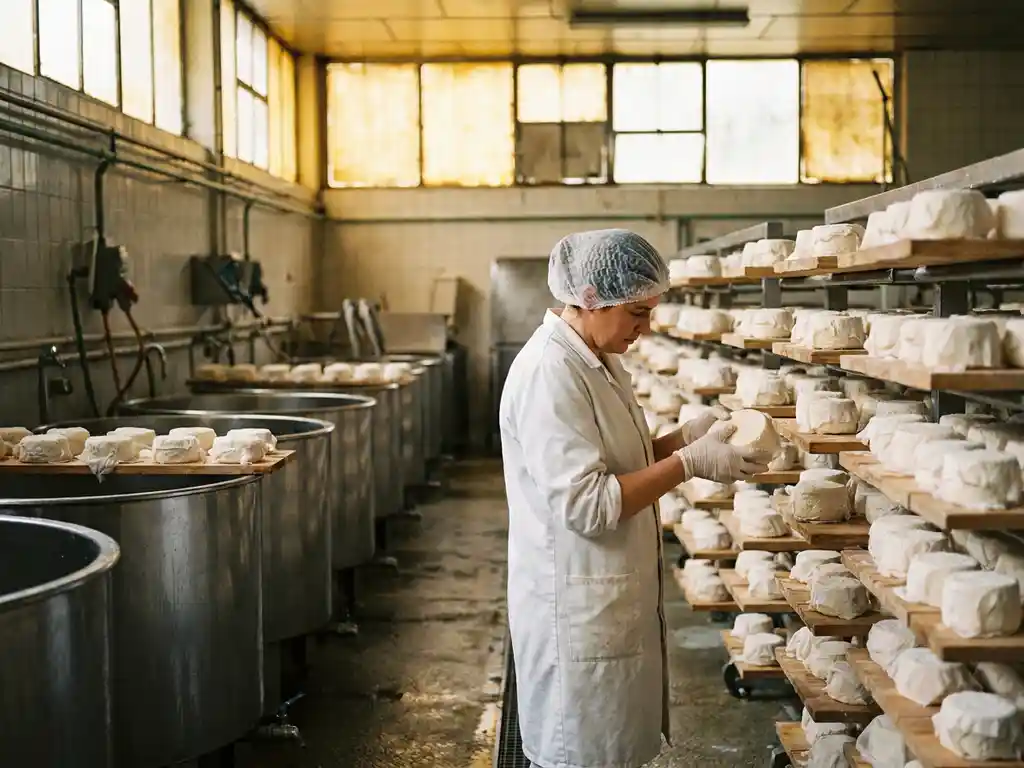
As your volumes grow, there are key questions you should ask a cheese producer: How do they ensure quality? What are the minimum and maximum order quantities? What are the lead times? How flexible are they during peak periods? What certifications do they have? And how is pricing structured? The larger your volumes become, the more important it is that your supplier has not just the capacity, but also the systems and processes to deliver consistent results. The questions below will help you make a smart choice and avoid surprises in your production line.
How does a cheese producer guarantee consistent quality at higher volumes?
A cheese producer guarantees consistent quality at higher volumes through standardized production processes, fixed recipes, and automated quality checks at multiple points in the production process. Always ask about their internal quality systems, how often products are tested, and how deviations are detected and corrected.
As volumes grow, the risk of quality variations increases if a producer hasn’t properly secured their processes. Useful questions to ask include:
- Which quality parameters are checked per batch, such as fat content, moisture content, and salt content?
- How are deviations documented and communicated to the buyer?
- Is there an in-house lab, or do they work with a certified external laboratory?
- What does the return policy look like for non-conforming deliveries?
For industrial applications like pizzas or ready meals, technical specs such as melting behavior, fat separation, and texture after heating are critical. Make sure these properties are captured in a product specification that becomes part of your supply agreement.
What are the minimum and maximum order volumes at a specialized cheese producer?
Minimum and maximum order volumes at a specialized cheese producer vary widely depending on the producer and product type. For goat cheese specialties, minimum orders are typically higher than for standard cheese varieties, because production requires more artisanal handling and margins are tighter at small batch sizes.
Ask each supplier specifically about:
- The minimum order size per product type and per delivery
- Whether volume discounts apply at higher quantities
- The maximum capacity per week or per month, so you know the upper limit
- Whether there are seasonal limitations, for example due to fluctuations in goat milk availability
Understanding these limits is essential for your production planning. A supplier who can serve you well today must also be able to grow with you as your demand increases. Ideally, put this in writing with clear agreements about growth scenarios.
How flexible is a supplier when volumes suddenly spike?
A supplier’s flexibility during sudden volume spikes depends on their buffer stock, production planning, and raw material availability. A specialized producer with a steady milk supply and their own production facility generally has more capacity to respond than a trader who relies on third parties.
Ask the following questions to get a clear picture of their flexibility:
- What is the maximum additional capacity that can be deployed on short notice?
- What is the minimum lead time for an unexpected volume increase of twenty or thirty percent?
- Does the producer maintain buffer stock, and if so, for which products?
- How are demand peaks communicated and planned?
A reliable supplier is upfront about their limits. It’s better to know in advance what is and isn’t possible than to find out mid-production peak that your supplier can’t deliver what you need.
What documentation and certifications are required for industrial cheese supply?
For industrial cheese supply, you need at minimum a HACCP certification, product specifications, batch analysis certificates, and traceability documentation. Depending on your market and customer requirements, additional certifications may be necessary, such as IFS Food, BRC, or an organic certification.
Always check the following documentation from a potential supplier:
- Validity and scope of the food safety certification
- Availability of up-to-date product specifications per item
- Analysis certificates from recent batches covering microbiology, chemical composition, and allergens
- Traceability system from raw material to finished product
- Export documentation if you sell products outside the EU
Compliance is not a side issue. Gaps in documentation can lead to production stoppages, product recalls, or fines. Make sure your supplier delivers these documents proactively and keeps them current.
How does scaling up affect the price per unit for goat cheese?
Scaling up usually lowers the price per unit for goat cheese, but the effect is less straightforward than with standardized cheese varieties. For artisanal goat cheese specialties, manual handling and specific aging times remain a fixed cost component regardless of volume.
Keep the following factors in mind during volume negotiations:
- Raw material costs: goat milk prices fluctuate seasonally and directly affect the cost price
- Packaging costs: larger volumes make private label or custom packaging economically viable
- Logistics costs: larger shipments lower the transportation cost per unit
- Production efficiency: longer production runs reduce changeover time per batch
Ask your supplier for a transparent cost breakdown and discuss which volume thresholds lead to a lower price per unit. An honest conversation about cost drivers is the foundation of a lasting partnership.
When does it make sense to switch cheese suppliers as volumes grow?
It makes sense to switch cheese suppliers when your current supplier consistently can no longer meet your quality requirements, delivery reliability, or volume needs. Growing pains at a supplier often show up as longer lead times, more quality deviations, or a lack of flexibility when things change.
Signs that switching suppliers should be seriously considered:
- Repeated quality complaints that are never structurally resolved
- Inability to handle larger volumes within acceptable lead times
- Missing certifications needed for new markets or customers
- Lack of transparency about pricing and production processes
- No willingness to offer custom solutions or product development
Switching suppliers takes time and effort, but in the long run it’s better than staying with a partner who holds back your growth. Plan a careful transition period with parallel deliveries to keep your production running without interruption.
How DeJong Cheese helps with growing volume demands
As a family business in goat cheese specialties since 1995, we know what it takes to grow while keeping quality on track. From our production facility in Alphen, we supply retail, foodservice, and industrial customers worldwide under the Alphenaer brand, both under our own label and as private label. We actively work alongside buyers and product developers who want to scale up their volumes without compromising on quality or reliability.
What we offer as your volumes grow:
- Consistent product specifications with technical documentation per batch
- Flexible supply options for both retail and foodservice applications
- Open communication about capacity, lead times, and pricing
- Custom product development and private label collaboration
- Current food safety certifications and full traceability
Want to know what we can do for your production line? Get in touch with us and explore the options for your specific volume needs — no strings attached.
Frequently Asked Questions
How far in advance do I need to share my volumes with a cheese supplier?
Most specialized cheese producers work with a lead time of two to four weeks for standard orders, but for larger or seasonal volumes it’s smart to plan three to six months ahead. This is especially true for goat cheese specialties, where goat milk availability can be seasonal. Ask your supplier whether a forecast system is possible, where you share your expected volumes each month so the producer can align their planning accordingly.
What should a supply agreement with a cheese producer include at minimum?
A solid supply agreement should include at minimum: product specifications, minimum and maximum order volumes, lead times, pricing structure and indexing mechanisms, quality standards, and the return policy for non-conforming deliveries. Also add agreements on certification requirements, growth scenarios, and a transition arrangement in case the partnership ends. Have the agreement reviewed by a lawyer, especially for large volumes or international deliveries.
How do I verify a cheese producer's quality claims as a buyer?
Always ask a potential supplier for recent analysis certificates from independent, certified laboratories and compare them against the stated product specifications. Also schedule a factory visit to assess the production environment, quality controls, and hygiene practices firsthand. For long-term partnerships, you can arrange periodic audits by an external party, or include this as a condition in the supply agreement.
Can a foodservice company start with relatively small volumes at an industrial cheese producer?
That depends a lot on the producer, but many specialized cheese producers also work with growing foodservice companies that haven’t yet reached the volumes of a retail chain. It’s smart to be upfront about your current volume and your growth expectations, so the supplier can assess whether the partnership makes sense for both sides over time. Some producers offer entry programs where you start with a smaller order and the terms are reviewed once your volumes pass a certain threshold.
What are the most common mistakes when scaling up cheese purchasing?
A common mistake is scaling up too quickly without contractual agreements on quality standards — meaning that at higher volumes you suddenly run into batch variation that wasn’t noticeable with small orders. Another pitfall is not communicating volume changes in time, which prevents the supplier from adjusting production and causes lead times to slip. Finally, buyers often underestimate the importance of documentation: at higher volumes and with more customers, certifications and traceability stop being a nice-to-have and become a hard requirement.
How do I handle goat milk price fluctuations in long-term contracts?
Discuss with your supplier what portion of the unit price is directly tied to the goat milk price and how fluctuations in that price are passed on. A common solution is to include a price indexing clause in the contract, where the product price moves in line with an official commodity index or a pre-agreed reference price. This gives both parties clarity and avoids having to renegotiate prices every time the market shifts.
Is private label cheese also feasible at mid-sized volumes, or is it only for large retailers?
Private label is increasingly an option for mid-sized foodservice companies and regional retailers, as long as volumes are large enough to justify the cost of custom packaging and labeling. Ask your supplier at what volume private label becomes economically worthwhile and what upfront costs are involved, such as packaging design, printing, or packaging certification. Some producers offer flexible private label programs where you start with a shared packaging format that can later be fully customized.