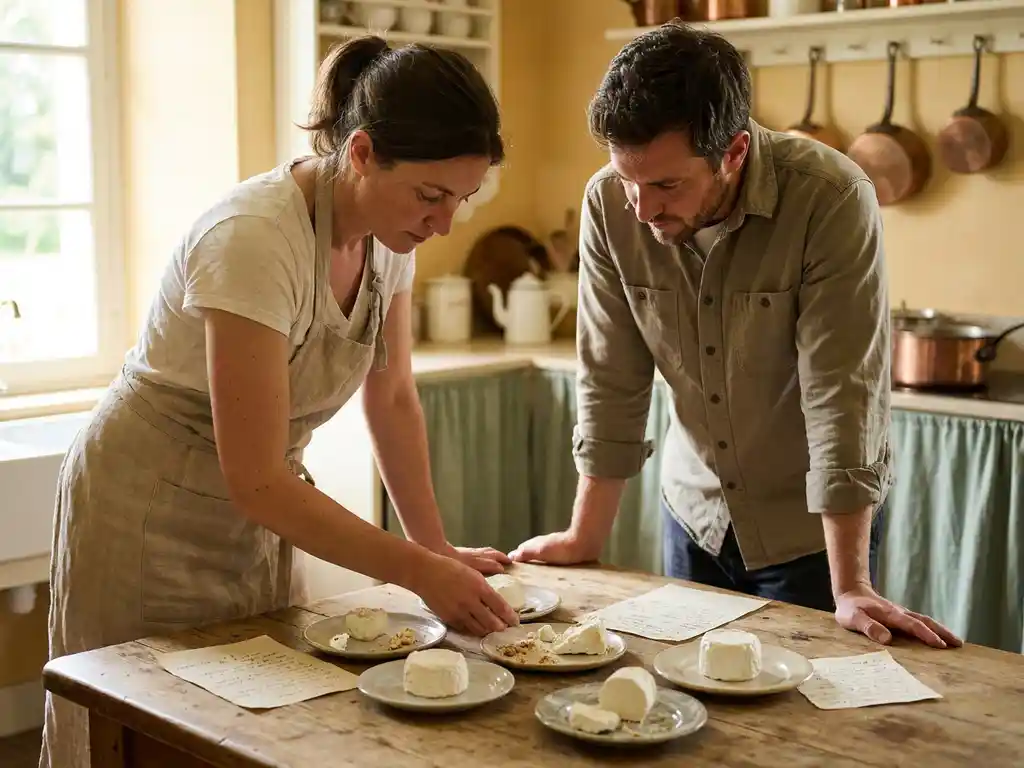
To organize a joint development session with a cheese producer, set clear goals in advance, bring the right people to the table, and come prepared with concrete product specifications or inspiration materials. These sessions work best when both parties are well-prepared and the producer is ready to actively contribute ideas — not just present their existing range.
For product developers in the food industry, co-development with a cheese producer is a powerful way to create distinctive products faster. The session works like a structured conversation where technical knowledge, flavor expertise, and creative ambition come together. In this article, we answer the most practical questions about how to approach this process.
What can you achieve with a joint development session?
A joint development session gives you concrete product directions in a short amount of time — directions that match your market needs. Instead of spending months emailing back and forth about specifications, one session brings all the knowledge and wishes together at once. You leave with a shared picture of what’s technically feasible, which flavor variants show promise, and what the next step looks like.
The biggest advantage is getting direct feedback on your ideas from the producer’s production and flavor expertise. Think about questions like: does this type of cheese hold up when heated, which fat content suits my application, or is a specific herb combination achievable within the production process? You’ll get those answers in a session much faster than through a quote request.
A development session also builds trust. You get to know the producer as a partner, not just a supplier. That matters when you later need scalable volumes or want to develop the concept further.
Who should be present at the session?
On your side, you need at least the product developer and a representative from marketing or sales. From the cheese producer, you want a technologist or cheesemaker who can engage with the content, plus a commercial point of contact. The more relevant knowledge is at the table, the more concrete the outcomes.
- Product developer (you): brings the product brief, the target audience, and the desired flavor and texture profiles
- Marketing or category management: keeps an eye on positioning and commercial feasibility
- Cheesemaker or technologist from the producer: provides insight into production capabilities and limitations
- Account manager or commercial contact: connects technical agreements to realistic lead times and volumes
Keep the group manageable. More than five or six people at the table makes the session slow and unfocused. Opt for a small group with decision-making authority — people who can move quickly after the session.
How do you prepare for a development session as a product developer?
Prepare by making your product brief as specific as possible and bringing supporting materials with you. Think moodboards, reference products, flavor profiles, or a briefing document with technical requirements. The more specific you can be about what you’re looking for, the more targeted the producer’s input will be.
Practical steps for good preparation:
- Define your product brief: What kind of product are you developing, for which target audience, and in which channel? Retail, foodservice, or industrial?
- Set out technical requirements: Think about melting behavior, fat content, shelf life, packaging format, and any clean-label requirements
- Bring inspiration materials: Reference products, trend reports, or flavor combinations you want to explore
- Know your volume needs: Give an indication of the quantities you expect to need, even if it’s still a rough estimate
- Propose an agenda: Share a short agenda in advance so the producer can also prepare properly
A well-prepared product developer makes the session more efficient for both parties. It prevents the session from getting stuck on general information you could have found in a brochure.
What can you expect during the session itself?
During a well-run co-development session, you exchange knowledge, taste products, discuss technical possibilities, and work toward concrete concept directions. The cheese producer will present relevant products from their range, but the real work lies in jointly exploring adjustments, combinations, and variants that fit your needs.
Expect to learn things you didn’t anticipate. A cheesemaker might tell you that a certain herb combination is technically trickier with goat cheese than expected — or that a variant you hadn’t considered is a perfect fit for your application. Those unexpected insights are often the most valuable outcomes of a session.
At the end of the session, it’s important to summarize the outcomes together. Which directions will be developed further? Who does what, and by when? A brief closing with clear action points prevents the session’s energy from fading in the weeks that follow.
What questions do you ask a cheese producer during product development?
During a product development process, you ask questions that map out both technical feasibility and commercial conditions. The strongest questions are the ones that invite the producer to think along with you — not just answer.
Technical questions you’ll want to ask:
- How does this type of cheese melt at temperatures above 350°F?
- What fat content options are available, and how do they affect texture and flavor?
- Are clean-label variants possible without preservatives or additives?
- How does the cheese respond to freezing and thawing in an industrial setting?
- What adjustments are possible in aging time, salt content, or seasoning?
Commercial and logistical questions:
- What are the minimum order quantities for a custom variant?
- How long does the development process take from the first sample to a production-ready product?
- What are the lead times when scaling up to larger volumes?
- What certifications and food safety documentation are available?
How do you turn the outcomes of a session into a concrete product?
You turn the outcomes of a development session into a concrete product by translating the agreed concept directions into a structured development plan with clear milestones. That means: writing a product brief, requesting samples, giving feedback, and repeating the process until the product meets all technical and sensory requirements.
A typical follow-up process looks like this:
- Write a product brief: Document the agreed specifications, flavor direction, and technical requirements in a document that serves as a guide for the producer
- Receive and evaluate the first sample: Assess flavor, texture, appearance, and technical properties such as melting behavior or sliceability
- Feedback round: Give specific, constructive feedback. Avoid vague terms like “tastier” and be concrete about what you want changed
- Work through iterations: Expect two to four sample rounds for a complex product, fewer for smaller adjustments
- Scale test and production review: Verify that the product maintains the same quality at production scale as the small sample
- Finalize commercial agreements: Close the process with clear agreements on volumes, lead times, and pricing structure
Throughout the entire process, stay in regular contact with your point of contact at the producer. A goat cheese product development process requires mutual transparency: if your market launch date changes, or if technical requirements are adjusted, the producer needs to know as soon as possible.
How DeJong Cheese supports goat cheese product development
At DeJong Cheese, we believe the best products are created through collaboration. As a family business with more than thirty years of experience in artisanal goat cheese specialties under the Alphenaer brand, we know what it means to be a reliable partner in a co-development process. We actively contribute ideas at every stage — from the first concept to a scalable final product.
What we bring to a joint development session:
- Technical expertise in fresh and aged goat cheese specialties, including melting behavior, fat content, and clean-label options
- Flexibility in custom work: from seasoning and aging time to packaging format and private label
- Direct access to our cheesemakers for in-depth consultation — no middlemen
- Proven delivery reliability for both retail partners and foodservice customers worldwide
- Complete food safety documentation and certifications that meet industrial purchasing requirements
Want to find out what we can do for your product development? Get in touch with us and we’ll be happy to schedule an introductory call or development session.
Frequently Asked Questions
How long does a typical co-development session with a cheese producer take?
An effective development session typically lasts two to four hours, depending on the complexity of your product brief and the number of concept directions you want to explore. Plan for a half day if possible, so there’s enough time for tastings, technical discussion, and capturing concrete action points. A session that’s too short often leads to surface-level outcomes, while one that runs too long can lose focus.
What if I don't have a concrete product brief yet — can I still request a session?
Yes, but it’s best to approach the session as an exploratory conversation rather than a full co-development session. Share at least the market need or consumer segment you want to serve in advance, so the producer can present targeted inspiration and possibilities. The more direction you can give — even if it’s broad — the more valuable the outcomes of the conversation will be.
Are there costs involved in a joint development session?
It depends on the producer. Some cheese producers don’t charge for an initial session, as they see it as part of the sales process. For more intensive co-development processes involving multiple sample rounds and custom formulations, development costs may be charged — and these can sometimes be offset against future orders. Ask about this upfront to avoid any budget surprises.
How do I protect my product idea during a co-development process?
Sign a non-disclosure agreement (NDA) with the cheese producer before the session — especially if you’re working with innovative concepts or unique flavor combinations. Also put all agreements about ownership of recipes and product specifications in writing in a collaboration agreement. A professional producer will have no objection to this and may even provide standard documentation themselves.
What are the most common mistakes product developers make in a co-development session?
The most common mistake is defining the product brief too vaguely, which causes the session to get bogged down in general presentations with no concrete outcomes. Other frequent mistakes include bringing too large a group, having no one with decision-making authority at the table, and failing to capture action points at the end of the session. Also make sure you have realistic expectations about timelines: a complex custom cheese variant requires multiple rounds of iteration.
How do I know if a cheese producer is truly suited as a co-development partner?
A good co-development partner asks just as many questions during the session as they answer. Pay attention to whether the producer proactively thinks along with you about your end application, target audience, and market position — not just their own product range. Also ask about previous co-development projects and references, and assess whether the producer has the technical capacity, certifications, and flexibility that your product development requires.
How long does it typically take for a new cheese product to be market-ready after the session?
For a relatively straightforward custom variant, count on two to four months, including sample rounds and scale testing. For more complex products with specific aging times, clean-label requirements, or new recipes, the process can take six to twelve months. Always plan your market launch date well in advance and communicate it early to your producer, so that sample planning and production capacity can be aligned accordingly.
Related Articles
- How does protein content affect the structure of goat cheese in ready-made meals?
- What are the possibilities of goat cheese brie and camembert in premium retail concepts?
- Which seasonal goat cheese concepts fit the current food trends?
- How does goat cheese enable unique flavour combinations?
- How to use goat cheese in omelets?