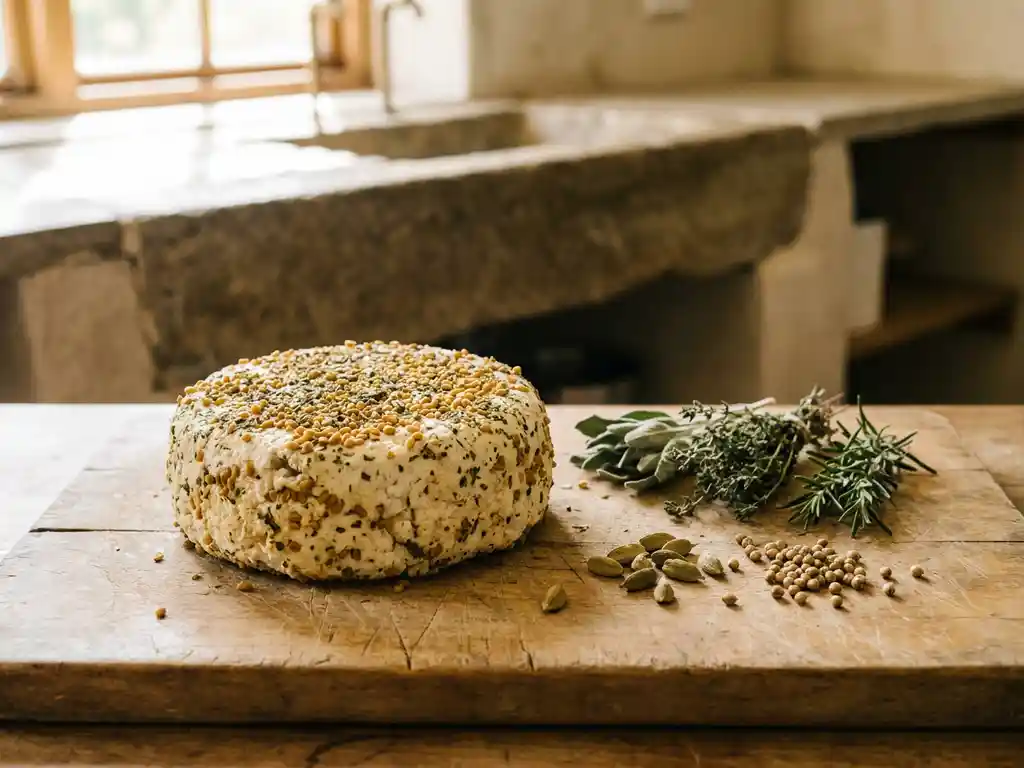
Developing a fenugreek or herb variety within the Alphenaer range starts with choosing herbs that work well — both technically and flavor-wise — with soft goat cheese. From there, it’s a shared development process where specifications, production options, and packaging preferences are aligned. The process is more straightforward than many product developers expect, especially when a cheese producer actively thinks along with you rather than just delivering. In this article, we answer the most common questions about developing your own herb variety in goat cheese.
Which herbs and flavorings go well with soft goat cheese?
Soft goat cheese has a mild, slightly tangy flavor and a creamy texture that pairs beautifully with both aromatic and savory herbs. Fenugreek is one of the most interesting choices: its slightly bitter, nutty note creates a surprising balance with the fresh dairy character of goat cheese. Other tried-and-tested combinations include rosemary, thyme, black pepper, red onion, and Mediterranean herb blends.
When choosing flavorings, two things matter: flavor profile and technical compatibility. Some herbs release their aroma quickly and are ideal for fresh applications. Others only come into their own after a ripening period. Fenugreek falls into the second category — the flavor intensifies as the cheese matures, making it especially well-suited for aged soft varieties.
- Fenugreek: nutty, slightly bitter, flavor builds during ripening
- Rosemary and thyme: Mediterranean, aromatic, popular in foodservice and retail
- Red onion and chives: savory, great for spreads and dips
- Black pepper and chili flakes: spicy, versatile for industrial use and snack concepts
- Truffle: premium positioning, strongly trending in charcuterie and delicatessen
The right herb or flavoring depends largely on the end product and target audience. A retail product calls for recognizability and seasonal appeal. For industrial applications, consistency and heat stability of the flavoring matter most.
How does the development process for a new herb variety work?
Developing a herb variety in goat cheese typically follows four steps: an intake meeting to discuss flavor preferences and technical requirements, followed by a trial production run, sensory evaluation, and finally scaling up to full production. The timeline varies depending on how complex the variety is and the quantities needed.
From concept to trial batch
In the first phase, the concept is translated into a concrete product specification. Which herb? At what concentration? At what point in the production process is it added? With fenugreek, the grind size of the seed plays a role: coarsely ground gives visible flecks and a rustic look, while finely ground distributes the flavor more evenly throughout the cheese. These choices are made together and documented in a technical production file.
Evaluation and fine-tuning
After the trial batch comes a sensory assessment. Does the product taste as expected? Is the herb note strong enough — or too strong? Does the texture hold up after the flavoring is added? Based on this feedback, the formulation is adjusted until the final result meets the desired specifications. Only then is the variety approved for regular production.
What are the technical requirements for a herb variety in industrial applications?
For industrial applications such as pizzas, savory pies, or ready-made meals, a herb variety in goat cheese needs to meet specific technical requirements. The key parameters are heat stability of the flavorings, microbiological safety of the added herbs, and consistency in fat and moisture content for predictable melting and baking behavior.
Herbs are naturally biologically active and can affect the microbiological status of a cheese. That’s why added herbs and flavorings are typically treated or supplied with certification, ensuring they meet current food safety standards. This isn’t a minor detail — it’s a basic requirement for use in industrial production environments.
The processability of the herb variety also matters. An industrial buyer wants to know whether the cheese can be processed by machine, whether the herbs won’t clog dosing equipment, and whether the shelf life is comparable to the standard variety. All of these parameters are documented in a technical product sheet that forms the basis for the partnership.
Can a herb variety also be produced as a private label?
Yes, a herb variety in soft goat cheese can be fully produced as a private label goat cheese, including custom packaging, brand name, and specific formulation. Private label production gives retailers and foodservice companies the opportunity to bring a distinctive product to market without investing in their own production capacity.
With private label production of a herb variety, the following elements are customizable:
- The specific herb blend and concentration
- Packaging format and materials
- Label design and brand identity
- Weight and portion size
- Shelf life and storage instructions
Minimum order volumes do play a role in private label projects. The larger the volume, the more room there is for customization in formulation and packaging. For smaller volumes, it’s sometimes more efficient to start with an existing base variety and add a custom label, before moving to a fully tailored formulation.
How does a fenugreek or herb variety fit current food trends?
Fenugreek and other specialty herbs are a perfect fit for the biggest food trends in 2026: clean label, authentic ingredients, botanical flavors, and the premiumization of everyday products. Consumers are increasingly looking for products with a clear story behind the ingredients — and fenugreek has that story. It has been used for centuries in the cuisines of the Middle East, India, and the Mediterranean.
For product developers, fenugreek goat cheese offers an interesting positioning: distinctive enough to stand out on the shelf, but not so exotic that it puts off the average consumer. The combination with soft goat cheese reinforces a premium image, while goat cheese itself enjoys broad recognition in the market.
Herb varieties also fit well with the growing demand for plant-based and minimally processed products. Herbs like fenugreek, rosemary, or thyme are natural and free from artificial additives — which strengthens the clean-label positioning of a product. That’s a concrete selling point for end consumers and a plus for retail buyers who are paying closer attention to ingredient lists.
How DeJong Cheese helps you develop your herb variety
As a family business with years of experience in soft goat cheese specialties, we actively think along with you when developing new varieties within the Alphenaer range. Whether you want to develop a fenugreek cheese for industrial use, are looking for a herb variety for your foodservice concept, or want to launch a fully private label product — we offer the technical expertise, production capacity, and personal support to make it happen.
What we offer for custom product development:
- A shared development process from concept to finished product
- Technical specifications and product sheets for industrial applications
- Private label production in a range of formats and packaging options
- Consistent quality and reliable delivery, even at larger volumes
- Complete food safety documentation and compliance support
Curious about what we can do for your specific concept? Get in touch with our team and talk through your ideas — no strings attached. We’d love to think along with you.
Frequently Asked Questions
What is the minimum order quantity to develop a custom herb variety?
The minimum order quantity varies depending on the type of project and packaging format. A fully custom-developed herb variety with its own formulation typically requires higher minimum volumes than an existing base variety with a custom label. It’s a good idea to discuss this early in the conversation, so the development process fits your commercial reality and you don’t incur unnecessary costs for customization that the volume doesn’t yet justify.
How long does it typically take for a new herb variety to be production-ready?
The timeline from concept to production-ready variety is typically between six and twelve weeks, depending on the complexity of the formulation and the number of iterations needed after the trial batch. Varieties with ripening-dependent herbs such as fenugreek take a little longer, because the flavor intensity can only be fully assessed after the ripening period. Realistic planning prevents disappointment and allows time for careful sensory evaluation.
Can I develop a herb variety that works for both retail and foodservice?
Yes, that’s possible — but it does require that the technical specifications are aligned for both channels from the start. Retail products have different requirements for packaging, portioning, and shelf life than foodservice applications, while industrial buyers also have requirements around heat stability and machine processability. By making this clear during the intake phase, the producer can develop a formulation that performs well in both contexts — or advise using a slightly different variant per channel.
Are there food safety risks associated with adding herbs to goat cheese?
Herbs are naturally biologically active and, if not handled correctly, can affect the microbiological status of the cheese. In practice, herbs added to cheese are typically supplied with certification and meet strict food safety standards, including controls for pathogens and pesticide residues. A professional cheese producer ensures that all added ingredients are included in the HACCP plan and that the full food safety documentation is available for your own compliance file.
What if my desired herb combination has never been produced before?
A herb combination that hasn’t been produced before is actually an opportunity to develop a truly distinctive product. During the trial phase, technical feasibility is tested: how does the herb behave in the cheese matrix, what is the optimal concentration, and at what point in the production process is it best added? As long as the chosen flavorings meet current food safety standards, there is in principle plenty of room for innovation and originality.
How do I protect my own herb formulation when developing a private label product?
In private label product development, the specific herb blend, concentrations, and production specifications are documented in a confidential technical product file that belongs to the client. It’s advisable to agree on this upfront in a partnership agreement, including provisions on exclusivity and confidentiality. A reliable production partner will be transparent about this and will actively guide you in protecting your intellectual property.
What documentation do I need to introduce a new herb variety to a retail buyer?
Retail buyers typically ask for a complete technical product sheet including an ingredient list, nutritional values, allergen information, shelf life, and storage instructions, along with food safety certificates such as IFS or BRC from the producer. In addition, a clear story about the positioning and unique selling points of the variety is becoming increasingly important for listing requests. An experienced production partner can help you put together this complete retail file, so you go into the conversation well prepared.