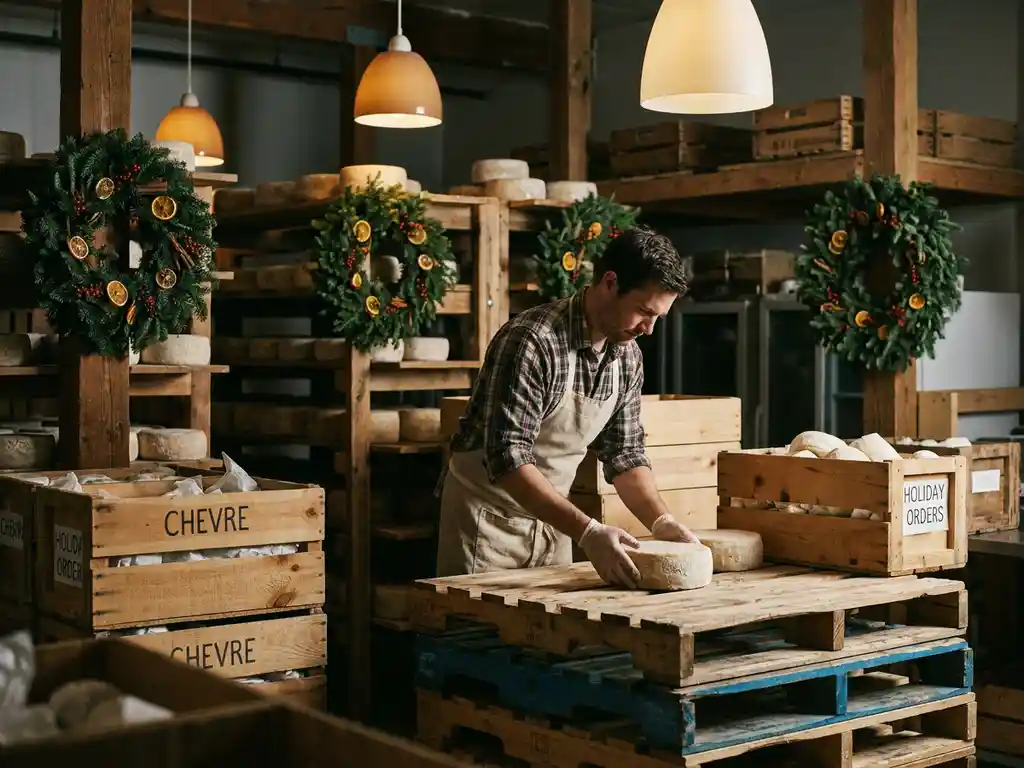
You can avoid supply problems during peak demand around the holidays by locking in delivery agreements well in advance, building in inventory buffers, and working with suppliers who have proven capacity at higher volumes. For cheese purchasing, a good rule of thumb is: start planning at least three to four months before the holidays. The questions below walk you through the steps to secure reliable cheese deliveries — from timing to contract terms.
When does peak holiday demand for cheese purchasing begin?
Peak demand for cheese purchasing around the holidays typically starts as early as September and October, when retailers and foodservice companies are putting together their end-of-year product ranges. For industrial buyers who use cheese in finished products — such as pizzas, ready meals, or charcuterie — the purchasing rush starts even earlier.
In practice, for the November and December holidays, demand for goat cheese and other specialty products noticeably increases as early as August. Producers and buyers who haven’t made arrangements by then risk finding that capacity has already been reserved by other customers. For product developers launching new holiday concepts, preparation ideally starts in the spring — leaving enough time for trial productions and adjustments.
Keep the summer vacation period in mind as well, since it can temporarily reduce available production capacity. If you wait until September to start negotiating, you’re already behind competitors who locked in their volumes earlier in the year.
What are the most common causes of supply problems during peak demand?
The most common causes of supply problems during peak demand are insufficient production capacity at the supplier, shortages in the raw material supply chain, late order confirmation, and poor communication about changes in volumes or specifications. Any one of these factors can cause delays on its own — combined, they can quickly bring a production line to a halt.
For cheese purchasing, there are a number of specific risks:
- Seasonal milk production: The availability of goat’s milk varies by season, which makes production planning more complex when demand is high.
- Aging times: Aged cheese varieties require weeks or even months of maturation, which means last-minute orders for these products simply aren’t feasible.
- Capacity conflicts: When multiple customers increase their volumes at the same time, a supplier without solid planning can’t serve everyone.
- Logistics bottlenecks: Around the holidays, transport capacity and cold chains are under extra pressure, increasing the risk of delays.
- Changed specifications: Product specification changes communicated too late disrupt the supplier’s production planning.
For buyers in the food industry, it’s important to understand that supply problems rarely have a single cause. They’re usually a series of small disruptions that add up to a bigger problem.
How far in advance should you lock in delivery agreements for the holidays?
To secure reliable cheese deliveries around the holidays, you should lock in agreements at least three to four months in advance. For aged cheese specialties or custom varieties, six months in advance is not unusual. The more specific the product and the larger the volume, the earlier you need to start.
A practical timeline for the end-of-year period looks like this:
- January to March: Analyze the previous year’s sales data and make an initial volume estimate for the holidays.
- April to June: Reach out to suppliers to discuss capacity and record initial intentions.
- July to August: Confirm volumes and specifications in writing. Include acceptable deviation margins in an agreement.
- September to October: Check in on production planning progress and align on any adjustments.
- November: Make sure the first deliveries are confirmed and that a contingency plan is in place for unexpected situations.
Buyers who follow these steps significantly reduce the risk of supply problems during peak demand. Skipping steps means taking on a structurally higher level of risk.
What supplier characteristics reduce the risk of supply problems?
Suppliers that reduce the risk of supply problems during peak demand have proven production capacity, transparent communication, a stable raw material base, and experience with industrial volumes. Food safety certifications and a proven track record of supplying multiple sectors are concrete indicators of reliability.
When selecting a cheese supplier, look for the following characteristics:
- In-house production: Suppliers who produce their own products have more control over quality and planning than traders who depend on third parties.
- Scalability: The supplier must be able to scale up without compromising quality. Ask for concrete examples of how they’ve handled peak demand in the past.
- Food safety certifications: Certifications such as BRC, IFS, or FSSC 22000 are a minimum requirement for industrial buyers and simplify compliance documentation.
- Proactive communication: A good supplier gives you early notice of potential bottlenecks rather than waiting until a problem has already occurred.
- Private label and custom options: Suppliers who offer custom solutions are better equipped to guarantee specific product specifications, even at higher volumes.
For goat cheese purchasing specifically, suppliers with their own herds or long-term relationships with dedicated dairy farmers can deliver more consistently than those who depend on changing raw material suppliers.
How do you keep quality consistent at higher production volumes?
You maintain consistent quality at higher production volumes by putting clear product specifications in writing, building in regular quality checks, and agreeing on acceptance criteria for each delivery. Quality fluctuations are a real risk during peak demand, as production lines are under pressure and raw materials are sourced more quickly.
Practical measures to ensure quality consistency:
- Technical specifications: Record fat content, moisture percentage, melting behavior, and other relevant parameters precisely in a product specification sheet. This is the foundation for every quality check.
- Incoming inspections: As a buyer, require mandatory incoming inspections for every delivery, including random sampling and certificates of analysis.
- Audit rights: Negotiate the right to visit or have the production facility audited. This increases transparency and works as a preventive measure.
- Batch traceability: Make sure every delivery can be traced back to a specific production batch. This makes it much easier to identify the cause and limit the damage if a quality issue arises.
For cheese used in heated products — such as pizza or oven dishes — it’s especially important to specify melting behavior and fat separation. These properties can vary between batches if the raw material composition changes.
What should a delivery agreement include to handle peak demand?
A delivery agreement that properly covers peak demand should include at minimum: volume commitments and volume flexibility, delivery lead times, quality specifications, pricing arrangements for raw material fluctuations, and escalation procedures for shortfalls. An agreement without these elements doesn’t offer enough protection when supply problems arise around the holidays.
The essential elements of a solid cheese delivery agreement:
- Minimum and maximum volumes: Specify the guaranteed baseline volume and the acceptable deviation — both up and down — including the deadline for communicating volume changes.
- Delivery timelines and lead times: Specify when orders must be confirmed and what the maximum lead time is from order confirmation to delivery.
- Pricing agreements: Agree on price stability for a set period, or establish an indexing mechanism tied to raw material prices so that budget planning stays predictable.
- Quality guarantees and penalties: Describe what happens when a delivery doesn’t meet specifications — return rights, replacement, discounts, or compensation.
- Escalation procedure: Specify who is contacted when a supply problem is looming and within what timeframe a solution must be provided.
- Force majeure clause: Define which circumstances are considered force majeure and what the consequences are for the delivery obligation.
A good agreement isn’t just a formality — it’s a working tool that protects both parties. Have the agreement reviewed by someone with purchasing experience in the food industry before you sign.
How DeJong Cheese helps ensure reliable holiday deliveries
As a family business with more than thirty years of experience producing goat cheese specialties, we understand what reliable supply means for industrial buyers and product developers. Our Alphenaer goat cheese specialties are produced using fixed traditional recipes — the foundation for consistent quality, even at higher volumes.
Here’s what we offer to prevent supply problems during peak demand:
- Early capacity reservation based on preliminary volume forecasts
- Fixed product specifications with certificates of analysis per delivery
- Flexibility in private label and custom solutions, including seasonal concepts
- Delivery to retail and foodservice worldwide, with a proven track record at industrial volumes
- A dedicated personal contact for purchasing and product development, so communication is always direct
Want to know how we can secure your supply for the upcoming holiday season? Get in touch with us and we’ll explore the options together.
Frequently Asked Questions
What do I do if my supplier tells me mid-season that they can't meet the agreed volumes?
Immediately activate the escalation procedure in your delivery agreement and request written confirmation of the shortfall, including the expected scope and duration. At the same time, bring in an alternative supplier — ideally one you’ve already pre-qualified as a backup option. The faster you act, the better your chances of securing enough volume for the holidays.
How much inventory buffer is realistic to maintain for cheese around the holidays?
A common guideline for industrial buyers is a safety buffer of ten to twenty percent on top of the expected sales volume, depending on the product’s shelf life and your storage capacity. For aged cheese varieties with a longer shelf life, a higher buffer is both feasible and smart. When calculating the buffer, also factor in the lead time for an emergency order, so you know how long the buffer needs to last.
How do I discuss volume flexibility with a supplier without putting the relationship under pressure?
Frame the conversation as a mutual benefit: by being transparent about your forecasts and possible deviations, you’re helping the supplier optimize their own planning. Suggest agreeing on a range — for example, plus or minus fifteen percent on the base volume — with a fixed communication deadline for adjustments. Suppliers value predictability and are often willing to offer more flexibility to customers who communicate openly and on time.
What if my holiday volume forecasts are highly uncertain? Is it still worth making agreements early?
Yes, even with uncertainty, acting early pays off. In that case, lock in a minimum volume you can commit to with confidence, and make additional arrangements for an optional extra volume that you can activate up to a certain date. This gives the supplier enough certainty to reserve capacity, while you retain the flexibility to adjust as your forecasts become clearer.
What documents should I request from a new cheese supplier before signing a contract?
Request at minimum: current food safety certifications such as BRC, IFS, or FSSC 22000; product specification sheets with analytical values; recent certificates of analysis for comparable products; and references from existing industrial customers. Also ask for a capacity overview of the production facility and how they’ve handled peak demand in the past. These documents give you a well-founded picture of the supplier’s reliability before you commit to a long-term agreement.
How do I prevent quality differences between deliveries produced at different points in the season?
In the product specification sheet, record not only the target values but also the allowable tolerances for each parameter — such as a maximum variation in fat content or moisture percentage. Require a certificate of analysis with every delivery and compare them systematically with previous deliveries to catch trends or deviations early. Also agree that the supplier will proactively notify you of any changes to the raw material composition or production process that could affect the specifications.
Is it smart to work with multiple cheese suppliers at the same time to spread the risk?
For larger volumes or critical product categories, spreading across two suppliers is a sound risk strategy — as long as you offer both suppliers enough volume to keep the relationship worthwhile. The downside is that it requires more management and you lose some economies of scale. A practical middle ground is one primary supplier for the bulk of your volume and one pre-qualified backup supplier that you keep active on a smaller scale, so you can scale up quickly if needed.