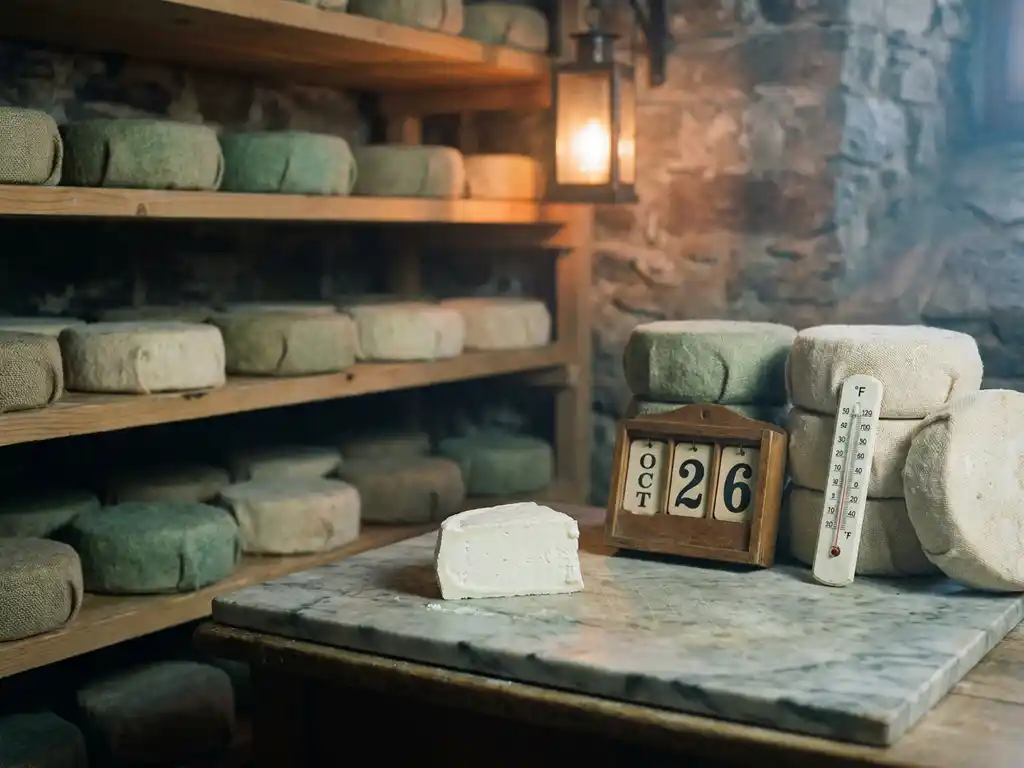
Building a buffer stock of goat cheese is possible without losing quality — as long as you match your storage conditions and packaging choices to the type of cheese. Fresh goat cheese needs faster rotation and strict refrigeration, while aged varieties give you more buffer room. The key is combining the right storage conditions, packaging formats, and delivery agreements with your supplier. In this article, we answer the most common questions about safely managing goat cheese inventory in an industrial setting.
How long does goat cheese last under industrial conditions?
Fresh goat cheese typically has a shelf life of two to four weeks after production under industrial refrigeration conditions. This depends on fat content, acidity, and packaging. Aged goat cheese can last several months when stored correctly. The exact shelf life varies by product and is determined by the production method, packaging, and temperature control.
For buyers in the food industry, it’s important to distinguish between the expiration date stated by the producer and the actual quality window within your own production chain. Goat cheese is a living product — even within the stated shelf life, flavor and texture can change. In an industrial setting, it’s smart to agree with your supplier on a minimum number of remaining shelf life days at the time of delivery, so you have enough time to process the product.
Factors that directly affect the shelf life of goat cheese in industry include the pH level of the product, the presence of protective molds or ripening cultures, and moisture content. The drier and more aged the cheese, the longer it lasts — and the better it works as a buffer stock.
Which storage conditions determine goat cheese quality in the supply chain?
The quality of goat cheese in the supply chain is primarily determined by temperature, humidity, and cross-contamination. Fresh goat cheese stores best between 34°F and 39°F (2–4°C), while aged varieties can tolerate slightly higher temperatures. A stable cold chain without interruptions is the most important condition for maintaining quality.
Beyond temperature, humidity plays a critical role. Storage that is too dry causes the rind to dry out and the interior to lose quality. Conditions that are too moist encourage unwanted mold growth. For industrial storage of aged goat cheeses, a relative humidity of 85 to 95 percent is the recommended guideline. Fresh cheeses are best kept in sealed packaging to prevent drying out and absorption of foreign odors.
One often-overlooked risk in the supply chain is temperature fluctuation during transport and handling. Every time the cold chain is broken, microbial activity speeds up and the effective shelf life shortens. Make sure your suppliers use certified refrigerated transport and that incoming goods are checked for temperature immediately upon arrival.
How much goat cheese can you safely stock without losing quality?
The safe stock level for goat cheese depends on the type of product. For fresh goat cheese, a buffer stock of five to a maximum of ten working days is realistic. For aged goat cheese specialties, you can — depending on packaging and storage conditions — maintain a buffer of four to eight weeks without noticeable quality loss.
When setting the right stock level, you’re always balancing supply security against quality risk. Too large a buffer increases the chance of products approaching their expiration date before processing. Too small a buffer leaves you vulnerable to supply chain disruptions. The most effective approach is rolling inventory management based on first-in-first-out, combined with fixed delivery agreements that align with your production cycle.
In practice, it’s smart to define a minimum and maximum stock level for each product type. Set triggers for automatic reordering when stock drops below the minimum level. This prevents both stockouts and unnecessary surpluses that put quality under pressure.
What is the difference between fresh and aged goat cheese as a buffer product?
Fresh goat cheese is less suitable as a buffer product than aged goat cheese because of its shorter shelf life and higher sensitivity to temperature fluctuations. Aged goat cheese offers a longer buffer period, more stability in the supply chain, and is therefore better suited as a strategic stock in an industrial production environment.
Fresh goat cheese as a buffer product
Fresh goat cheese has a high moisture content and a soft texture, which makes it sensitive to microbial changes. As a buffer product, it requires frequent deliveries and strict rotation. In production environments where fresh goat cheese is functionally required — for example, for cold applications or specific flavor profiles — it’s advisable to keep the buffer small and increase delivery frequency rather than building up larger stocks.
Aged goat cheese as a buffer product
Aged goat cheese specialties, such as those from our Alphenaer line, are considerably more stable thanks to their lower moisture content and protective rind. They are an excellent fit as a buffer product for industrial applications where goat cheese is used in heated products like pizza, quiche, or ready meals. The intense flavor of aged cheese also means you typically need less volume per application, which keeps inventory management costs down.
How do you align delivery frequency with production planning for goat cheese?
The best way to align goat cheese delivery frequency with your production cycle is to work with fixed delivery moments that fit your weekly schedule. For fresh goat cheese, two to three deliveries per week is the industrial standard. For aged varieties, weekly or biweekly delivery is sufficient in most production environments.
Effective alignment starts with understanding your own consumption pattern. Analyze how much goat cheese you process per day or per week for each product line, and identify peak periods. Combine this with the minimum and maximum buffer levels you’ve set for each cheese type, then calculate the optimal order frequency and order quantity.
Communicate this need clearly to your supplier. Suppliers serving industrial customers can often set up fixed delivery schedules with predictable delivery windows. This gives you planning certainty and allows the supplier to better align production and logistics with your demand. Flexible adjustments during seasonal peaks or promotional production runs become much easier to discuss.
Which packaging formats help extend the shelf life of goat cheese?
Vacuum packaging and modified atmosphere packaging (MAP) are the most effective formats for extending the shelf life of goat cheese in an industrial setting. Vacuum removes oxygen, which slows oxidation and unwanted microbial activity. MAP adjusts the gas composition to optimize shelf life without compromising the flavor or texture of the cheese.
For fresh goat cheese in industrial applications, vacuum packaging is the most practical solution. The cheese stays stable longer, is easy to portion, and fits well into production lines. Aged goat cheese can also be packaged in a modified atmosphere, depending on the degree of ripening, with the gas ratio tailored to the specific product.
Beyond the packaging format, the packaging unit also plays a role in inventory management. Larger industrial packaging lowers the cost per kilogram and is more logistically efficient, but requires that the product be processed quickly after opening. Smaller units offer more flexibility but cost more per kilogram. The right choice depends on your processing volume per production run.
Another relevant option for industrial applications is frozen goat cheese. While freezing can affect the texture of fresh goat cheese, it is an effective way to build a long-term buffer stock without quality risk for certain processing applications — particularly heated products.
How DeJong Cheese helps with goat cheese inventory management
As a family business with years of experience producing and supplying goat cheese specialties under the Alphenaer brand, we understand better than anyone what industrial customers need when it comes to reliable supply and consistent quality. We offer practical solutions for every aspect of inventory management:
- Fixed delivery schedules tailored to your production cycle, for both fresh and aged goat cheese specialties
- Flexible packaging options including vacuum packaging and industrial formats that fit your processing line
- Consistent specifications with every delivery, so you can count on stable quality without surprises in production
- Custom product assortment, from fresh goat cheese to aged specialties, also available as a private label solution
- Technical support for product development and finding the right goat cheese variety for your specific application
Whether you supply retail or work in foodservice, we’re happy to think along with you about a delivery structure that fits your production planning. Contact us and discuss your specific needs with one of our specialists.
Frequently Asked Questions
How do I recognize quality loss in my goat cheese inventory?
Quality loss in goat cheese shows up as unwanted mold growth (different from the protective ripening molds), an overly strong ammonia smell, a slimy texture, or visible drying of the rind. In an industrial setting, it’s a good idea to perform a visual and sensory check both at the time of receipt and at regular intervals during storage. Set clear acceptance criteria for each product type so that deviations are assessed objectively and consistently.
Can I freeze goat cheese as an emergency solution during a supply interruption?
Yes, freezing is a valid emergency solution, but its suitability depends heavily on the application. Fresh goat cheese loses its soft, creamy texture after thawing and is then less suitable for cold applications — but it still works well in heated products like quiche, pizza, or warm sauces. Aged goat cheese holds up better after freezing. Always freeze quickly and under controlled conditions, and store the cheese at a minimum of -0.4°F (-18°C).
What common mistakes should I avoid when building a goat cheese buffer stock?
The most common mistakes are keeping too large a buffer of fresh goat cheese, not consistently applying the first-in-first-out principle, and lacking clear minimum and maximum stock levels per product type. Another frequent mistake is not recording agreements about remaining shelf life days at delivery, which means products can approach their expiration date before being processed. Also make sure storage areas are regularly checked for temperature and humidity — deviations are often noticed too late in practice.
How do I handle seasonal fluctuations in goat cheese availability?
Goat milk production naturally follows seasonal peaks, with higher availability in spring and summer and a more limited supply during the winter months. Plan ahead proactively by working with your supplier to prepare for periods of lower availability. Consider building a larger buffer of aged goat cheese during the summer months to serve as a strategic winter stock. Good communication with your supplier about your long-term production planning is essential here.
How do I set the right order quantity per delivery for goat cheese?
Calculate your optimal order quantity based on your average daily usage per product type, multiplied by the desired number of buffer days plus your supplier’s lead time. Also factor in your minimum and maximum storage capacity and the packaging units your supplier offers. A practical starting point is to analyze your consumption data from the past three to six months to map out seasonal patterns and outliers, so your order quantities are based on realistic figures.
What should I check when receiving a goat cheese delivery?
Always check the core temperature of the products, the remaining shelf life days relative to the agreed minimum, the integrity of the packaging (vacuum intact, no damage), and the visual quality of the product. Record any deviations directly in your receiving log and report them back to your supplier. A structured receiving protocol prevents substandard products from entering the production line unnoticed and protects you in any quality disputes down the line.
Is it possible to combine goat cheese from different suppliers in one buffer stock?
Technically this is possible, but it carries risks in terms of consistency in flavor, texture, and specifications. Goat cheeses from different producers can vary significantly in acidity, fat content, and ripening profile, which can affect the quality uniformity of your end product. If you do combine multiple suppliers, make sure you have clear product specifications that all suppliers must meet, and store products from different sources separately with their own rotation management.
Related Articles
- What are the sustainability benefits of choosing a local cheese supplier?
- How do you ensure continuity with a supplier that depends on seasonal milk?
- What are the trends in goat cheese usage on pizzas in the European food industry?
- What is the history of goat cheese?
- What are the different textures of goat cheese varieties?