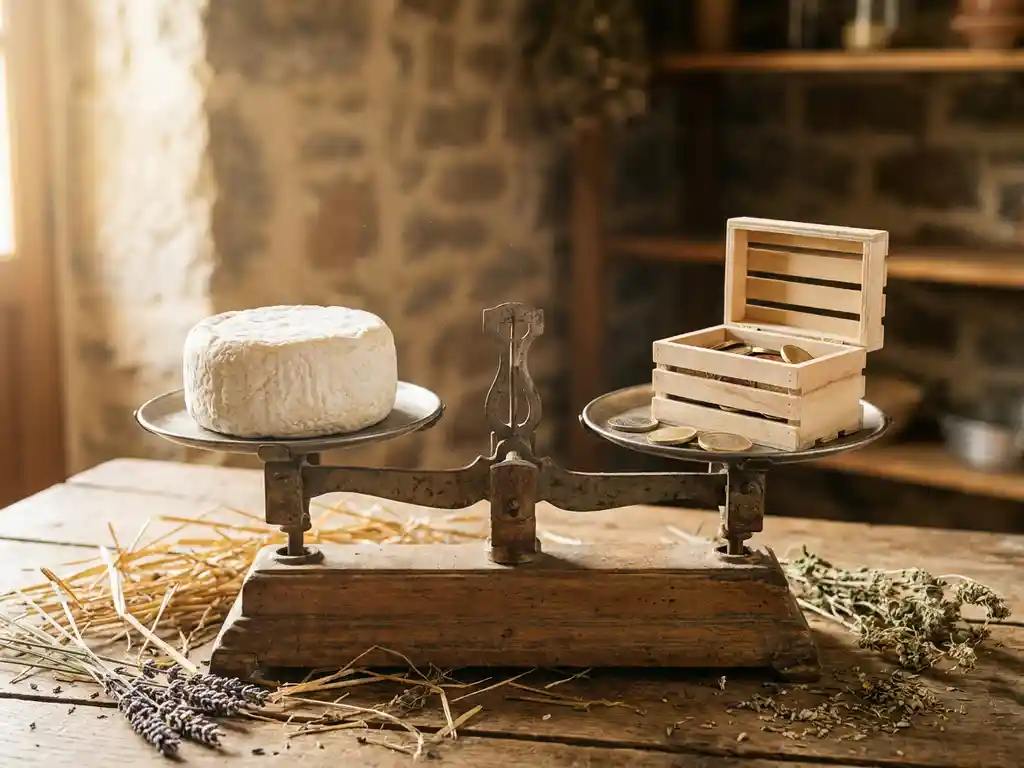
The true cost of goat cheese is calculated by adding all logistics costs, quality risks, and administrative burdens to the base price per kilogram — costs that a quote doesn’t always show. If you only look at the sticker price, you’re comparing apples to oranges. The total cost of ownership of cheese includes shipping costs, incoterms, losses due to quality differences, and the hidden costs of delivery failures. In this article, we walk through the six most frequently asked questions about cost calculation when buying goat cheese.
What hidden costs are buried in a cheese quote?
A cheese quote usually shows only the product price per kilogram. But the true cost of buying goat cheese includes several hidden items: freight costs, customs duties, quality checks, packaging costs, payment terms, and the costs of returns or rejected goods. If you don’t account for these, you’ll consistently underestimate your purchasing costs.
The most overlooked cost items are:
- Shipping costs and fuel surcharges: Refrigerated transport for goat cheese costs more than ambient transport. Fuel surcharges change every quarter and are often not included in the base quote.
- Packaging and labeling: Custom formats or private label packaging come with extra costs that are sometimes invoiced separately.
- Payment terms and currency risk: A longer payment term has a financing value. When buying outside the eurozone, currency fluctuations also come into play.
- Inspection and certification costs: Some buyers require BRC, IFS, or specific halal certification. Those costs get passed on — whether stated explicitly or not.
- Minimum order quantities and volume discounts: Volume discounts that only kick in above a certain threshold can make a quoted price misleadingly low if you don’t consistently hit those volumes.
The practical approach is to use a fixed checklist for every quote, filling in each cost item separately. That’s the only way to make total purchasing costs truly comparable.
How do you calculate logistics costs per kilogram of goat cheese?
You calculate logistics costs per kilogram of goat cheese by dividing the total shipping costs of a delivery by the net weight of the cheese received. Don’t forget to factor in weight loss from moisture loss or damage — this raises the effective cost per usable kilogram.
A simple calculation method works like this:
- Request the full freight costs per shipment, including fuel surcharges and refrigeration costs.
- Add any customs duties and import costs.
- Divide the total logistics costs by the net weight of the received and approved batch.
- Add this amount to the product price per kilogram from the quote.
With goat cheese, weight loss plays a bigger role than with hard cheeses. Fresh and soft goat cheese can lose moisture during transport, meaning the net weight at delivery is lower than the ordered weight. This difference — also known as tare loss — needs to be factored into your cost calculation. A two percent loss per shipment adds up significantly over the course of a year.
What is the difference between EXW, DAP, and DDP when buying cheese?
EXW (Ex Works), DAP (Delivered at Place), and DDP (Delivered Duty Paid) are incoterms that determine who bears the shipping costs, risk, and customs handling. With EXW, the buyer handles everything. With DAP, the seller covers transport but not import duties. With DDP, the seller covers all costs right to the buyer’s door.
In practice, this means the following for goat cheese purchasing:
- EXW: The cheese is ready at the supplier’s warehouse. You arrange and pay for transport, refrigeration, customs, and assume all risk along the way. This gives you maximum control — but also maximum responsibility.
- DAP: The supplier delivers to the agreed location, but you pay import duties and VAT on arrival. This is a commonly used incoterm for European deliveries outside the EU.
- DDP: The supplier handles everything, including customs clearance and import duties. You pay a higher invoice price, but there are no surprises at delivery. For buyers who want to focus on their core business, DDP is often the most straightforward option.
When comparing quotes, it’s essential to convert all prices to the same incoterm. A price quoted EXW that looks five percent lower than a DDP price can end up being more expensive once you add shipping and customs costs.
What quality costs should you factor in when buying goat cheese?
When calculating the cost of goat cheese, you need to factor in more than just the purchase price. You also need to account for quality checks, rejected batches, production downtime caused by inconsistent specs, and the administrative burden of handling complaints. Quality costs are often invisible in a quote — but they’re very real.
The main quality-related cost items are:
- Incoming inspection: Every batch of goat cheese you receive needs to be checked for fat content, moisture content, pH level, and microbiological specs. The cost of this lab work is part of your total cost.
- Rejections and returns: If a batch doesn’t meet specs, you have to return or dispose of it. The costs of transport, replacement, and production downtime can be significant.
- Production downtime: Inconsistent cheese properties — such as varying melting behavior or off-spec moisture content — can disrupt a production line. Downtime costs are hard to quantify but can be very high.
- Compliance documentation: Food safety requirements call for traceability documents, certificates, and lab reports. If a supplier doesn’t provide these as standard, it costs you extra time and money to track them down.
A supplier with a higher base price but consistently proven quality and complete documentation can be cheaper over the course of a year than a low-cost supplier with frequent quality issues.
How do you fairly compare quotes from different goat cheese suppliers?
You compare goat cheese supplier quotes fairly by converting all prices to the same basis: the same incoterm, the same weight, the same packaging, and the same quality requirements. Without this normalization, you’re comparing things that can’t actually be compared — and you risk choosing the wrong supplier.
A structured comparison works like this:
- Normalize the incoterm: Convert all quotes to DDP or another fixed basis. Use the actual freight rates from your own logistics partner as a reference.
- Compare by net weight: Ask each supplier about the weight loss they guarantee, and convert the price to the usable kilograms you actually receive.
- Quantify quality risk: Ask about historical rejection rates and calculate what an average rejected batch costs you in replacement and downtime.
- Factor in payment terms: A supplier offering 60-day payment terms gives you an effective financing advantage over a supplier with 30-day terms — even if the product price is the same.
- Weigh the service costs: Technical support, sample packages, lab reports, and flexibility on rush orders all have value you can express in saved hours and avoided costs.
When is a more expensive goat cheese supplier actually cheaper?
A more expensive goat cheese supplier can be cheaper overall when the higher product price is offset by lower logistics costs, fewer quality rejections, less production downtime, and less administrative burden. The total cost of ownership of cheese is almost always more favorable with a reliable supplier offering consistent quality than with the cheapest option on the market.
Specific situations where a higher sticker price still works out to be more affordable:
- The supplier delivers DDP, so you don’t need to involve your logistics team in customs clearance and refrigerated transport.
- Quality consistency is so high that you can simplify incoming inspections and production downtime is practically zero.
- The supplier provides full traceability documentation and certificates as standard, reducing your compliance costs.
- Flexible delivery times and a reliable supply chain reduce the need for safety stock, which lowers your storage costs.
- Technical support during product development replaces the need for external consulting costs.
The industry rule of thumb is that even a one percent rejection rate at high volumes can completely wipe out the price advantage of a cheaper supplier. Anyone who seriously calculates the total cost of ownership of cheese rarely chooses based on base price alone.
How DeJong Cheese helps with transparent cost calculation
As a family business with more than thirty years of experience in goat cheese specialties, we at DeJong Cheese know exactly what questions buyers and product developers ask when assessing the true cost. We work transparently and provide quotes that clearly break down all relevant cost items — so you can make a fair comparison.
What we offer in practice:
- Clear quotes with explicit details on incoterm, weight guarantee, and packaging costs
- Consistent quality thanks to traditional production methods and fixed specs per product line
- Full traceability documentation and certificates included as standard with every delivery
- Flexible delivery terms for both retail and foodservice customers
- Technical support for integrating goat cheese into your production process or product development
Want to know what our goat cheese specialties will truly cost you — including all logistics and quality aspects? Contact us for a transparent, tailored quote.
Frequently Asked Questions
How often should I recalculate the total cost of ownership for my goat cheese supplier?
It’s smart to recalculate the total cost of ownership at least once a year — and also whenever there’s a significant change in fuel prices, exchange rates, or logistics rates. Quarterly updates are recommended if you work with suppliers outside the eurozone or deal with highly variable volumes. This way, you avoid a situation where a supplier that was the cheapest option last year has quietly become the most expensive this year.
What is a realistic rejection rate to use when buying goat cheese?
A rejection rate of 0.5 to 2 percent is considered realistic in the industry, depending on the type of goat cheese (fresh, aged, or processed) and how strict your incoming specs are. With fresh and soft goat cheese, the risk of rejection is higher due to shorter shelf life and sensitivity to temperature deviations during transport. Always ask suppliers for their historical rejection data and set a maximum percentage in your contract.
Can I apply this cost calculation method when buying small volumes of goat cheese?
Yes, the method scales, but with small volumes the fixed costs — such as shipping and inspection costs — carry more weight per kilogram. In that case, it may be worth working with an importer or wholesaler who spreads logistics costs across multiple customers, rather than buying directly from the producer. With smaller volumes, always ask explicitly about minimum order requirements and the associated price breaks, so you know at what volume direct purchasing actually becomes advantageous.
What tools or templates can I use to compare goat cheese supplier quotes in a structured way?
A simple Excel or Google Sheets model with fixed columns for product price, incoterm adjustment, logistics costs, quality risk surcharge, and payment terms is enough for most buyers. Make sure you use a separate tab to normalize all quotes to the same basis (e.g., DDP, net weight, 30-day payment terms) before comparing them. For larger organizations, purchasing platforms like Jaggaer or SAP Ariba offer built-in comparison modules that automate this process further.
How do I handle suppliers who refuse to be transparent about hidden costs?
If a supplier isn’t willing to itemize shipping costs, packaging costs, or quality certification costs separately, that’s already a red flag. Make it a firm requirement that quotes include a full cost breakdown, and explain that without that information you can’t make a fair comparison. Suppliers who treat transparency as a matter of course tend to be more reliable in the day-to-day execution of the partnership as well.
What is the most common mistake when comparing goat cheese quotes?
The most common mistake is comparing quotes with different incoterms without first converting them to a common basis. An EXW price that looks five percent lower on paper can end up being ten percent more expensive than a DDP quote once you add transport, refrigeration, and customs handling. The second most common mistake is ignoring weight loss: if you don’t correct for moisture loss or tare loss, you overestimate the amount of usable cheese and underestimate the effective price per kilogram.
How do I factor in storage costs and inventory management in the total cost calculation?
Storage costs are calculated by multiplying the average inventory value by your internal cost of capital (typically 5 to 15 percent per year), plus the direct costs of refrigerated storage per pallet per week. A supplier with short lead times and high delivery reliability allows you to operate with a lower safety stock, which directly saves on storage costs. Include this advantage explicitly in your total cost of ownership calculation — at high volumes, it can add up to significant annual savings.
Related Articles
- How do you compare technical datasheets from different goat cheese producers?
- How do you develop a clean-label product with goat cheese as the main ingredient?
- What does solar energy in cheese production mean for the CO₂ footprint of curds?
- How does DGZK certification contribute to sustainable goat cheese production?
- How to track goat cheese consumer preferences in retail?