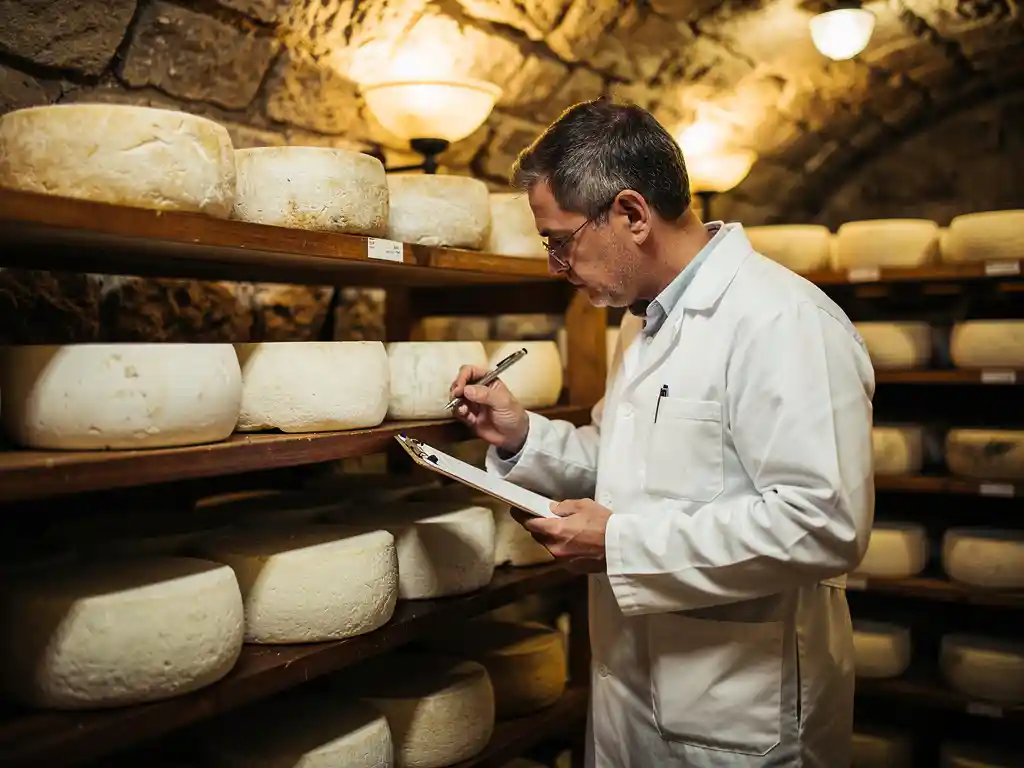
When selecting a producer for industrial goat cheese, requesting the right references is crucial. As a buyer in the food industry, you know that reliability, consistent quality, and technical specifications make the difference between a smooth production process and costly disruptions. This guide helps you systematically evaluate the most important references, from quality certificates to production capacity.
What are the most important references for an industrial goat cheese producer?
The most important references for an industrial goat cheese producer are client testimonials from comparable industrial customers, proof of long-term supply relationships, annual production volume, and documentation of successful private label projects. These references provide insight into the producer’s reliability and experience with large-scale deliveries.
Start by requesting at least three references from companies that purchase similar volumes as your organization. Specifically ask for clients from the ready-meal industry, pizza producers, or other processing companies. These references should contain information about:
- Duration of the partnership (ideally at least 3 years)
- Average purchase volumes per month or quarter
- Type of products delivered (fresh goat cheese logs, crumbles, or aged varieties)
- Experience with delivery reliability and quality consistency
- Flexibility during sudden volume changes
Also ask for concrete examples of successful private label projects. An experienced producer can show references for customized solutions for industrial processing, including specific recipe adjustments for heating applications or customized packaging sizes like industrial 2.6 kg logs.
Which quality certificates should a goat cheese producer be able to provide?
A goat cheese producer for industrial applications must have at least IFS Food certification, HACCP certification, and preferably also BRC Global Standards. These certificates guarantee that the producer meets international food safety standards and is suitable for deliveries to the food industry.
IFS Food certification is essential for suppliers to industry and retail. This certificate confirms that the producer operates according to strict quality and safety procedures. Ask for the most recent audit report and pay attention to the score – a Higher Level certification (score above 90%) provides additional assurance.
Additional certificates that add value:
- ISO 22000 for food safety management systems
- Organic certification if relevant for your products
- Halal or Kosher certification for specific markets
- DGZK quality mark for Dutch goat cheese producers
Also check if the producer has product-specific certificates such as lactose-free verification for special product lines. Ask about the validity dates of all certificates and inquire about planned re-certifications to ensure continuity.
How do you verify the delivery reliability of a cheese producer?
You verify delivery reliability by requesting historical delivery data for at least 12 months, including on-time delivery percentages, number of complaints per 100 deliveries, and average response time for urgent orders. A reliable producer can provide this data directly with percentages above 95% for timely delivery.
Specifically ask for the following performance indicators:
- Average delivery reliability percentage over the past year
- Number of times orders were delivered in full versus partial deliveries
- Average delivery time for standard products (for example, 3 weeks for hard cheeses)
- Track record during seasonal peaks or sudden volume increases
- Available safety stocks for core products
Test communication by asking about their procedure for delivery problems. A professional producer has a clear escalation protocol with contact persons available 24/7 for critical deliveries. Also inquire about their contingency planning – do they have backup production locations or alternative transport routes during emergencies?
References from existing clients about delivery reliability are valuable. Specifically ask about experiences during challenging periods such as raw material shortages or transport strikes to see how the producer performs under pressure.
Which technical specifications do you request for industrial applications?
For industrial applications, you request technical specifications such as fat content, moisture percentage, pH value, melting behavior at different temperatures, and microbiological parameters. This data is essential to determine if the goat cheese is suitable for your specific production processes and end products.
The most important technical parameters for industrial processing include:
- Fat content (for example, 16% for spreadable varieties to standard percentages for fresh cheese)
- Dry matter content and moisture percentage for consistency in recipes
- pH value and acidity level for stability in end products
- Protein content and composition for nutritional calculations
- Melting point and flow behavior when heated (crucial for pizza and oven applications)
Also ask for functionality data such as:
- Freezability and thaw stability
- Shelf life after opening in production environment
- Interaction with other ingredients in your recipe
- Color and texture stability during processing
- Microbiological specifications including maximum bacterial counts
A professional producer provides these specifications in a detailed technical datasheet, including tolerances and measurement methods. Ask about seasonal variations in specifications and how these are managed to guarantee year-round consistency.
How do you assess the production capacity of a goat cheese producer?
You assess production capacity by requesting information about maximum monthly production in kilograms, number of production lines, storage capacity, and occupancy rate. An industrial producer should have at least 20-30% overcapacity to handle growth and seasonal peaks without delivery problems.
Essential questions for capacity assessment:
- Total production capacity per month for fresh and aged goat cheese
- Current occupancy rate and available capacity for new clients
- Flexibility in production planning for urgent orders
- Minimum and maximum batch sizes per product type
- Lead time from milk receipt to end product
Also evaluate supply chain capacity:
- Number of milk suppliers and geographical distribution
- Storage capacity for raw materials and end products
- Cooling capacity and temperature zones for different aging stages
- Packaging capacity including possibilities for client-specific packaging
- Transport capacity and partnerships with logistics partners
Ask about investment plans for capacity expansion. A forward-thinking producer has concrete plans for growth and can indicate how your volumes fit within their long-term strategy. Also check if they have experience scaling up production for growing industrial clients.
What are red flags when requesting references?
Red flags when requesting references are refusal to share concrete client contacts, only old references (older than 2 years), lack of industrial clients in the reference list, and vague answers about production capacity or certifications. These signals indicate possible problems with reliability or experience.
Important warning signals to be alert to:
- Reluctance to show recent audit reports or certificates
- No references from your specific industry (ready meals, pizza, etc.)
- Only small customers in the reference list without volume experience
- Unclear delivery times or changing answers
- No track record with private label or client-specific products
Also watch for these more subtle signals:
- Exaggerated promises about flexibility without concrete examples
- Lack of technical knowledge among sales contacts
- No clear escalation procedures for problems
- Changing contact persons during the reference process
- Evasive answers about production capacity or occupancy rate
Be extra cautious if a producer doesn’t allow visits to the production location or only under very limited conditions. Transparency about production processes and quality systems is essential for a reliable industrial partnership. A professional producer welcomes potential clients for an audit or tour.
How De Jong Cheese helps with selecting the right industrial goat cheese producer
As a family business with more than 30 years of experience, we at De Jong Cheese understand exactly what buyers like Marco Visser need. Our transparent approach means we can provide all requested references directly, from concrete client contacts to detailed technical specifications.
What we offer for industrial customers:
- IFS Food certification and complete documentation for audits
- Technical datasheets for all our industrial products, including fresh goat cheese logs of 2.6kg
- Proven delivery reliability with on-time delivery above 95%
- Flexible production capacity with 3 weeks delivery time for standard products
- Experience with private label and client-specific solutions worldwide
Our specialists are ready to answer your specific questions about melting behavior, fat contents, or volume possibilities. We gladly invite you for a visit to our production location in Alphen where you can see for yourself how we combine traditional quality with modern production standards.
Please contact us for a non-binding conversation about your industrial goat cheese needs. We’re happy to share references from comparable clients and propose a test delivery so you can experience our quality and service yourself. Also check our complete range for foodservice and industry or find our products at one of our sales points.
Frequently Asked Questions
How long does it take on average to fully screen a new industrial goat cheese producer?
A thorough screening of a new producer takes an average of 4-6 weeks, including requesting and verifying references, technical audits, and testing sample products. Plan extra time for any site visits and aligning specific product specifications for your applications.
What are typical minimum order sizes for industrial goat cheese products?
Minimum order sizes vary per producer, but for industrial applications this is usually between 500-1000 kg per product type. Fresh goat cheese logs are often ordered per pallet (approximately 400-600 kg), while specialized products may have higher minimums due to production efficiency.
How do you test if goat cheese is suitable for your specific heating process?
First request technical melting profiles and then perform practical tests in your own production environment with different temperature-time combinations. Test at least three batches from different production dates to ensure consistency, and document melting behavior, oil separation, browning and texture changes at your specific process parameters.
What questions do you ask reference clients of a potential producer?
Ask reference clients specifically about their experience with delivery reliability during peak periods, how the producer handles quality deviations, response time for urgent orders, and flexibility with recipe adjustments. Also inquire about any problems and how these were solved, plus whether they would recommend the producer for large-scale industrial applications.
What do you do if a producer doesn't want to provide direct competitors as references?
This is understandable from competitive considerations. Instead ask for references from adjacent industries (for example ready meals if you produce pizza) or anonymized case studies with volume data. A professional producer can also give references from clients in other geographical markets where there’s no direct competition.
How do you determine if a producer can grow with your volume needs?
Analyze their current occupancy rate, investment plans for the next 3-5 years, and track record with growing clients. Ask for concrete examples of clients where they have doubled or tripled volumes, and how they freed up capacity. Also check if they’re willing to enter long-term contracts with volume guarantees and growth agreements.
When is it time to switch goat cheese producers?
Consider switching with structural delivery problems (more than 3 missed deliveries per quarter), consistent quality deviations causing production disruptions, lack of innovation or growth capacity, or significantly higher prices without added value. Always start by testing a new producer in parallel before ending the current relationship.
Related Articles
- How do you test the melting behavior of goat cheese before making a large-scale purchase?
- How do you use fig or truffle goat cheese as a premium ingredient in a ready-to-eat product?
- Why is certification important in cheese sourcing?
- How to make goat cheese salad dressing?
- Can goat cheese be made with plant-based rennet?