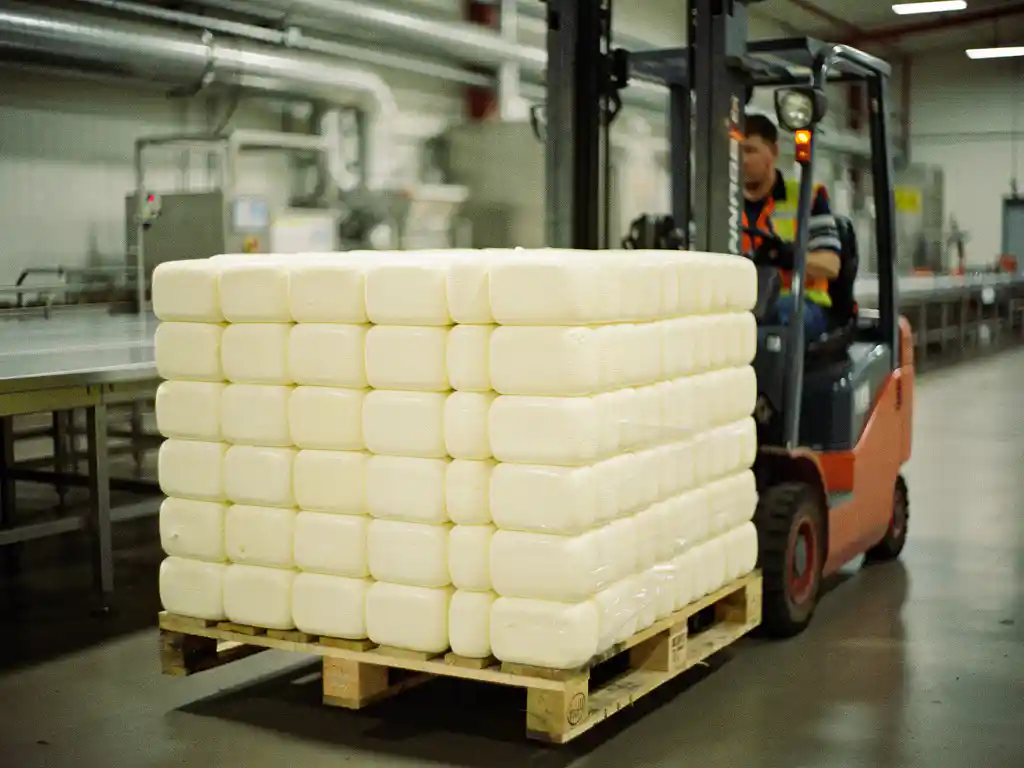
Goat cheese curd is a versatile raw material that is increasingly being used in the food industry. For buyers like Marco Visser, who are looking for reliable suppliers for their production lines, pallet delivery of curd offers an efficient solution. In this article, we answer the key questions about how pallet delivery of goat cheese curd works for the food industry.
What is goat cheese curd and why do food producers choose it?
Goat cheese curd is the fresh, unaged cheese mass that is created after coagulating and draining goat milk. It is a semi-solid product with a crumbly texture that serves as a base ingredient for various cheese products and food applications in the industry.
Food producers choose goat cheese curd because of its unique functional properties. The product has a mild, slightly acidic flavor profile that combines well with other ingredients without dominating. The curd contains natural proteins and fats that provide a creamy texture in end products.
An important advantage is the versatility in processing. Curd can be processed into spreadable products, used as filling in pasta and quiches, or applied as a topping on pizzas. The melting behavior is predictable and consistent, which is essential for automated production lines.
For producers with specific target groups, goat cheese curd also offers advantages. The product is naturally low in lactose and is often better tolerated by people with sensitivity to cow milk products. Moreover, it fits within the trend toward premium and artisanal ingredients.
How does the ordering process work for pallet deliveries of goat cheese curd?
The ordering process for pallet deliveries begins with an inventory of production needs and specifications. Industrial customers contact the sales department to discuss volume, delivery frequency, and technical requirements. The standard minimum order size for curd is one pallet.
After the initial introduction, a technical evaluation follows. Producers receive product specifications including fat content, moisture percentage, pH value, and microbiological parameters. For new customers, a sample of 5-10 kg is often made available for product testing in their own facilities.
Upon approval, a delivery agreement is drawn up. This contains agreements about:
- Fixed delivery times (weekly, bi-weekly, or monthly)
- Volume per delivery (number of pallets)
- Quality specifications and tolerances
- Price agreements and payment conditions
- Lead time for orders (standard 4 weeks)
The actual ordering is done through a dedicated contact person. Orders are placed at least two weeks before the desired delivery date. For regular customers, framework contracts can be concluded where deliveries proceed automatically according to schedule.
What packaging options are available for curd on pallets?
Goat cheese curd is delivered in bulk packaging that is optimized for industrial processing. The most commonly used packaging option is the 10 kg block in vacuum packaging, with 100 blocks stacked per Euro pallet for a total weight of 1000 kg per pallet.
For producers with specific processing processes, alternative packaging is available:
- 20 kg blocks: For large-scale processing with less handling, 50 pieces per pallet
- 5 kg portions: For smaller production lines or test batches, 200 pieces per pallet
- Flow pack packaging: Curd in bags of 10 or 20 kg for direct dosing
All packaging is equipped with Modified Atmosphere Packaging (MAP) technology that extends shelf life to 8 weeks at 2-4°C. The packaging is suitable for freezing, which is indicated with a snowflake icon on the label.
Pallets are wrapped with shrink film and provided with corner protectors. Each pallet has a unique identification number for traceability. Labels contain production date, best-before date, batch number, and the EC number NL Z1977 EU for export within Europe.
What are the quality requirements for goat cheese curd in the food industry?
Quality requirements for goat cheese curd in the food industry include strict microbiological standards, consistent physico-chemical properties, and complete traceability. Producers must comply with HACCP guidelines and are preferably IFS Food certified for deliveries to the industry.
The microbiological parameters are strictly defined:
- Listeria monocytogenes: absent in 25g
- Salmonella: absent in 25g
- E. coli: < 100 cfu/g
- Staphylococcus aureus: < 100 cfu/g
- Yeasts and molds: < 1000 cfu/g
Physico-chemical specifications that curd must meet:
- Fat content: 20-24% (on product basis)
- Moisture content: 58-62%
- pH value: 4.4-4.8
- Salt content: 0.8-1.2%
- Texture: homogeneous, without hard grains
Documentation requirements are as important as product specifications. Each delivery must be accompanied by an analysis certificate, a delivery note with batch numbers, and a declaration of conformity. For export, additional health certificates are required.
Quality control takes place at multiple levels. The milk is tested upon receipt from DGZK-certified goat farms. During production, samples are taken every hour. End products undergo a complete analysis before being released for delivery.
How does the logistics of pallet delivery to production facilities work?
The logistics of pallet delivery begins with order planning where deliveries are scheduled based on production capacity and inventory levels. Transport is done with refrigerated trucks that guarantee a constant temperature of 2-4°C from the warehouse to the customer’s production facility.
The loading process at our cheese dairy follows a fixed protocol:
- Check truck temperature before loading
- Scan pallet labels for the digital waybill
- Load according to the LIFO principle (Last In, First Out)
- Temperature recording during transport via data loggers
- Sealing of the loading space with unique number
For deliveries within the Netherlands, a standard delivery time of 24-48 hours after production applies. International deliveries within Europe take 48-72 hours, depending on the destination. All transports are tracked in real-time via track-and-trace systems.
Upon arrival at the production facility, a structured receiving protocol is followed. The driver reports to goods receiving where temperature controls are performed. Pallets are visually inspected for damage. After approval, they are directly transferred to refrigerated storage or the production area.
For urgent deliveries or smaller orders, special courier services can be deployed. These services guarantee delivery within 12-24 hours, but are only available for orders up to 5 pallets due to capacity limitations of the refrigerated trucks.
What applications does goat cheese curd have in different food products?
Goat cheese curd is used in pizzas, pasta, quiches, salads, and ready-to-eat meals. The curd functions as a flavor enhancer, texture improver, and protein source in these products, where the mild character combines well with Mediterranean and modern culinary applications.
In the pizza industry, curd is popular for premium varieties. The curd is crumbled over the pizza before baking, where the melting behavior creates creamy spots without excessive flowing. The product retains its characteristic flavor at temperatures up to 220°C, which is essential for industrial pizza ovens.
For pasta producers, curd offers possibilities as filling in ravioli and tortellini. The curd is mixed with herbs and possibly other cheeses into a homogeneous mass. The moisture content of 58-62% provides a smooth filling that doesn’t dry out during the cooking process.
In the ready-to-eat meal sector, we see applications in:
- Mediterranean salads: Crumbled curd as topping
- Stuffed peppers: Curd mixed with grains and vegetables
- Lasagnas: As a layer between pasta sheets
- Wraps and sandwiches: Processed into spreadable variant
A growing application is in vegetarian and flexitarian products. Goat cheese curd serves as a protein-rich component that increases nutritional value. The product is combined with plant-based ingredients for burgers, balls, and schnitzels where the curd provides binding and juiciness.
How DeJong Cheese helps with pallet delivery of goat cheese curd
At DeJong Cheese, we understand the specific needs of the food industry. Since 1995, we have been delivering high-quality goat cheese curd to producers worldwide, with consistent quality and reliable delivery as our priorities.
Our services for industrial customers include:
- Flexible delivery options: From weekly to monthly deliveries according to your production planning
- Technical support: Our team advises on the optimal application of curd in your products
- Quality guarantee: IFS Food certified with complete traceability
- Private label possibilities: Curd according to your specific recipe and packaging requirements
- Sustainable production: 100% DGZK-certified milk from local goat farms
For Marco Visser and other buyers in the food industry, we offer the certainty of a family business with industrial capacity. Our curd is produced according to traditional recipes, but with modern quality controls that meet the highest industrial standards.
Would you like to know more about the possibilities of goat cheese curd for your production? Contact us for a no-obligation conversation. Visit our foodservice page for more information about our complete range. You can also visit us at one of our sales points or check our homepage for the latest news about our products and services.
Frequently Asked Questions
What is the minimum order quantity for a first order of goat cheese curd?
For new customers, we maintain a minimum order quantity of one pallet (1000 kg). We do offer the possibility to order a smaller sample of 5-10 kg beforehand for product testing in your own facilities. After successful tests, you can proceed to pallet orders with possibly a framework contract for regular deliveries.
How long can I store goat cheese curd after receipt and can it be frozen?
Fresh goat cheese curd has a shelf life of 8 weeks at 2-4°C thanks to the MAP packaging. The product can indeed be frozen for longer storage up to 12 months at -18°C. After thawing, the curd retains its functional properties, although the texture may become slightly more crumbly. Plan thawing 24-48 hours in advance in refrigeration for optimal results.
What certifications must my company have to be allowed to process goat cheese curd?
Your company must be at least HACCP-certified and have adequate refrigeration facilities (2-4°C). For export within the EU, registration with the NVWA is required with a valid TRACES number. Additional certifications such as BRC, IFS, or FSSC 22000 are not mandatory but are recommended for smooth cooperation and to meet retail requirements.
How do I prevent quality loss when processing large quantities of curd?
Work according to the FIFO principle and only take the required amount from refrigeration. Process opened packages within 48 hours and cover temporarily with foil. Use clean equipment and avoid cross-contamination. When processing above 8°C, curd may only remain outside refrigeration for a maximum of 2 hours. Invest in good temperature recording during your entire production process.
Can the composition of curd be adjusted for specific applications?
Yes, we can produce curd according to your specifications. Adjustments in fat content (15-30%), salt content (0.5-2%), or pH value are possible with a minimum order of 10 pallets per batch. We can also use specific starter cultures for unique flavor profiles. Development time for customized recipes is 6-8 weeks including validation and stability tests.
What are the most common mistakes when processing goat cheese curd in industrial applications?
The three biggest mistakes are: too high processing temperatures (above 220°C) causing proteins to burn, insufficient mixing causing uneven distribution of curd, and adding too much moisture leading to a mushy texture. Also avoid direct contact with acidic ingredients (pH < 3.5) that can cause the curd to curdle.