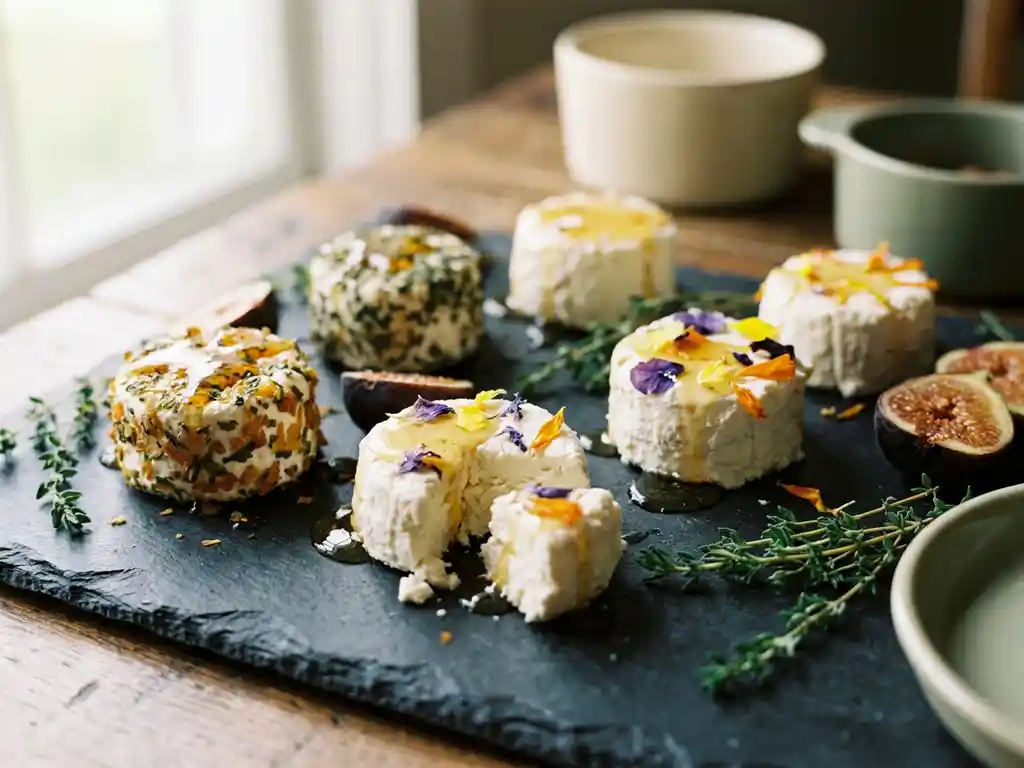
You can create unique goat cheese flavor combinations by pairing its natural creaminess and lightly tangy profile with ingredients that enhance or contrast those characteristics — think truffle, red onion, honey, or fresh herbs. The key is understanding the flavor profile of the specific goat cheese variety you’re working with. Fresh goat cheese calls for different pairings than an aged specialty. In this article, we answer the most common questions about goat cheese product development — from basic combinations to clean-label positioning and custom concepts.
Which flavors naturally pair well with goat cheese?
Goat cheese pairs naturally with sweet, earthy, and bright tangy flavors. Its lightly acidic, creamy base works best with ingredients that add complexity: think honey, figs, beets, walnuts, fresh herbs like thyme and rosemary, and citrus zest. These are the flavor combinations that work time and again — in both retail and foodservice applications.
Goat cheese has a unique flavor profile: it’s both fresh and full-bodied. Fresh goat cheese has a bright, lightly tangy note that works beautifully with sweet counterparts. Aged goat cheese develops deeper, earthier, nuttier tones that pair better with savory combinations like olives, sun-dried tomatoes, or smoked ingredients.
- Sweet: honey, fig, pear, dried apricot
- Savory/earthy: walnut, beet, sun-dried tomato, olive
- Herby: thyme, rosemary, basil, lavender
- Fresh/tangy: lemon, cranberry, balsamic
- Umami: truffle, caramelized onion, roasted bell pepper
For product developers, it’s worth knowing that goat cheese flavor combinations hold up well during processing — as long as temperature and processing time are carefully matched to the type of cheese.
How do you combine goat cheese with truffle for a premium product?
Goat cheese and truffle work well together because truffle’s earthy, intense flavor deepens the creamy, lightly tangy base of goat cheese without overpowering it. For a premium product, a soft or lightly aged goat cheese works best as the base — it lets the truffle aromas really shine. The ratio and quality of the truffle component are what make or break the result.
In practice, there are several approaches to a goat cheese and truffle concept:
- Truffle through the curd: truffle pieces or truffle oil are added during production for an even distribution of flavor
- Truffle layer or coating: the outside of the cheese is treated with truffle components, creating a visually striking and flavorful result
- Truffle cream as a filling: ideal for processed products like spreads or filled savory snacks
For a clean-label premium positioning, it’s best to use real truffle pieces or truffle extract rather than synthetic truffle flavoring. Consumers in the premium segment can tell the difference, and positioning the product as authentic adds significant brand value. Goat cheese innovation in the truffle segment remains one of the fastest-growing niches in specialty cheese in 2026.
What are the trendiest goat cheese combinations on the market right now?
The trendiest goat cheese combinations in 2026 include goat cheese with truffle, red onion and honey, goat cheese with harissa or other North African spices, and goat cheese paired with fermented flavors like miso or kimchi. There’s also strong interest in botanical combinations featuring lavender, hibiscus, or edible flowers for the premium segment.
These trends are driven by consumer demand for authentic, flavorful products with a story behind them. Goat cheese fits perfectly into the movement toward artisanal, local, and recognizable ingredients. Here are some concrete trend directions:
- Mediterranean: goat cheese with za’atar, olive oil, and lemon
- Umami-driven: goat cheese with truffle, caramelized onion, or miso
- Sweet-savory: goat cheese with fig jam, honey, or pear
- Botanical: goat cheese with lavender, thyme, or edible flowers
- Spicy: goat cheese with harissa, chipotle, or jalapeño
For product developers looking to build a on-trend product line, it pays to choose combinations that are both visually appealing and distinctively flavorful. Unique specialty cheeses in these categories perform well on social media and in premium retail channels.
How do you adapt goat cheese for different product formats?
Goat cheese can be adapted for a wide range of product formats by varying moisture content, fat content, aging time, and processing method. Fresh goat cheese is well suited for spreadable formats, fillings, and dips. Lightly aged varieties hold up better in sliced or portioned products. For heated applications like pizza or warm snacks, specific melting and stability properties become key.
Fresh and soft goat cheese
Fresh goat cheese is ideal for spreadable products, dips, spreads, and as a filling in puff pastry or savory pastries. Its high moisture content makes it soft and creamy, but it also requires careful packaging and shelf-life management. In this format, flavor additions are easiest to incorporate.
Aged and firm goat cheese
Lightly to fully aged goat cheese works well for slices, cubes, and grated applications. Its firmer texture makes it suitable for charcuterie boards, salads, and hot dishes. When heated, aged goat cheese behaves differently from fresh varieties — which requires technical fine-tuning for industrial applications.
What role does clean-label play in goat cheese product development?
Clean-label plays a central role in goat cheese product development because consumers and retailers increasingly ask for products with a short, recognizable ingredient list — no artificial additives. Goat cheese naturally has a simple profile, making it an excellent base for clean-label concepts. The challenge is keeping things simple when adding flavor components.
For product developers, clean-label means in practice:
- Using natural flavor carriers instead of synthetic flavorings
- Avoiding preservatives through smart packaging and process optimization
- Transparent sourcing of ingredients, including the milk and any flavor additions
- Clear allergen information and straightforward product labeling
- A preference for locally or regionally sourced ingredients
A clean-label focus in goat cheese product development also strengthens a product’s premium positioning. Consumers are willing to pay more for products with ingredients they recognize and trust. In retail channels, clean-label has become a baseline requirement for placement in the premium segment.
How do you start a partnership for custom goat cheese concepts?
Starting a partnership for custom goat cheese concepts begins with clearly defining your product requirements: what format, flavor direction, volume, and technical specifications do you need? From there, you look for a producer that offers both technical expertise and flexibility in product development. A good cheese partner is involved from concept to finished product and understands the demands of your specific market.
Concrete steps to get a partnership started:
- Define your concept: flavor direction, target audience, packaging format, and positioning
- Map out technical requirements: shelf life, melting behavior, moisture content, allergens
- Select a partner with proven experience in goat cheese specialties and private label production
- Plan a trial production run: test the concept on a small scale before scaling up
- Evaluate and refine: adjust the recipe based on taste and technical test results
Open communication about volumes, lead times, and quality requirements is essential to avoid disappointments. A supplier who gets involved early in the process will save you a lot of time and money down the line.
How DeJong Cheese helps with goat cheese flavor combinations and product development
As a family business with more than thirty years of experience in goat cheese specialties, we understand what product developers and buyers need: reliable quality, flexibility in custom work, and a partner who truly thinks along with you. Under our brand Alphenaer, we produce a wide range of fresh and aged goat cheeses that form the foundation for innovative product concepts.
What we offer for your product development:
- Custom goat cheese concepts tailored to your flavor profile, format, and volume needs
- Technical support for integrating flavor components like truffle, red onion, or specialty herbs
- Private label production with consistent quality and full traceability
- Clean-label products with a short, recognizable ingredient list
- Delivery to retail and foodservice worldwide — from small runs to large-scale volumes
Ready to develop your goat cheese concept? Get in touch with us and tell us about your idea. We’d love to schedule an introductory meeting to talk about how we can take your product line to the next level.
Frequently Asked Questions
What is the difference between fresh and aged goat cheese in flavor combinations, and how do I choose the right variety for my product?
Fresh goat cheese has a bright, tangy note that pairs best with sweet and light flavors like honey, citrus, and fresh herbs. Aged goat cheese develops deeper, nuttier, and earthier tones that work better with more intense combinations like truffle, olives, or smoked ingredients. The choice depends on your product format and target audience: for spreadable products and dips, go with fresh goat cheese; for charcuterie boards and premium cheese specialties, an aged variety is usually the better base.
How do I prevent flavor additions like herbs or truffle from losing their intensity during the production process?
Heat-sensitive flavor components like fresh herbs and truffle aromas quickly lose intensity at high processing temperatures. Add these ingredients as late as possible in the production process, or opt for more heat-stable alternatives such as dried herbs, truffle pieces, or concentrated extracts. Small-scale trial runs are essential for finding the optimal addition method and dosage before you scale up.
Which goat cheese combinations work best for a retail product that also needs to look visually appealing?
Combinations with strong visual contrast perform best in retail — such as goat cheese with beet (deep red color), edible flowers (botanical and premium), or black truffle pieces (a luxurious look). Packaging plays just as big a role as the product itself: a transparent package or window lets the unique ingredients speak for themselves and reinforces the premium perception right on the shelf. Pair this with a clean-label ingredient list for maximum impact in the premium segment.
Is goat cheese suitable for flexitarian product lines, and how do I position it to my target audience?
Goat cheese fits perfectly into a flexitarian positioning because it’s associated with artisanal production, natural ingredients, and a lighter choice compared to heavier cheese varieties. It’s not a plant-based product, but health-conscious consumers appreciate the recognizable ingredients and relatively straightforward production process. Communicate on the label and in your marketing materials about the origin of the milk, the short ingredient list, and any local or regional sourcing to effectively reach this audience.
What are common mistakes when developing a new goat cheese product, and how do I avoid them?
A common mistake is overloading the product with too many flavor components at once, which causes the unique character of the goat cheese itself to get lost. Product developers also often underestimate the impact of packaging and shelf life on the taste experience: a product that tastes different at the consumer’s home than it did in the test kitchen is a missed opportunity. Always start with one clear flavor combination, validate it thoroughly through consumer panels and technical tests, and only scale up once the concept is stable and consistent.
How long does a typical product development process take for a custom goat cheese concept?
A typical product development process for a custom goat cheese concept usually takes between three and six months, depending on the complexity of the recipe, the technical adjustments needed, and the number of iterations in the trial production. Simple concepts based on existing base cheeses with a new flavor component can be realized more quickly, while entirely new formats or special aging processes require more time. Transparent communication with your production partner about deadlines and milestones from the very start of the process helps prevent delays.
Which certifications or quality marks are relevant if I want to sell my goat cheese product internationally?
For international sales, certifications such as BRC, IFS, or FSSC 22000 for food safety are virtually essential to gain access to major retail chains worldwide. Depending on your target market, halal or kosher certification, an organic label, or PDO/PGI status (protected designation of origin) can also be highly valuable for positioning and brand trust. Discuss the desired certifications with your production partner early on, so that the production process and documentation meet the right requirements from the start.
Related Articles
- How do you test the shelf life of a new goat cheese concept in practice?
- How do you manage the expiration date of fresh goat cheese pucks in a production environment?
- What are successful goat cheese upselling techniques?
- How to optimize goat cheese delivery schedules for restaurants?
- Can goat cheese be smoked?