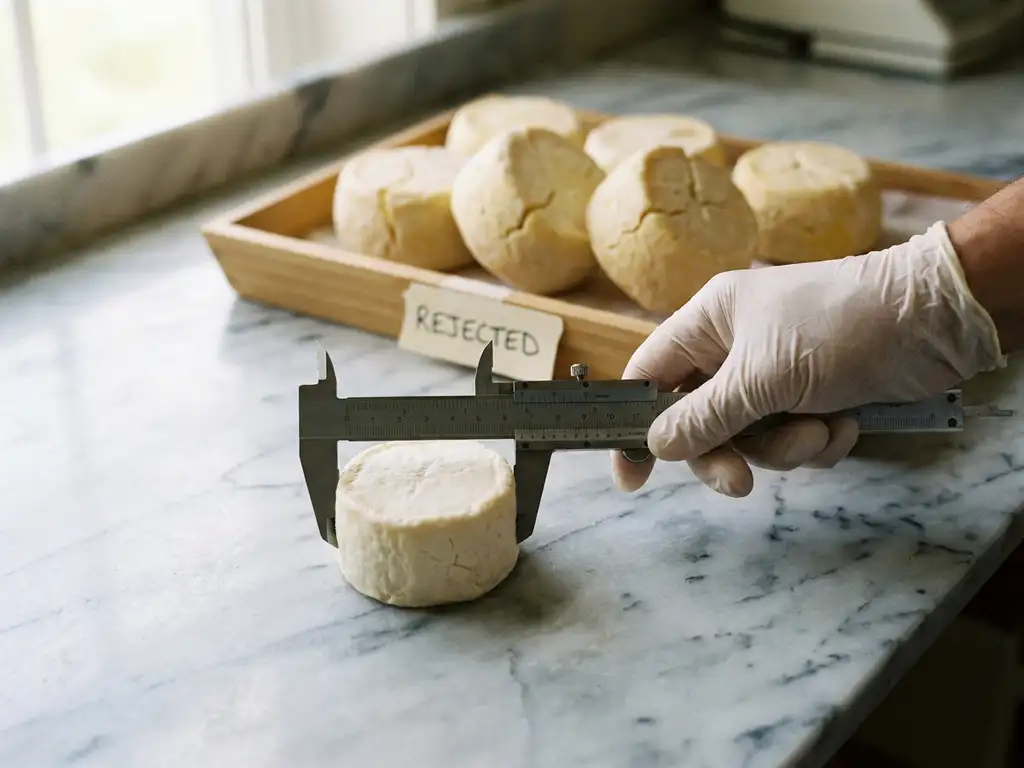
Preventing production failures caused by incorrect cheese specifications starts with one thing: knowing which technical parameters actually affect your production line. Most problems don’t come from bad cheese — they come from a mismatch between what a supplier delivers and what your process requires. In this article, we answer the most common questions about cheese specifications, melting behavior, documentation, and supplier reliability in the food industry.
Which cheese specifications cause the most production problems?
The specifications that most often cause production problems are fat content, moisture content, pH level, and salt content. Small deviations in these parameters can have a big impact on processability, shelf life, and final product quality. Goat cheese is especially sensitive here because its composition can vary significantly by season and production method.
In practice, we see that buyers in the food industry often discover too late that specifications don’t match. A fat content that’s just slightly too low can cause cheese to melt poorly or feel dry in the final product. Moisture content that’s too high leads to shelf life issues and can encourage bacterial growth. The pH level affects texture and how the cheese interacts with other ingredients in a recipe.
The most critical cheese specifications for industrial applications are:
- Fat content (% on dry matter): affects melting behavior, flavor, and texture
- Moisture content (water activity/aw): determines shelf life and processability
- pH level: impacts texture, sliceability, and interaction with other ingredients
- Salt content: relevant for flavor, preservation, and legal labeling requirements
- Protein content: important for binding and structure in composite products
Always ask for a complete product specification sheet before adding a new cheese variety to your production line. One missing value can require costly adjustments down the road.
How does the melting behavior of goat cheese affect your production line?
Goat cheese melts differently from cow’s milk cheese, and that has a direct impact on processing temperatures, dosing, and final product quality. Goat cheese typically melts at lower temperatures and flows differently — which can be either an advantage or a challenge, depending on the application.
For applications like pizza, savory pies, or ready meals, melting behavior is a critical variable. Goat cheese with a higher moisture content melts faster and more evenly, but it can also release more liquid during baking. This can lead to a soggy base or uneven distribution of cheese across the product. Fresh goat cheese behaves differently from aged varieties: fresh cheese holds its shape better when heated, while aged goat cheese becomes more fluid.
Testing melting behavior before production
Before adding a goat cheese to your production line on a structural basis, it’s smart to run a melt test under production conditions. Pay attention to:
- The temperature at which the cheese starts to melt
- The amount of moisture released during heating
- The degree of browning (Maillard reaction)
- How the cheese behaves after cooling
How aging level affects processability
The aging level of goat cheese directly affects how it behaves in heated applications. Young, fresh goat cheese is firmer and holds its shape better when heated. Semi-aged and aged varieties become softer and more fluid. For applications where cheese needs to be visibly present in the final product, a young variety is often the better choice. For applications where cheese needs to be fully incorporated into a sauce or filling, an aged variety offers more flexibility.
What are the minimum technical documentation requirements for cheese purchasing?
For professional cheese purchasing in the food industry, you need at least four documents: a product specification sheet, a food safety certificate (such as IFS or BRC), an allergen declaration, and a delivery specification with tolerances. Without these documents, you risk compliance issues and unexpected quality deviations.
In 2026, food safety and traceability requirements are stricter than ever. European legislation requires you, as a buyer, to demonstrate that your supplier meets current standards. This means you don’t just ask for certificates — you also ask for up-to-date audit reports and a clear description of your supplier’s HACCP system.
A complete technical documentation package for cheese purchasing includes at minimum:
- Product specification sheet with all relevant parameters and tolerances
- Food safety certificate (IFS Food, BRC, or equivalent)
- Allergen declaration including information on possible cross-contamination
- Microbiological standards and testing frequency
- Shelf life information including storage conditions
- Traceability documentation for raw materials
Also ask your supplier for a clear procedure for what happens when a deviation occurs. How quickly will you be informed, and what steps will be taken to prevent it from happening again? A professional supplier will have a clear answer to this.
How do you verify that a cheese supplier delivers consistent quality?
You verify consistent quality from a cheese supplier through a combination of incoming quality checks, periodic audits, and analyzing delivery data over multiple periods. One good delivery proves nothing — a pattern of consistent results over at least six months gives you a reliable picture.
Buyers in the food industry often make the mistake of only doing thorough checks on the first delivery. Quality fluctuations tend to appear over time, as seasonal variations in milk composition affect the cheese. Goat’s milk naturally varies in composition throughout the year, which means a reliable supplier must compensate for this through consistent production processes.
Practical ways to monitor supplier quality:
- Carry out random incoming quality checks on fat content, moisture content, and pH
- Keep a log of deviations per delivery and analyze trends
- Schedule at least one production visit per year at your supplier’s facility
- Request access to the supplier’s internal quality results
- Establish contractually which tolerances apply and what the consequences are if they are exceeded
A supplier who is transparent about their own quality data and communicates proactively when deviations occur is far more reliable than one who only responds when you raise a problem.
When is private label goat cheese the right choice for industrial buyers?
Private label goat cheese is the right choice when you have specific technical requirements that standard products don’t cover, when your order volumes are large enough to justify custom production, or when you want to build your own brand identity around a premium ingredient. It gives you full control over specifications, packaging, and positioning.
For product developers in the food sector, private label goat cheese also makes it possible to create unique flavor combinations that aren’t available off the shelf. Think of goat cheese with specific herbs, a particular aging level, or a custom packaging format that fits your production facility. This kind of custom work requires a supplier who genuinely thinks along with you in developing new concepts.
Private label is less suitable when your volumes are too low for minimum production quantities, or when the product development timeline doesn’t fit your launch date. In that case, an existing quality product with the right specifications is often the faster and more cost-effective choice.
Consider private label goat cheese when:
- Standard products don’t meet your technical specifications
- You want to develop a distinctive product for retail or foodservice
- You can guarantee sufficient volume for an efficient production run
- You want to build a long-term relationship with a supplier that grows alongside your brand
How DeJong Cheese helps prevent production failures
As a family business with years of experience in goat cheese specialties, we understand exactly what challenges buyers and product developers in the food industry face. We don’t just supply cheese — we also provide the technical support needed to prevent production failures.
What we offer industrial buyers:
- Complete technical documentation including product specification sheets, food safety certificates, and allergen declarations
- Consistent quality through controlled production processes and strict quality assurance from our facility in Alphen
- Custom production and private label options for specific technical requirements or your own brand concepts
- Personal contact with a dedicated account manager who knows your production line and requirements
- Flexible delivery to retail, foodservice, and industry worldwide
Whether you’re looking for a reliable supplier of fresh goat cheese with consistent specifications, or a partner who thinks along with you in developing innovative product concepts — we’re ready to find the right solution together. Get in touch with our team and discover what DeJong Cheese can do for your production line.
Frequently Asked Questions
How far in advance do I need to submit cheese specifications to my supplier when switching to a new product?
When switching products, plan for at least 4 to 8 weeks to submit and validate specifications. This gives your supplier time to produce a trial batch, send you the required documentation, and gives you the space to run melt tests and production trials before scaling up. For private label or custom work, this lead time can extend to 3 months, depending on the complexity of the specifications.
What should I do if a delivered batch of cheese falls just outside the agreed specification tolerances but still seems usable?
Never use such a batch without written approval from your internal quality department and a formal deviation report to your supplier. Even small deviations that ‘seem usable’ can affect the shelf life, texture, or food safety of your final product. Document every deviation in your log so you can spot trends and support contractual consequences if the pattern repeats.
How do I handle seasonal fluctuations in goat cheese specifications?
Proactively ask your supplier for a seasonal overview of historical quality data, so you know which periods see the most variation in goat’s milk composition. Adjust your incoming quality checks during those periods by increasing sample sizes and measuring parameters like fat content and moisture content more frequently. A reliable supplier compensates for seasonal fluctuations through consistent production processes and gives you advance notice when expected deviations are coming.
What is the most common mistake buyers make when evaluating a new cheese supplier?
The most common mistake is judging a supplier based on one or two good deliveries and the presence of a certificate, without looking at long-term data and transparency around deviations. Always ask to see internal quality results covering at least six months, and test how the supplier communicates when something goes wrong. A supplier who proactively reports deviations and has a clear corrective action plan is structurally more reliable than one with an impressive certificate but poor communication.
Is it possible to have goat cheese developed with specific melting or texture properties if standard varieties don't meet our needs?
Yes, through a private label or custom collaboration you can have goat cheese produced with specific parameters — such as an adjusted moisture content, aging level, or fat percentage — that directly match your processing requirements. This does require sufficient order volume and a clear technical briefing document with your desired specifications and test criteria. Discuss this early with your supplier so there is room for multiple trial rounds before the final specifications are confirmed.
Which certifications are most relevant for cheese purchasing in the European food industry in 2026?
The most relevant certifications are IFS Food (Higher level or above), BRCGS Food Safety (Grade A or B), and — for organic goat cheese — a recognized organic label such as EU Organic or Demeter. Depending on your target market, additional certifications may be required, such as Halal, Kosher, or a specific retail standard from a major chain buyer. Always check the validity date of certificates and ask for the most recent audit report, not just the certificate itself.
How do I set up an effective incoming quality control protocol for cheese in my production line?
An effective protocol includes at minimum a visual inspection, a sample measurement of fat content, moisture content, and pH per batch, and a temperature log at the time of receipt. Link every inspection result to the lot number for full traceability, and set threshold values that automatically place a batch in quarantine. Review the protocol every six months based on the deviation data you’ve collected, so you can tighten controls on the parameters that vary most in practice.