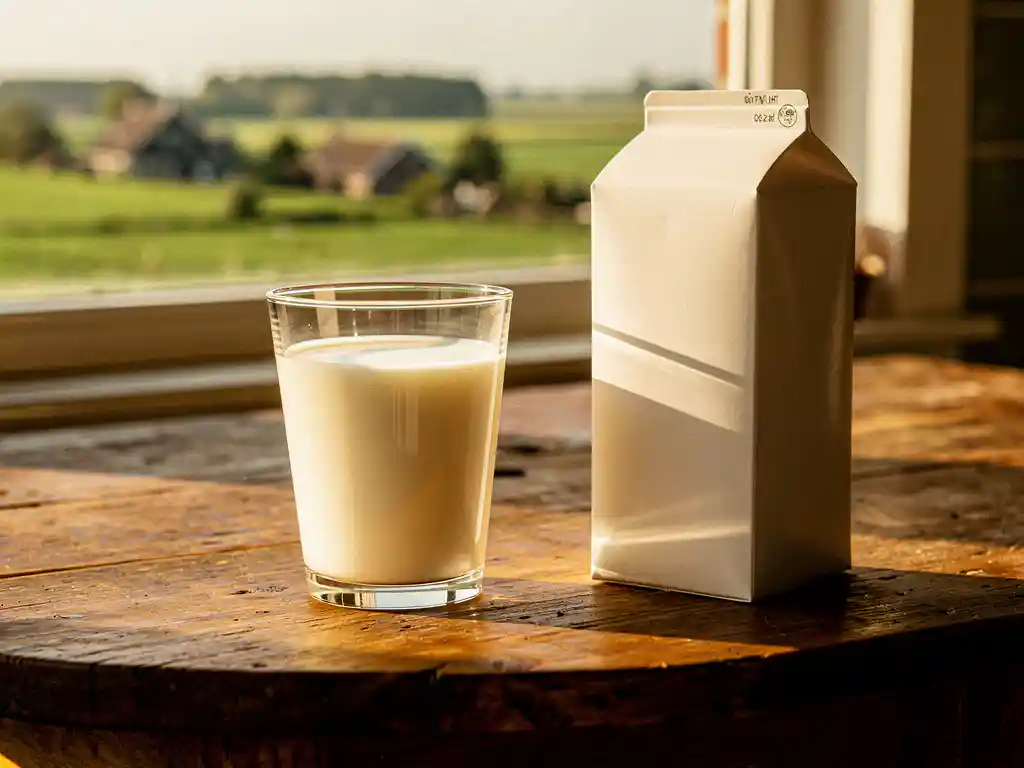
Lactose-free UHT goat milk combines the benefits of goat milk with an extremely long shelf life of 45 weeks. This special milk variant plays an important role in the modern food industry, where consistent quality and long storage periods are essential for efficient production and distribution. For professionals like Marco Visser, who work with industrial food processing, this milk offers unique opportunities for developing lactose-free products with a stable supply chain.
What exactly is lactose-free UHT goat milk?
Lactose-free UHT goat milk is goat milk that has undergone two important processes: lactose removal and ultra-high temperature treatment (UHT). The result is a milk product that is suitable for lactose-intolerant consumers and remains shelf-stable for months without refrigeration.
The lactose-free aspect is achieved by adding the enzyme lactase to the goat milk. This enzyme breaks down lactose into glucose and galactose, two simple sugars that are digestible for people with lactose intolerance. Goat milk naturally contains less lactose than cow milk, making the process more efficient.
The UHT treatment heats the milk for several seconds to 135-150°C, killing all microorganisms while largely preserving nutritional value. This combination of lactose removal and UHT treatment creates a product that is both accessible to a broader target group and practical for industrial applications.
How does the UHT process work for goat milk?
The UHT process for goat milk works by heating the milk very rapidly to 135-150°C for 2-5 seconds, followed by immediate cooling. This brief, intense heating kills all bacteria and spores while maximally preserving flavor and nutrients.
The process begins with preheating the milk to approximately 75°C. The milk is then passed under high pressure through a heating system where steam or superheated water rapidly increases the temperature. The specific protein structure of goat milk makes it particularly suitable for this process, as the smaller fat globules and different casein composition are more resistant to temperature shock.
After heating, the milk is immediately cooled to room temperature in a sterile environment. The entire process takes place in a closed system to prevent recontamination. The milk is then aseptically packaged in sterile multi-layer packaging that keeps out light, air, and bacteria.
Why does lactose-free goat milk last longer than regular milk?
Lactose-free UHT goat milk lasts longer than regular milk because all microorganisms are killed during the UHT process and aseptic packaging prevents recontamination. Regular pasteurized milk still contains living bacteria that can multiply, while UHT milk is completely sterile.
The absence of lactose also contributes to stability. Lactose in regular milk can ferment due to lactic acid bacteria, leading to acidification and spoilage. Without lactose, this major cause of spoilage is eliminated. The glucose and galactose produced after lactose splitting are chemically more stable in the UHT environment.
Additionally, the specific composition of goat milk provides extra stability. The smaller fat globules and different protein structure make goat milk less susceptible to oxidation and enzymatic breakdown. These natural properties, combined with UHT treatment and lactose removal, result in a product that remains stable for months at room temperature.
What factors determine the 45-week shelf life?
The 45-week shelf life is determined by four main factors: the effectiveness of the UHT process, the quality of aseptic packaging, the absence of lactose, and storage conditions. These factors work together to ensure microbiological, chemical, and physical stability.
Packaging plays a crucial role in maintaining long shelf life. Modern UHT packaging consists of multiple layers:
- An inner layer of polyethylene in direct contact with the milk
- Aluminum foil that keeps out light and oxygen
- Cardboard layers for strength and protection
- Outer layers that repel moisture
Storage temperature is equally essential. Although UHT milk can be stored at room temperature, storage below 20°C significantly extends shelf life. Temperature fluctuations should be avoided as they can cause condensation in the packaging. The lactose-free composition prevents enzymatic reactions that would otherwise affect flavor and texture during the long storage period.
How does UHT goat milk maintain its quality for 45 weeks?
UHT goat milk maintains its quality through the combination of sterile conditions, protective packaging, and stable chemical composition after lactose removal. The absence of living microorganisms and enzymes prevents active degradation processes that would normally reduce quality.
The natural properties of goat milk contribute to quality preservation. The higher content of medium-chain fatty acids in goat milk is chemically more stable than the longer fatty acids in cow milk. These fatty acids are less susceptible to oxidation, preventing rancidity. The homogeneous structure of goat milk, with its smaller fat globules, also prevents creaming during the long storage period.
During the storage period, some minimal changes may occur:
- Slight discoloration due to Maillard reactions between proteins and residual sugars
- Minimal sediment formation due to protein aggregation
- Subtle flavor changes due to fat oxidation
These changes remain within acceptable limits during the 45-week shelf life, provided the milk is stored correctly. The lactose-free composition minimizes many of these reactions because lactose normally plays an important role in Maillard reactions.
What are the benefits of 45-week shelf life for the food industry?
For the food industry, 45-week shelf life offers crucial advantages: predictable inventory planning, reduced waste, flexible production cycles, and cost-effective storage without refrigeration. This long shelf life makes it possible to handle seasonal fluctuations and consistently meet demand.
The practical benefits for industrial processors are significant. Buyers like Marco Visser can order large volumes without worrying about spoilage, leading to better price negotiations and lower transportation costs. Inventory predictability eliminates production interruptions due to unexpected shortages. Companies can build strategic inventories for peak periods without investing in refrigerated storage.
The lactose-free property opens new market segments. Producers can develop lactose-free variants of their products with the same shelf life as regular products. This is especially valuable for:
- Ready meals with long shelf life
- Bakery products for lactose-intolerant consumers
- Export products to markets with limited cooling infrastructure
- Emergency supplies and catering applications
How DeJong Cheese helps with lactose-free milk solutions
As specialists in goat milk products since 1995, we at DeJong Cheese understand the complex needs of the food industry. Our expertise in goat milk processing enables us to provide advice on lactose-free milk applications for industrial processing, in addition to our cheese specialties.
For professionals like Marco Visser, we offer:
- Technical support for product development with goat milk products
- Consistent quality and reliable deliveries according to industrial standards
- Flexible packaging options adapted to production processes
- Certifications including IFS Food and DGZK for complete traceability
While our focus is on fresh goat cheese, aged goat cheese and specialties like goat cheese slices and spreadable goat cheese, we gladly share our knowledge about the broader goat milk sector. Discover more about our products for foodservice and industry or contact us for specific advice on your lactose-free product development. Also visit our homepage for the complete overview of our goat cheese specialties or find us through our sales points.
Frequently Asked Questions
How can I best implement lactose-free UHT goat milk in my production process?
Start with small test batches to evaluate processing properties in your specific recipes. Lactose-free UHT goat milk behaves slightly differently than regular milk due to the split sugars and may have a slightly sweeter taste. Gradually adjust your recipes and test the stability of the final product throughout the full shelf life period.
What quality controls should I perform when receiving large volumes of UHT goat milk?
Always check packaging integrity, especially at seal edges and corners where leakage may occur. Perform random sensory tests (odor, taste, color) and measure pH value which should remain stable around 6.5-6.7. Document batch numbers for traceability and store samples for possible later comparison in case of quality issues.
What are common mistakes when working with lactose-free UHT goat milk in industrial applications?
The most common mistakes are exceeding storage temperatures above 25°C, mixing opened packages with different production dates, and not adjusting recipes for the sweeter taste. Also avoid direct sunlight exposure during storage and use opened packages within 3-5 days for optimal quality.
How does the lactose-free composition affect functional properties in my final product?
The glucose and galactose from split lactose can enhance browning reactions during heating, which is especially noticeable in baked products. Viscosity may differ slightly and crystallization properties in sweet applications may change. Therefore, always test the shelf life and texture stability of your final product over the complete storage period.
Can I combine lactose-free UHT goat milk with other milk types in my products?
Yes, but consider differences in protein structure and fat composition between goat milk and cow milk. When mixing, emulsion problems may occur, especially in products that are stored for long periods. Always test the stability of mixed products and consider using emulsifiers to prevent phase separation.
What certifications are essential when purchasing lactose-free UHT goat milk for export?
Besides standard food safety certificates like IFS or BRC, specifically request lactose-free certification (<0.1% lactose) and halal/kosher certificates for international markets. For export outside the EU, additional health certificates may be required. Ensure your supplier can provide this documentation timely and keep it up-to-date.
How can I optimize total costs when working with 45-week shelf-stable goat milk?
Maximize cost benefits by concluding annual contracts with fixed price agreements and ordering larger volumes per delivery. Invest in adequate storage space at controlled temperature below 20°C to utilize the full shelf life. Calculate savings on cooling costs and reduced waste in your total cost calculation to determine the actual value.
Related Articles
- How do you shorten the selection process when searching for a new cheese supplier?
- How do you ensure a good backup supplier for wrongel in your production chain?
- How to optimize goat cheese packaging for storage efficiency?
- Goat cheese vs cream cheese in cheesecake?
- What vegetables pair well with goat cheese?