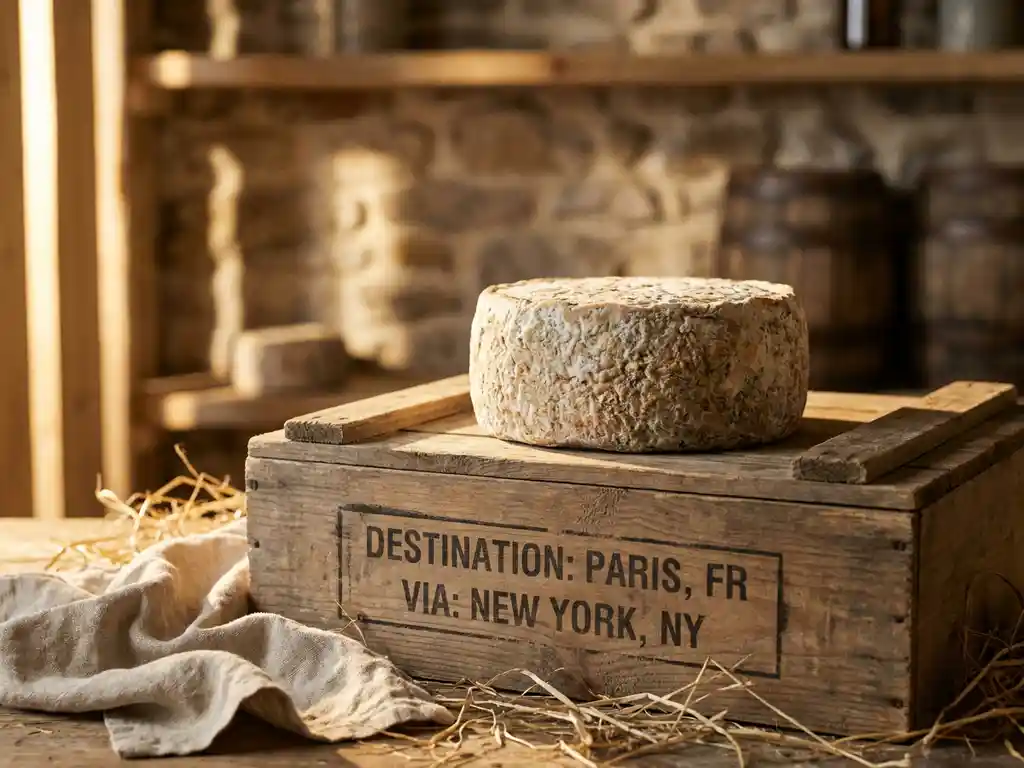
Export figures tell you a lot about how reliable a cheese producer really is. They show whether a producer can deliver consistently, at scale, and according to international quality standards. The more markets a producer serves, the more likely they have solid procedures in place for quality control, logistics, and compliance. In this article, we answer the most common questions about how to use export data when evaluating a cheese producer as a potential supplier.
What do export figures say about the reliability of a cheese producer?
Export figures are a direct indicator of how reliably a cheese producer operates. A producer who consistently exports to multiple countries has proven they can meet a wide range of quality requirements, handle logistical challenges, and deliver volumes on time. Export data reflects not just size, but also how mature and well-developed a producer’s operations truly are.
For a buyer like Marco, who needs consistent quality and reliable delivery for his production line, export figures are one of the most objective signals available. A producer who has been supplying retail and foodservice in multiple countries for years has tested their quality control, documentation, and supply chain systems in the real world. That is fundamentally different from a producer who mainly operates locally.
That said, export figures alone don’t tell the whole story. They need to be read alongside the types of markets served, the product categories being exported, and how consistent that export activity has been over time. A one-time export spike means less than a steady, growing export pattern over several years.
Which export markets are most meaningful for quality assessment?
The most meaningful export markets for evaluating a cheese producer are countries with strict import requirements — such as the United States, Japan, Canada, and EU member states. Accessing these markets requires proven compliance with rigorous food safety standards, traceability requirements, and official approvals. Exporting to these markets is, in itself, a mark of quality.
Markets like the US and Japan have their own import protocols that require producers to thoroughly document their processes and submit to audits. A cheese producer who regularly supplies these markets has already had their quality management system reviewed by external parties. For a product developer like Laura, who works with premium ingredients for innovative concepts, that is a meaningful guarantee that the raw materials meet the highest standards.
Exporting to less regulated markets is less telling from a quality standpoint, but it can still give you useful information about logistical capacity and the ability to manage complex distribution chains. So don’t just look at which countries a producer exports to — also consider how long and how consistently they have been supplying those markets.
How do export volume and production capacity relate to each other?
Export volume and production capacity need to be in balance for a supplier to be truly reliable. High export volume with limited production capacity increases the risk of delivery delays, quality inconsistencies, and prioritization issues. On the other hand, a producer with ample capacity and a diversified export volume offers greater assurance of stable delivery — even during sudden demand peaks.
When evaluating a cheese producer as a supplier, it’s essential to understand how their total capacity is divided across different customers and markets. If a large portion of capacity is already committed to existing customers, a new client has less certainty about availability. So ask directly about the balance between fixed contracts and available production capacity.
Another thing to look at is production flexibility. Can the producer scale up quickly when demand increases, or are their lines already running at full capacity? This is especially relevant for buyers who deal with seasonal demand peaks or rapidly changing volumes.
What is the difference between export experience and export certification?
Export experience refers to the practical knowledge and track record a producer has built by actually exporting to international markets. Export certification is a formal recognition, issued by a competent authority, that proves a producer meets specific standards for a particular market or application. Both are valuable, but they measure different things.
What export experience shows
Export experience shows that a producer has proven in practice that they can process international orders, provide correct documentation, and solve logistical challenges. This is hard to fake — it’s the result of years of operational routine. A producer with ten consecutive years of exporting to multiple continents has proven their processes in a way that no certificate can replace.
What export certification shows
An export certification — such as USDA approval for the American market or an EU export license — proves that a producer met the formal requirements of that market at a specific point in time. Certifications are objectively verifiable and give a buyer legal assurance. However, they are a snapshot and say nothing about day-to-day execution. That’s why you should always look for both: producers with proven experience and current certifications.
What questions should you ask a cheese producer about their export history?
Asking the right questions about export history helps you quickly tell the difference between producers who are truly international and those who treat exporting as a side activity. Ask targeted questions about continuity, market spread, documentation, and customer relationships to get a complete picture of a cheese producer’s export maturity.
Specific questions to ask:
- Which countries do you export to consistently, and for how long?
- What percentage of your total revenue comes from exports?
- What export certifications do you hold, and when were they last renewed?
- Can you provide references from international customers in foodservice or retail?
- How do you handle supply chain disruptions that affect your exports?
- What are the minimum and maximum volumes you can deliver per order?
- How do you ensure consistent quality on large or recurring export orders?
The answers to these questions reveal not just the facts, but also how a producer thinks about their own business. A supplier who answers these questions smoothly and concretely has clearly internalized their export processes. Hesitation or vague answers are a signal to dig deeper — or to consider alternative suppliers.
How we at DeJong Cheese provide transparency about our export experience
At DeJong Cheese, we have been exporting our Alphenaer goat cheese specialties to retail, foodservice, and industry customers worldwide for many years. This isn’t a side activity — it’s a core part of our business. We understand what buyers like Marco need: clear specifications, consistent quality, and reliable delivery at volume. And we understand what product developers like Laura are looking for: a partner who thinks along with them and is flexible when it comes to custom solutions.
What we offer:
- Proven export experience across multiple international markets, built since 1995
- Up-to-date documentation and certifications for relevant export markets
- Consistent production processes that minimize quality variation
- Flexible volumes, both for retail partners and foodservice customers
- Personal contact and transparent communication about lead times and capacity
- Private label options alongside our own Alphenaer brand
Want to know if we’re the right export partner for your specific needs? Get in touch with us and we’ll be happy to discuss what we can do for you.
Frequently Asked Questions
How can I verify a cheese producer's export data myself before reaching out?
You can verify export data through public sources such as chambers of commerce, industry associations like the NZO (Dutch Dairy Organisation), and international trade databases such as Panjiva or ImportGenius. You should also ask the producer directly for verifiable documentation, such as certificates, customs export documents, or references from international customers. Combining independent sources with information directly from the producer gives you the most reliable picture.
What are common mistakes when evaluating a cheese producer based on export figures?
A common mistake is placing too much weight on absolute export volumes without looking at continuity and market spread. A single large export order tells you much less than a consistent export pattern over several years across diverse markets. Another pitfall is confusing export capacity with available production capacity: a producer may export a lot, but if their lines are fully booked, they can offer you little assurance of delivery capacity as a new customer.
How do I know if a cheese producer will remain a reliable export partner in the long term?
Look at the stability of their export pattern over at least five years: is it growing steadily, or are there large fluctuations? Also ask about customer retention — producers with long-term relationships with international buyers show they can maintain lasting partnerships. In addition, investments in production capacity, quality systems, and certifications are a good indicator of the ambition and ability to keep performing over the long term.
Does it matter whether a cheese producer exports through an intermediary or delivers directly to buyers?
Yes, it makes a significant difference. Direct export to international customers indicates a higher level of operational maturity: the producer manages their own documentation, compliance, and customer relationships. Exporting through an intermediary or trading house can make export figures look larger on paper, but says less about the producer’s own export capabilities. Always ask explicitly whether the export experience was built directly or through third parties.
Which certifications are specifically important if I want to source cheese for the American or Asian market?
For the American market, USDA approval is essential, along with FDA registration and compliance with Foreign Supplier Verification Program (FSVP) requirements. For Japan and other Asian markets, specific import protocols apply around veterinary inspections and traceability documentation, which vary by country. Always check that certifications are current and ask for the date of the last renewal or audit — expired certifications are a direct risk to your supply chain.
As a buyer, how do I handle a cheese producer with limited export experience who otherwise meets my requirements?
In that case, start with smaller trial orders to test operational reliability in practice, rather than immediately purchasing large volumes. Set clear KPIs for quality, lead times, and documentation, and evaluate after each order. Also consider scheduling an on-site audit to assess the production environment and quality systems yourself — limited export experience doesn’t have to be a dealbreaker, but it does call for extra due diligence on your part.
What is a realistic timeline for qualifying a new cheese producer as a regular export supplier?
A thorough qualification process takes an average of three to six months, depending on the complexity of your sourcing requirements and the markets you are buying for. This includes requesting and reviewing documentation, conducting a trial order, processing feedback, and formalizing contractual agreements on volumes, quality standards, and lead times. Take this time seriously: a well-qualified supplier prevents costly disruptions in your supply chain down the line.