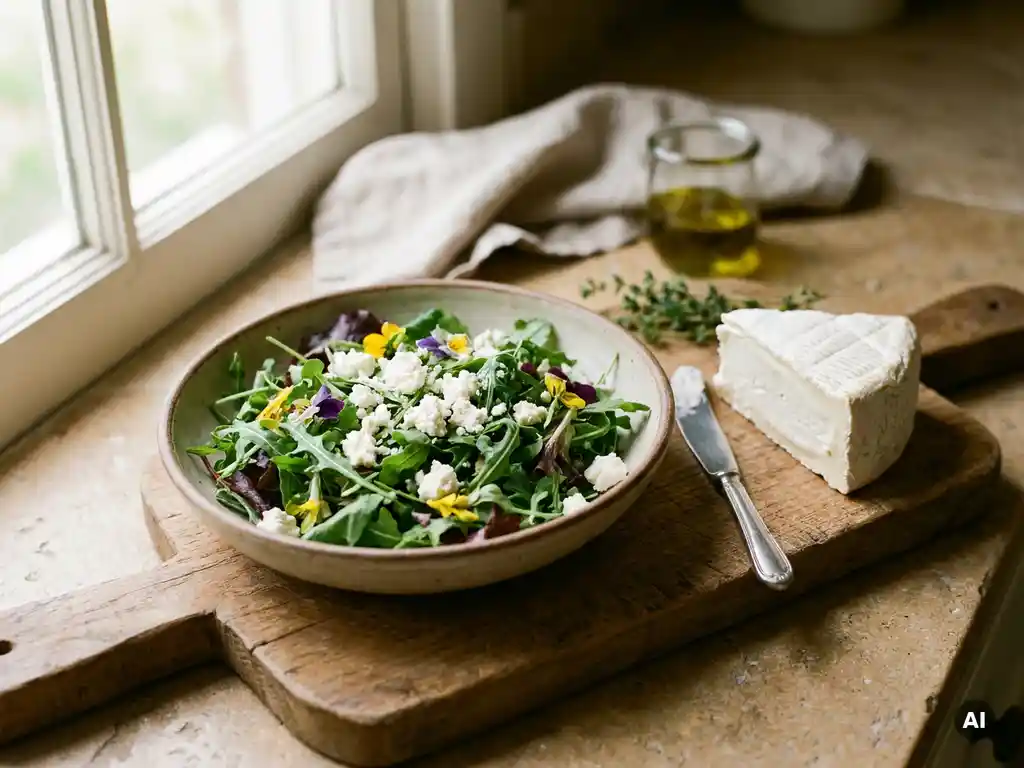
Fresh goat cheese is available for immediate delivery for salad production in formats such as crumbled cheese, cubes, slices, and small rounds. As a specialist in soft goat cheese specialties, we supply foodservice and industry with flexible ordering options and short lead times. In this article, we answer the most frequently asked questions about goat cheese for salad production, from formats and shelf life to private label and flavor customization.
Which formats and textures work best for salads?
For salad production, crumbled goat cheese, small rounds, and cubes are the most commonly used formats. Crumbled soft goat cheese distributes evenly across a salad and offers a creamy texture that pairs well with leafy greens and dressings. Rounds and cubes are ideal when the cheese needs to remain visually recognizable in the final product.
The choice of format depends heavily on the type of salad and the production method. In automated salad lines, crumbled goat cheese is preferred because it is easy to portion. For more artisanal or premium salads, rounds provide an attractive presentation. Soft goat cheese has a naturally fresh, slightly tangy flavor that pairs well with sweet ingredients such as beets, walnuts, or honey.
- Crumbled: easy to portion, even distribution, suitable for automated production
- Rounds: visually appealing, recognizable cheese moment, ideal for premium salads
- Cubes: firm texture, holds up well during mixing, versatile in use
- Slices: suitable for warm salads or gratin applications
What is the minimum order quantity for direct delivery?
The minimum order quantity for direct delivery of goat cheese for salad production varies by supplier and product type. With specialized goat cheese producers, the minimum order size is typically between 50 and 200 kilograms per order, depending on the chosen format and packaging type.
For product developers testing new recipes, it is advisable to ask a supplier about smaller trial deliveries or sample batches. This allows you to evaluate the cheese on flavor, texture, and processability before placing a larger order. Direct delivery is in most cases possible within two to five business days, depending on the desired volume and logistics arrangements.
We offer flexible delivery options through our foodservice solutions that align with the production planning of food manufacturers and caterers.
Which types of goat cheese are available as private label?
Private label goat cheese available for salad production typically includes fresh soft goat cheese, goat cheese logs, crumbled varieties, and lightly aged goat cheese. Private label gives producers the opportunity to carry their own brand on a high-quality product without having to set up their own production facility.
In a private label partnership, the following aspects are typically customizable:
- Packaging design: own brand name, logo, and labeling
- Weight and portioning: tailored to the desired packaging unit
- Recipe: adjustment of fat content, salt content, or herbs
- Packaging format: consumer packaging or bulk packaging for industrial use
Private label goat cheese is attractive for retailers, salad companies, and foodservice partners who want to stand out with their own product line. Through our retail solutions, we offer custom solutions for both small and large buyers.
What is the shelf life of fresh goat cheese in salad production?
The shelf life of fresh goat cheese in salad production is typically 21 to 45 days from the production date, provided the cheese is stored refrigerated between 2 and 7 degrees Celsius. The exact expiration date depends on the fat content, packaging method, and the presence of preservatives or a protective atmosphere.
For salad producers, shelf life is a critical factor, because the cheese must still have sufficient remaining shelf life after being processed into a salad for distribution and retail. Fresh goat cheese in a modified atmosphere (MAP packaging) has a longer shelf life than cheese in regular foil. When goat cheese is processed into a salad, the shortest expiration date of all ingredients typically determines the expiration date of the final product.
Practical considerations for salad production:
- Check the remaining shelf life upon receipt of the cheese
- Store goat cheese separately from strongly scented ingredients
- Add the cheese as late as possible in the production process to minimize quality loss
- Discuss with your supplier which packaging type offers the longest shelf life
Can goat cheese be customized with truffle or other premium ingredients?
Yes, goat cheese can be customized with premium ingredients such as truffle, red onion, fresh herbs, honey, rosemary, or sun-dried tomatoes. These flavor combinations align with the growing demand for premium and artisanal salad ingredients in foodservice and retail. The soft, creamy base structure of goat cheese makes it an excellent carrier for more intense flavors.
Truffle goat cheese is one of the most requested premium varieties in 2026, both for salads and for charcuterie boards and foodservice applications. The earthy, intense flavor of truffle pairs exceptionally well with the fresh, tangy note of fresh goat cheese. Other popular flavor combinations include:
- Goat cheese with red onion and thyme: savory and aromatic, suitable for warm and cold salads
- Goat cheese with honey and walnut: sweet-savory balance, appealing for premium salads
- Goat cheese with basil and sun-dried tomato: Mediterranean profile, broadly applicable
- Goat cheese with chives and lemon: fresh and light, ideal for summer salad lines
When developing a flavored goat cheese for industrial use, it is important to pay attention to the distribution of the ingredient throughout the cheese, the impact on shelf life, and clean-label possibilities. Suppliers who actively participate in product development can play a valuable role in this process.
How DeJong Cheese helps with goat cheese for salad production
As a family business with years of expertise in fresh and soft goat cheese specialties, we actively think along with you in your product development. Whether you are looking for a standard ready-to-deliver goat cheese for salad production or a fully customized private label variety with truffle or other premium ingredients, we offer the flexibility and expertise you need as a product developer.
What we offer:
- Direct delivery of fresh goat cheese in multiple formats and textures for salad production
- Private label options with customizable recipes, packaging, and portioning
- Flavor customization with premium ingredients such as truffle, herbs, and spices
- Technical support for product development and clean-label questions
- Flexible ordering tailored to your needs, from trial batches to structural deliveries
Want to know what we can do for your salad concept? Contact us and discover how DeJong Cheese takes your product development to the next level.
Frequently Asked Questions
What is the best way to store fresh goat cheese during the production process to prevent quality loss?
Always store fresh goat cheese refrigerated between 2 and 7 degrees Celsius and keep the cheese separate from strongly scented ingredients such as onion or garlic, as goat cheese easily absorbs odors. Add the cheese as late as possible in the production step to optimally preserve its quality and texture. Preferably use MAP packaging (modified atmosphere) for the longest shelf life, and check the remaining expiration date immediately upon each delivery.
What are the most common mistakes when processing goat cheese in automated salad lines?
A common mistake is adding goat cheese too early in the mixing process, causing the cheese to become too fine and lose its texture — especially with soft, creamy varieties. Crumbled goat cheese is the most suitable for automated lines, but even then a light dosing pressure is recommended to minimize crumbling. Always calibrate the dosing equipment to the specific format and texture of the goat cheese you are using, and ask your supplier for technical specifications that support processing.
Is goat cheese suitable for clean-label salad recipes, and what should I look out for?
Yes, fresh goat cheese is naturally very suitable for clean-label recipes, as the product in its base form contains few to no additives. When purchasing, make sure the goat cheese is free from artificial preservatives, colorings, and flavor enhancers, and ask your supplier for a complete ingredient overview. When using flavored varieties — such as goat cheese with truffle or herbs — check whether the added ingredients also meet the clean-label criteria of your brand or retailer.
How long does it typically take to develop and launch a private label goat cheese?
The lead time for a private label goat cheese typically ranges from four to twelve weeks, depending on the complexity of the recipe, the packaging design, and the required approvals. A simple variety with a standard recipe and customized labeling can be realized more quickly than a completely new flavor combination with specific portioning. Always schedule a trial delivery before the final production start, so you can evaluate the cheese on flavor, texture, and processability in your own salad lines.
Can I also use goat cheese for warm salad concepts or gratin applications?
Absolutely — goat cheese is excellent for warm applications such as gratin salads, warm vegetable dishes, or oven-prepared meals. Slices and rounds are the most suitable formats for this, as they hold their shape better when heated than crumbled varieties. Keep in mind that goat cheese melts quickly at high temperatures and forms a light golden-brown crust, which creates an attractive visual effect in premium salad concepts.
What are the advantages of working with a specialized goat cheese producer compared to a general dairy supplier?
A specialized goat cheese producer offers in-depth product knowledge, more flexibility in recipe development, and a wider range of formats, textures, and flavor combinations specifically tailored to applications such as salad production. General dairy suppliers often carry goat cheese as a secondary product in their range, which limits customization and technical support. With a specialist, you can also count on shorter communication lines, faster adjustments, and expertise in niche segments such as truffle goat cheese or clean-label varieties.
How can I as a small salad producer or start-up begin purchasing goat cheese when my volumes are still limited?
Many specialized goat cheese producers offer the option to start with smaller trial batches or sample orders, so you can test the cheese without immediately committing to large volumes. Openly discuss your current and expected volumes with the supplier, so that flexible arrangements can be made that grow along with your production. A good supplier actively thinks along with you during the start-up phase and provides technical support for product development, even if you are not yet a large buyer.
Related Articles
- What are the possibilities of shredded goat cheese for new product concepts?
- How do you position goat cheese as a premium ingredient compared to cow's milk cheese?
- How do you establish volume guarantees when purchasing goat cheese crumbles at pallet scale?
- Why is goat cheese valuable for private label innovation?
- What are shelf-ready packaging options for goat cheese?