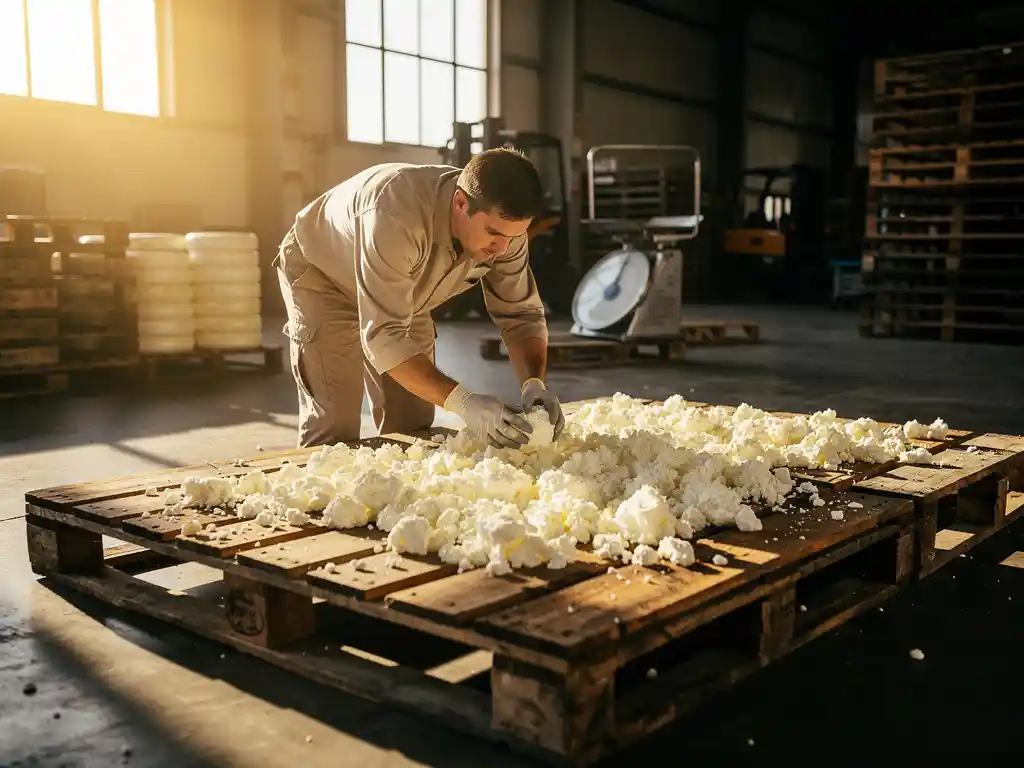
As a buyer in the food industry, you know the challenges of working with large volumes of cheese products. Goat cheese crumbles are popular for pizza toppings, salads and ready-made meals, but ensuring reliable deliveries on a pallet scale requires well-thought-out agreements. This article covers the key aspects of volume guarantees when purchasing goat cheese crumbles, from contract types to negotiation tactics.
What are volume guarantees when purchasing goat cheese crumbles?
Volume guarantees are contractual agreements where a cheese producer commits to delivering an agreed quantity of goat cheese crumbles over a specific period under predetermined conditions. These guarantees include minimum and maximum delivery volumes, fixed price agreements and specific quality parameters for industrial processing.
For goat cheese crumbles, these involve pre-packaged products in bulk packaging of typically 5 to 15 kilograms per unit, suitable for direct processing in production lines. The guarantees usually cover periods of 6 to 24 months and specify exact numbers of pallets per delivery. For industrial buyers, this means certainty about availability, with suppliers committing to, for example, 48 pallets per month with each containing 60 boxes of 15 kilograms of product.
The agreements also contain provisions about quality consistency, such as a fat content between 35% and 45%, a specific grain size of the crumbles, and technical properties like melting behavior. Important elements also include delivery frequency, stock building during seasonal peaks, and agreements about what happens when guaranteed volumes are under- or over-purchased.
Why are volume guarantees important for industrial cheese processors?
Volume guarantees are crucial for industrial processors because they provide certainty about delivery continuity, price stability and consistent product quality. These guarantees prevent production downtime due to shortages and protect against sudden price increases in the volatile dairy market.
For companies that produce pizzas or ready-made meals, an interruption in cheese delivery can have disastrous consequences. A production stop of just a few hours can quickly cost tens of thousands of euros in lost revenue and disrupted planning. Volume guarantees eliminate this risk by contractually binding the supplier to agreed deliveries, regardless of market conditions.
The financial benefits are significant. With fixed price agreements, processors can accurately calculate their cost prices and protect margins. This is especially important with long-term contracts with retailers, where price changes are difficult to implement. Moreover, volume guarantees often lead to economies of scale: the larger the guaranteed volume, the sharper the price per kilogram.
Quality consistency is another important aspect. Industrial processes are tuned to specific product characteristics. Variations in fat content, moisture or grain size can lead to production problems, quality deviations and complaints. Volume guarantees force suppliers to invest in stable production processes and quality control.
What contract types exist for volume guarantees for goat cheese?
The most common contract types for volume guarantees are take-or-pay contracts, minimum-maximum contracts, framework agreements with call-off orders, and exclusivity contracts. Each type has specific advantages and disadvantages depending on the business situation and market expectations.
Take-or-pay contracts oblige the buyer to purchase or pay for a minimum volume, regardless of actual need. This form offers suppliers maximum certainty and often results in the sharpest prices. For processors with stable production and good sales markets, this is interesting. The risk lies in demand shortfall: even with disappointing sales, the volume must be purchased.
Minimum-maximum contracts offer more flexibility by defining a bandwidth. The buyer guarantees a minimum of, for example, 30 pallets per month, with the right to a maximum of 50 pallets under the same conditions. This balances certainty for the supplier with flexibility for the buyer. Prices are usually slightly higher than with take-or-pay.
Framework agreements with call-off orders work with predetermined conditions without hard volume commitments. The buyer calls off volumes as needed, while the supplier commits to delivery within agreed timeframes. This offers maximum flexibility but less price advantage.
Exclusivity contracts link volume guarantees to exclusive delivery rights for specific products or markets. The processor buys all goat cheese crumbles from one supplier in exchange for guaranteed volumes and often attractive prices. This strengthens the negotiating position but also creates dependency.
How do you calculate the right volumes for pallet purchasing of cheese crumbles?
The right volume calculation starts with analysis of historical consumption, seasonal patterns and growth expectations, calculating with standard pallet units of 60 boxes of 15 kilograms each. Consider: production peaks, shelf life of 4 weeks fresh or 2 years frozen, and storage capacity.
Start by determining your basic consumption by analyzing the past 12 months. Count all goat cheese crumbles you have purchased and processed, including waste and samples. Divide this by 52 weeks for the weekly average. A typical pizza producer uses, for example, 8 pallets per week, or 7,200 kilograms of goat cheese crumbles.
Seasonal influences are crucial for accurate planning. Many processors see peaks around holidays and summer months. Analyze monthly deviations from the average. December can be 40% above normal, while January is 20% lower. Build these variations into your volume guarantees by agreeing on flexibility bandwidths.
Growth scenarios require careful estimation. For new product launches or market expansion, start conservatively and build in escalation clauses. For example: year 1 guarantees 30 pallets per month, with automatic increase to 40 pallets in year 2 upon successful market introduction. Avoid overcommitment by using realistic growth percentages.
Practical factors often determine the minimum order size. Full trucks (33 pallets) or containers (20-24 pallets) offer logistical advantages. Storage capacity limits maximum deliveries: with 100 pallet spaces and weekly consumption of 8 pallets, a bi-weekly delivery of 16 pallets is optimal. Shelf life dictates rotation tempo: fresh crumbles require weekly delivery, frozen product allows longer cycles.
What legal aspects play a role in volume guarantee contracts?
Legal aspects include delivery terms, liability clauses, force majeure provisions, quality guarantees and dispute resolution. These elements protect both parties against unforeseen circumstances and define rights and obligations in case of contract breach or quality problems.
Delivery terms specify exact delivery locations, times and responsibilities. Incoterms like DDP (Delivered Duty Paid) or FCA (Free Carrier) determine who bears transport risks and where ownership transfer takes place. For pallet deliveries, return logistics of empty pallets is also a consideration. Delay clauses define penalties for late delivery, for example 0.5% discount per day of delay.
Liability must be clearly limited. Suppliers typically limit liability to invoice value, but with production downtime, damages can be much higher. Negotiate realistic liability limits and insurance requirements. Product recall scenarios require specific agreements about cost allocation and communication protocols.
Force majeure clauses are essential given recent supply chain disruptions. Define what does and doesn’t qualify as force majeure. Natural disasters and pandemics are common, but raw material shortages or strikes are discussion points. Build in escalation mechanisms: when shortages threaten, the supplier must warn within 48 hours and offer alternatives.
Quality guarantees go beyond specifications on paper. Contract rights to audits, sampling and rejection procedures. When deviations occur, it must be clear who bears costs for replacement, processing or destruction. Certification requirements like IFS Food or specific allergen controls should be contractually established. Changes in recipe or production process require prior approval.
How do you effectively negotiate volume guarantees with cheese producers?
Effective negotiation starts with thorough preparation: know your consumption data, market prices and alternatives. Build negotiations around mutual benefit, focus on long-term partnership and be transparent about expectations and limitations.
Market knowledge is your strongest weapon. Analyze current milk prices, seasonal trends and competing offers. Goat milk prices fluctuate less than cow milk but do have seasonal patterns. Spring often offers better prices due to higher milk production. Benchmark prices with at least three suppliers for realistic comparison.
Create leverage by making alternatives visible. Invite multiple suppliers for quotes and show that you’re comparing options. Combine volumes across product categories: negotiate goat cheese crumbles together with other cheese products for better overall conditions. Long-term commitment (24+ months) significantly strengthens the negotiating position.
Win-win thinking opens doors. Understand the challenges of cheese producers: seasonal milk supply, capacity limitations, cash flow needs. Offer solutions like advance payment, flexible delivery dates or purchase of less common products. Invest in relationship building through factory visits and regular management consultation.
Negotiation tactics require patience and strategy. Start with volume discussion before price negotiation. Larger volumes justify sharper prices. Ask for transparency in price structure: milk price, processing costs, margin. This facilitates discussion about price adjustment mechanisms when milk prices change. Close compromises on secondary conditions like payment terms or packaging requirements to achieve primary goals.
How De Jong Cheese helps with volume guarantees for goat cheese crumbles
As a traditional family business since 1995, we understand the challenges of industrial processors seeking certainty about their cheese delivery. Our specialization in goat cheese products, combined with flexible production capacity and a proven track record in volume deliveries, makes us the ideal partner for your volume guarantees.
Our volume guarantee solutions include:
- Flexible contract types: From take-or-pay to framework agreements, we think along about the best solution for your situation
- Guaranteed quality: IFS Food-certified production with consistent specifications (35-45% dry matter)
- Scalable volumes: Deliveries from 48 to 600 pallets per month, tailored to your needs
- Technical support: Advice on melting behavior, freeze stability and processing properties
- Private label possibilities: Develop your own goat cheese crumbles with our expertise
Our cow and goat cream cheese/curd is specially developed for industrial processing. This product is firmer and freeze-stable, perfect for large-scale production. With a shelf life of 4 weeks fresh or 2 years frozen, we offer the flexibility that modern food production requires.
Contact us for a no-obligation conversation about your volume needs. Our experienced account managers will analyze the optimal volume guarantee structure together with you. Visit our product page for foodservice for more information about our complete range, or schedule an appointment directly via our contact page. For inspiration and application possibilities, also check our sales points where our products are available. Discover more about our family business and our passion for goat cheese on our homepage.
Frequently Asked Questions
How can I best handle seasonal demand fluctuations within my volume guarantee contract?
Negotiate flexibility bandwidths of 20-30% above and below the base volume, allowing quarterly adjustments. Build in seasonal clauses that allow higher volumes during peak periods like December, and communicate expected fluctuations at least 6 weeks in advance to your supplier. Also consider strategic stock building in quiet months to handle peaks without contract breach.
What are the main pitfalls when drafting volume guarantee contracts for goat cheese crumbles?
The biggest pitfalls are overly optimistic volume forecasts without growth buffer, ignoring shelf life dates with order sizes, and unclear quality specifications that lead to disputes. Also avoid overly rigid contracts without adjustment possibilities for market changes, and don’t forget to include clear exit clauses for both parties in case of fundamental market changes.
How do I determine whether take-or-pay or a minimum-maximum contract better suits my company?
Choose take-or-pay with stable, predictable production with guaranteed sales and when the sharpest price is priority – often 5-8% more advantageous. Go for minimum-maximum contracts with new products, uncertain market conditions or when you need flexibility for innovation. Analyze your sales risk: if you can dispose of excess inventory elsewhere, take-or-pay is interesting.
What technical specifications should I minimally establish in a volume guarantee contract for industrial processing?
Specify minimally: fat content (range of 35-45%), moisture percentage, grain size in millimeters, pH value, salt content, and microbiological parameters. Also establish functional properties like melting behavior at specific temperatures, freeze stability, and pourability. Don’t forget to include packaging specifications, palletization requirements and temperature conditions during transport.
How can I best handle price increases due to milk price fluctuations in my contract?
Implement a transparent price adjustment formula linked to official milk price quotations, where adjustments occur quarterly for changes greater than 5%. Negotiate a bandwidth within which the supplier absorbs fluctuations, and consider a price ceiling against extreme increases. Also ask for open calculations so you can verify the reasonableness of adjustments.
What are realistic delivery times and minimum order sizes for pallet deliveries of goat cheese crumbles?
Standard delivery times vary from 48 hours for stock products to 2 weeks for specific recipes. Minimum order sizes usually start at 20 pallets (half truck) for economical transport, optimal is 33 pallets (full truck). For smaller volumes you calculate with higher transport costs. Also discuss possibilities for combined transport with other products to reduce costs.
How do I secure my company against quality problems with large volume deliveries?
Demand the right to unannounced audits and implement spot checks on incoming goods with every delivery. Contract clear rejection procedures with replacement within 24 hours and full compensation for consequential damage. Ask for batch traceability and keep reference samples from every delivery. Also consider a quality deposit or bank guarantee with new suppliers.