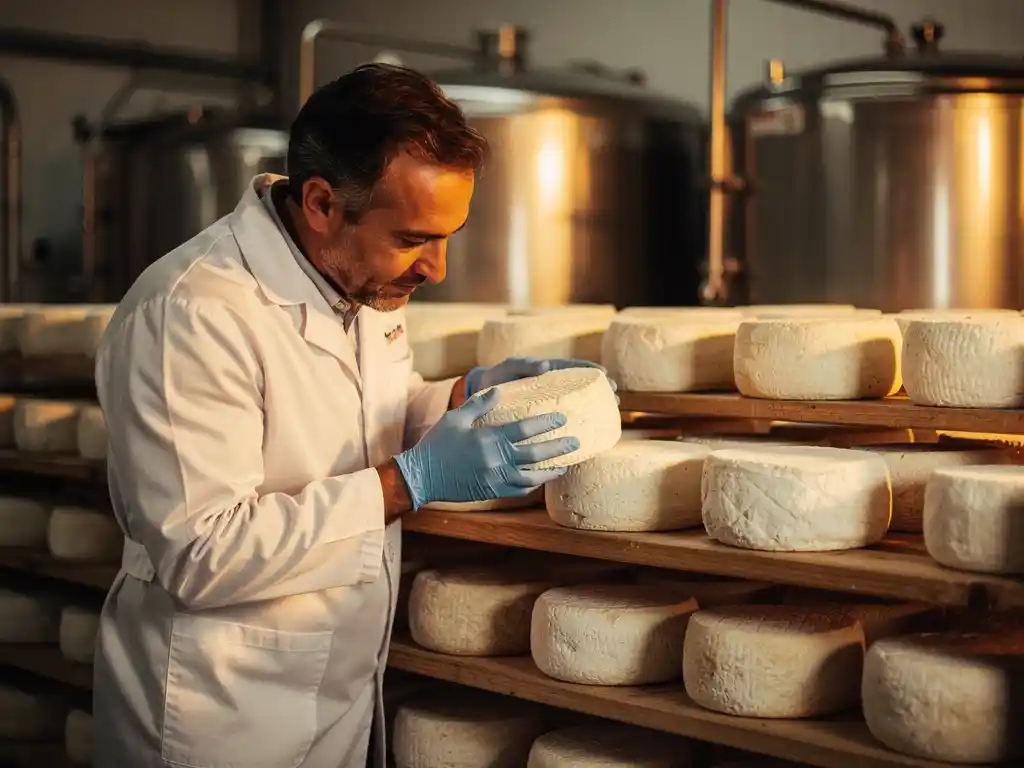
In the world of industrial food production, choosing the right goat cheese producer is crucial for the success of your end product. Whether you’re making pizzas, ready-to-eat meals, or other food products, the quality and reliability of your goat cheese partly determine the success of your production line. As a buyer, you face important decisions that go beyond just price and taste. From technical specifications to compliance requirements, every factor plays a role in the selection process. This guide covers the essential questions every professional buyer must ask when choosing an industrial goat cheese producer.
What are the key quality criteria for industrial goat cheese?
The key quality criteria for industrial goat cheese are consistent composition, microbiological safety, uniform texture, stable melting behavior, and predictable shelf life. These factors determine whether the cheese performs reliably in your production process and end product.
Consistent composition tops the list because variations in fat, protein, and moisture content directly impact your production process. A reliable producer delivers goat cheese with fixed specifications, where the fat content, for example, always falls between 16% and 45%, depending on your application. This prevents unexpected results in your end product.
Microbiological safety is non-negotiable in the food industry. Look for producers who work according to IFS Food certification or comparable standards. The goat cheese must be free from pathogens and have a stable pH value that prevents spoilage during processing and storage.
The texture must be uniform for machine processing. Whether you use goat cheese crumbles for pizza toppings or spread for fillings, the structure must be consistent. Clumping, separation, or irregular grain size can disrupt your production lines and lead to quality problems.
For processing involving heating, such as pizzas or casseroles, melting behavior is crucial. Industrial goat cheese must melt predictably without excessive oil separation or discoloration. Always test samples under your specific processing conditions before making a final choice.
What technical properties must goat cheese have for industrial processing?
For industrial processing, goat cheese must have specific technical properties such as adjustable dry matter content (35-45%), freeze stability, pumpability for automated systems, and structure retention during mechanical processing. These properties determine processability in large-scale production.
Dry matter content is a critical parameter that you can adjust to your specific application. For bakery products, a higher dry matter content (around 45%) often works better, while for sauces and fillings, a lower percentage (35%) is more suitable. Modern producers can adjust this percentage to your exact specifications.
Freeze stability is essential when working with inventory management or seasonal production. Industrial goat cheese must be freezable without whey loss or texture change after thawing. Products like goat cheese crumbles and spread can be frozen for up to 2 years and retain their quality for 10 to 23 weeks after thawing.
For automated production lines, the pumpability of goat cheese spread or curd is crucial. The product must flow smoothly through pipes without causing blockages. The viscosity must remain stable at different temperatures, and no separation should occur during pumping.
Mechanical stability determines how well the cheese withstands mixing, cutting, or other operations. Goat cheese pucks, for example, must retain their shape during transport on conveyor belts, while crumbles must not powder during dosing. Always test how the product behaves under your specific processing conditions.
How do you assess the reliability of a goat cheese producer?
You assess the reliability of a goat cheese producer based on their track record, certifications, delivery capacity, financial stability, and references from other industrial customers. Ask for concrete evidence of consistent deliveries over at least 2-3 years.
Start by researching their history and experience. A producer who has been active in the market since 1995 has proven they can navigate through economic cycles. Ask for specific examples of long-term collaborations with other food producers and what volumes they consistently deliver.
Certifications are objective evidence of quality systems. Check not only if they are certified, but also how recently audits were conducted and whether there were non-conformities. IFS Food, BRC, or FSSC 22000 certification provides assurance about food safety and process control.
Test delivery capacity by asking about their production capacity, inventory policy, and contingency planning. A reliable producer has multiple production lines, strategic inventories, and backup scenarios for unforeseen circumstances. Also ask about their minimum order quantities and flexibility with sudden volume changes.
Financial stability prevents unpleasant surprises. A family business with local roots and international sales often shows more stability than startups. Feel free to ask about their main sales markets and how they handle raw material price fluctuations.
What are the differences between traditional and modern goat cheese production for industry?
The difference between traditional and modern goat cheese production lies mainly in scalability, automation, and adaptability. Traditional production offers authentic flavor and artisanal quality, while modern methods guarantee consistency, efficiency, and customization for industrial applications.
Traditional production is characterized by the use of proven recipes, natural aging, and manual processes. The milk is acidified, coagulated, and processed according to centuries-old methods. This results in complex flavors and unique textures that are especially valuable for premium applications. The disadvantage is limited scalability and possible variations between batches.
Modern production techniques combine the best of both worlds. Automated systems ensure exact temperature control, pH monitoring, and consistent mixing ratios. Modified Atmosphere Packaging (MAP) extends shelf life without preservatives. Yet modern producers can respect traditional recipes and maintain authentic flavor.
For industrial processing, modern methods offer clear advantages. The ability to precisely adjust properties like dry matter content, salt content, and texture to your specifications is crucial. Modern production lines can also produce different formats, from 5 kg crumbles to 15 kg curd bags, all with identical quality.
The ideal producer combines traditional knowledge with modern technology. They understand the chemistry behind cheese making and can apply this knowledge to develop industrial solutions that are both authentic and functional.
What documentation and compliance requirements apply to industrial goat cheese?
For industrial goat cheese, essential documents are required: specification sheets, certificates of analysis (CoA), allergen information, HACCP documentation, traceability information, and veterinary health certificates. These documents must be current and comply with EU legislation and customer-specific requirements.
Specification sheets form the basis of every supply agreement. These must contain detailed information about composition (fat, protein, moisture, salt), microbiological parameters, physical properties, and organoleptic characteristics. For each product variant, whether natural crumbles or honey goat cheese spread, a separate specification sheet must be available.
Certificates of analysis (CoA) accompany every delivery and confirm that the batch meets the agreed specifications. These documents must show at least microbiological test results, chemical composition, and absence of prohibited substances. Modern producers deliver these digitally for quick processing in your quality system.
Traceability is legally required and crucial for crisis management. The producer must be able to provide complete traceability information within 4 hours, from milk supplier to end product. This includes batch numbers, production dates, raw materials used, and distribution data.
HACCP documentation shows that the producer has identified and controlled critical control points. Ask for their risk analyses, especially for your specific product. Veterinary documents guarantee the health of the goat herd and the absence of zoonoses.
How do you negotiate price and delivery terms with goat cheese producers?
Effective negotiation of price and delivery terms begins with understanding cost drivers such as milk price, seasonal influences, and production volumes. Focus on total costs including quality, reliability, and service, not just price per kilo. Long-term contracts often offer better terms.
Start negotiations with a thorough analysis of your own needs. Calculate not only volumes but also seasonal patterns, desired inventory levels, and flexibility requirements. Producers appreciate buyers who understand and can share their demand patterns, as this enables better planning.
Discuss volume discounts openly, but link them to realistic purchase commitments. A minimum purchase of a full pallet (for example, 60 boxes of goat cheese spread) can already lead to better prices. For really large volumes, custom solutions like dedicated production lines can be interesting.
Delivery terms include more than just price. Negotiate delivery times (standard often 3 weeks), minimum order quantities, flexibility with rush orders, and consignment inventory. Also ask about the possibility of frozen inventory for seasonal peaks, which extends shelf life to 2 years.
Payment terms deserve separate attention. Standard 30 days net is common, but with large volumes or long-term contracts, better terms are negotiable. Also consider price agreements with indexing to milk prices to provide both parties certainty with price fluctuations.
How De Jong Cheese helps with industrial goat cheese solutions
As a family business with more than 30 years of experience, we at De Jong Cheese understand the specific challenges of industrial food producers. Our combination of traditional cheese making and modern production techniques enables us to deliver custom solutions that perfectly match your production process.
Our industrial range offers solutions for every application:
- Goat cheese crumbles (5kg bags) for pizzas and salads, available both fresh and frozen
- Pumpable goat cheese spread (10kg buckets) for automated filling lines
- Freeze-stable curd (15kg bags) with adjustable dry matter content between 35-45%
- Goat cheese pucks in industrial packaging for large-scale processing
Our technical specialists are happy to work with you to determine the perfect specifications for your application. We offer extensive documentation, IFS Food certification, and complete traceability. With our flexible production capacity and strategic inventories, we guarantee reliable deliveries, even during seasonal peaks.
Are you looking for a reliable partner for industrial goat cheese? Contact our team for a no-obligation discussion about your specific needs. Visit our foodservice page for more information about our complete range, or visit our store in Alphen to taste our products. At dejongcheese.nl you’ll find all details about our products and services.
Frequently Asked Questions
How can I test the quality of goat cheese before ordering large volumes?
Always ask for product samples that you can test under your own production conditions. Test specifically the behavior during heating, mixing, and possibly freezing. Most producers offer free samples and can even facilitate small-scale trial productions to validate performance in your specific application.
What are typical pitfalls when switching to a new goat cheese producer?
The biggest pitfalls are underestimating recipe adjustments, insufficient testing of shelf life in your end product, and not establishing quality parameters in advance. Ensure a phased transition with parallel deliveries, test at least 3 production batches before switching completely, and establish all specifications contractually including tolerances.
How do I deal with seasonal fluctuations in goat milk production?
Goat milk production has natural peaks in spring and summer. Work with producers who build strategic frozen inventories during peak production. Consider long-term contracts with fixed volumes and prices, and plan large productions during April-September when fresh milk is abundantly available.
What innovations in goat cheese production are relevant for industrial processors?
New developments include enzymatically modified goat cheese for improved melting properties, micro-encapsulation for heat-resistant toppings, and natural preservation techniques that extend shelf life to 12 months. Ask producers about their R&D capabilities and possibilities for co-creation of new product forms.
How do I calculate the actual costs of goat cheese in my end product?
Calculate not only the price per kilo but also processing losses, labor costs for handling, storage costs, and possible product losses due to shelf life. Goat cheese with 5% less moisture may seem cheaper but may require recipe adjustments. Ask producers for total cost of ownership calculations for your specific situation.
What should I do if goat cheese quality suddenly deviates during production?
Stop production immediately and contact your supplier. Preserve samples of both the deviating product and reference material. Document all deviations with photos and measurements. A good producer has a 24/7 accessible quality service and can provide an initial analysis within 4 hours plus deliver replacement product if necessary.
Related Articles
- How do you shorten the selection process when searching for a new cheese supplier?
- Why can goat cheese spread with a shelf life of 10 weeks turn out cheaper than fresh?
- How does quality assurance work at a specialized Dutch cheese producer?
- What are the benefits of a supplier that provides both fresh and frozen goat cheese?
- What are EU requirements for imported goat cheese?