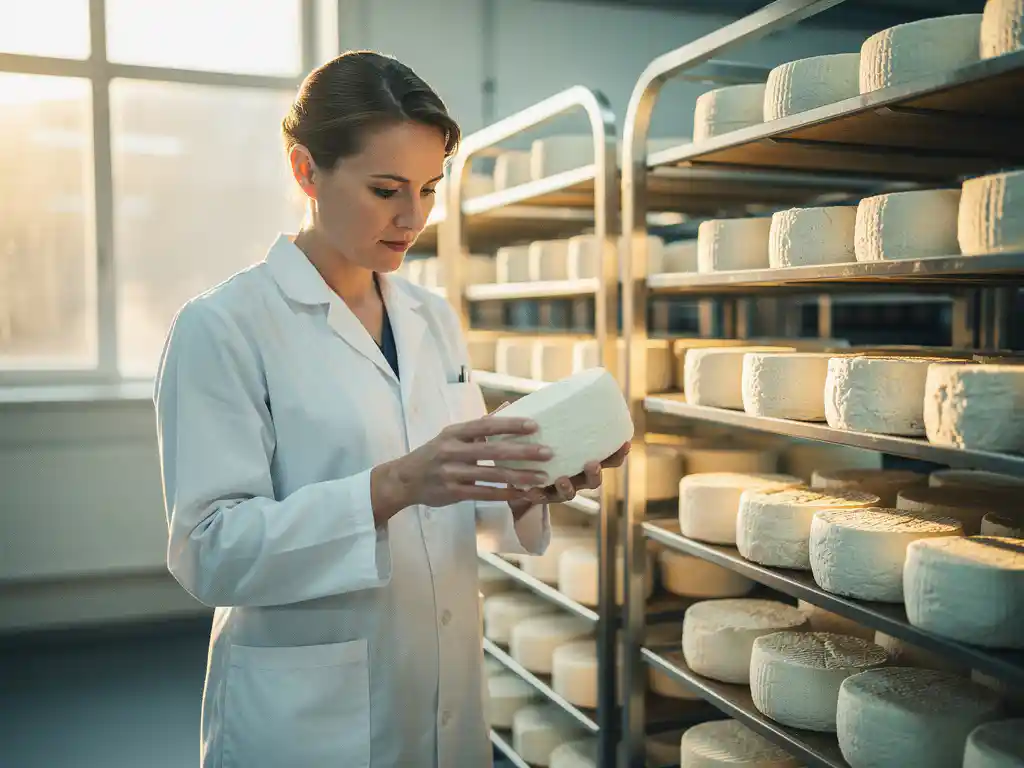
As a Dutch goat cheese producer, we at DeJong Cheese deal with strict quality controls on a daily basis. One of the most important institutions that oversees our production is COKZ, the Central Organization for Quality Matters in the Dairy Industry. In this article, we share our experience with COKZ inspections and explain why these inspections are so important for the quality and safety of Dutch goat cheese.
What is COKZ inspection and why is it important for goat cheese producers?
COKZ inspection is the official supervision of dairy companies in the Netherlands, carried out by the Central Organization for Quality Matters in the Dairy Industry. This organization checks whether goat cheese producers comply with all legal requirements for hygiene, quality and food safety according to Dutch and European legislation.
For us as a goat cheese producer, COKZ supervision means that we can guarantee that our fresh goat cheese, aged goat cheese and other specialties meet the highest quality standards. COKZ acts as an independent supervisor on behalf of the Dutch Food and Consumer Product Safety Authority (NVWA) and specifically monitors compliance with European hygiene regulations.
The importance of these inspections cannot be underestimated. They not only ensure food safety for consumers, but also protect the reputation of the Dutch dairy sector worldwide. For industrial customers like Marco Visser, who consistently need high-quality goat cheese for their production processes, COKZ certification provides the assurance that our products are reliable and safe.
Without COKZ approval, dairy companies are not allowed to market their products. This makes the inspections essential for our business continuity and for the confidence of our customers in retail, foodservice and industry.
What inspections does COKZ carry out at a goat cheese producer?
COKZ carries out five main categories of inspections at goat cheese producers: hygiene and sanitation, process control, product quality, traceability and documentation. These inspections cover the entire production process from milk reception to delivery of the final product.
In terms of hygiene, inspectors check the cleanliness of production areas, equipment and the personal hygiene of employees. They assess whether cleaning procedures are carried out correctly and whether disinfectants are applied properly. For our fresh goat cheese slices and spreadable goat cheese, this is extra critical due to the longer shelf life.
Process controls include temperature management during pasteurization, ripening and storage. COKZ verifies whether critical control points (CCPs) are correctly monitored and whether deviations are adequately corrected. In the production of our goat cheese slices, they check, for example, the accuracy of cutting equipment and packaging processes.
Product quality controls focus on microbiological parameters, fat content, moisture content and sensory properties. Inspectors take samples of different product types, from fresh goat cheese to aged varieties, for laboratory analysis.
Finally, COKZ checks the completeness of documentation, including recipes, production records, complaint handling and recall procedures. These administrative controls ensure that every product is traceable from raw material to end user.
How does a COKZ inspection proceed step by step?
A COKZ inspection follows a fixed protocol that begins with an announcement several days in advance, followed by an opening meeting, a tour through production, sampling, document review and final discussion. The complete inspection usually takes four to eight hours, depending on company size.
The inspection starts with an opening meeting in which the inspector explains the purpose and scope of the visit. This is followed by a systematic tour through all production areas, starting at milk reception and ending at dispatch. The inspector observes active production processes and asks employees questions about their working methods.
During the tour, the inspector takes samples for microbiological examination. In our production of goat cheese balls and other specialties, samples are taken from both semi-finished products and final products. These samples are analyzed in an independent laboratory.
The document review usually takes place in an office environment. The inspector reviews production records, temperature logs, cleaning schedules, supplier assessments and complaint records from the recent period. Special attention is paid to the traceability of raw materials and final products.
The inspection is concluded with a final discussion in which findings are discussed. Small deviations can often be corrected immediately, while larger shortcomings are recorded in an official report with deadlines for corrective actions.
What are the main requirements that goat cheese producers must meet?
Goat cheese producers must meet four core requirements: HACCP implementation, microbiological standards according to Regulation (EC) 2073/2005, infrastructure requirements for buildings and equipment, and qualified personnel with demonstrable hygiene training. These requirements form the basis for safe cheese production.
HACCP (Hazard Analysis and Critical Control Points) is the foundation of food safety in our sector. This system requires us to map all potential hazards, from microbiological risks to physical contamination. For each critical control point, such as pasteurization or metal detection, we must establish limit values, measurement methods and corrective actions.
Microbiological standards are particularly strict for fresh goat cheese and spreadable varieties. We must comply with limits for Listeria monocytogenes, Salmonella, Staphylococcus aureus and E. coli. These standards differ per product category and shelf life. For our fresh goat cheese with 23 weeks shelf life, stricter requirements apply than for products with a shorter shelf life.
Infrastructure requirements include smooth, washable walls and floors, adequate ventilation, separation between dirty and clean zones, and sufficient cooling and freezing capacity. Equipment must be made of stainless steel and designed so that cleaning can take place effectively.
Personnel requirements go beyond basic knowledge of hygiene. Employees must receive annual training on food safety, allergen management and personal hygiene. Health declarations are mandatory for everyone working with unpackaged products.
What happens if a goat cheese producer does not meet COKZ standards?
When not meeting COKZ standards, an escalation process follows that begins with a warning and recovery period, can lead to fines or production bans, and in serious cases results in revocation of the production license. The severity of the measure depends on the risk to food safety.
Small deviations, such as missing records or minor hygiene shortcomings, usually result in a written warning with a recovery period of two to four weeks. The producer must draw up an improvement plan and demonstrate that corrective measures have been implemented. A re-inspection verifies whether the shortcomings have been resolved.
In case of more serious violations, such as exceeding microbiological standards or structural hygiene problems, COKZ can intervene directly. This may mean that certain production lines are temporarily shut down or that specific product batches must be withdrawn from trade. For us, this could mean, for example, that a batch of aged goat cheese may not be delivered.
Financial consequences can be significant. Fines range from several thousand to tens of thousands of euros, depending on the violation. In addition, there are costs for product destruction, re-inspections and possible reputational damage with customers.
In the worst case, COKZ may advise to revoke the production license. This only happens with repeated serious violations or when food safety is structurally at risk. Without a license, a company may no longer produce or trade dairy products.
How DeJong Cheese helps with COKZ compliance
At DeJong Cheese, we have years of experience with COKZ inspections and help our partners in the food industry ensure compliance through our certified production processes and extensive documentation. Our approach ensures that customers like Marco Visser can rely on consistent quality without worrying about regulations.
Our support for customers includes:
- Complete product specifications including microbiological analyses for all our fresh goat cheese and aged varieties
- Traceability documentation from milk reception to final product for each batch
- IFS Food certification that goes beyond COKZ requirements and ensures international standards
- Technical support during audits of your own production location
- Regular updates on changes in laws and regulations that impact goat cheese processing
For industrial processors who use our goat cheese balls or spreadable goat cheese in their products, we offer complete compliance packages. These contain all documentation needed for your own HACCP system and quality assurance.
Would you like to know more about how our COKZ-certified production can strengthen your supply chain? View our complete range for foodservice and industry or contact us directly for a personal conversation. Also discover where you can find our products through our sales point map. Visit our homepage for more information about our family business and our passion for artisanal goat cheese.
Frequently Asked Questions
How often does COKZ carry out inspections at goat cheese producers?
COKZ carries out at least one regular inspection per year, but the frequency can increase to four times per year depending on the company’s risk category, previous inspection results and the production process. New producers or companies with previous shortcomings are inspected more frequently, while companies with an excellent track record may only be visited annually.
What are the costs of COKZ certification for a goat cheese producer?
The costs for COKZ supervision vary between €2,000 and €15,000 per year, depending on company size, number of production locations and complexity of the range. These rates include regular inspections, sampling and laboratory analyses, but additional re-inspections for shortcomings are charged separately at an hourly rate of approximately €150-200.
Can I as a small artisanal goat cheese maker get exemption from COKZ inspections?
No, there is no exemption from COKZ supervision for professional goat cheese production, regardless of company size. However, there are adapted procedures for small-scale producers with less than 2 tons of production per week, where some administrative requirements are simplified but all food safety requirements remain fully in effect.
How do I best prepare my goat cheese production for a COKZ inspection?
Start at least three months before the inspection with an internal audit according to the COKZ checklist, check all temperature records and cleaning logs for completeness, train employees in correctly answering inspection questions, and ensure that all documents are digitally available. Also carry out an extra thorough cleaning in the week before inspection, but avoid drastic last-minute changes that may seem suspicious.
What is the difference between COKZ certification and other quality marks such as IFS or BRC?
COKZ certification is legally required for Dutch dairy producers and focuses on compliance with EU legislation, while IFS and BRC are voluntary commercial standards that go beyond legal minimum requirements. COKZ primarily checks food safety and hygiene, but IFS/BRC also include quality management, customer satisfaction and continuous improvement, which is especially important for export and large retailers.
May I continue producing goat cheese during a COKZ recovery period?
In most cases, production may continue during a recovery period, unless acute food safety risks have been identified. COKZ may impose additional conditions such as increased sampling frequency, temporary production restrictions for specific products, or mandatory notifications for process changes until the shortcomings are resolved.