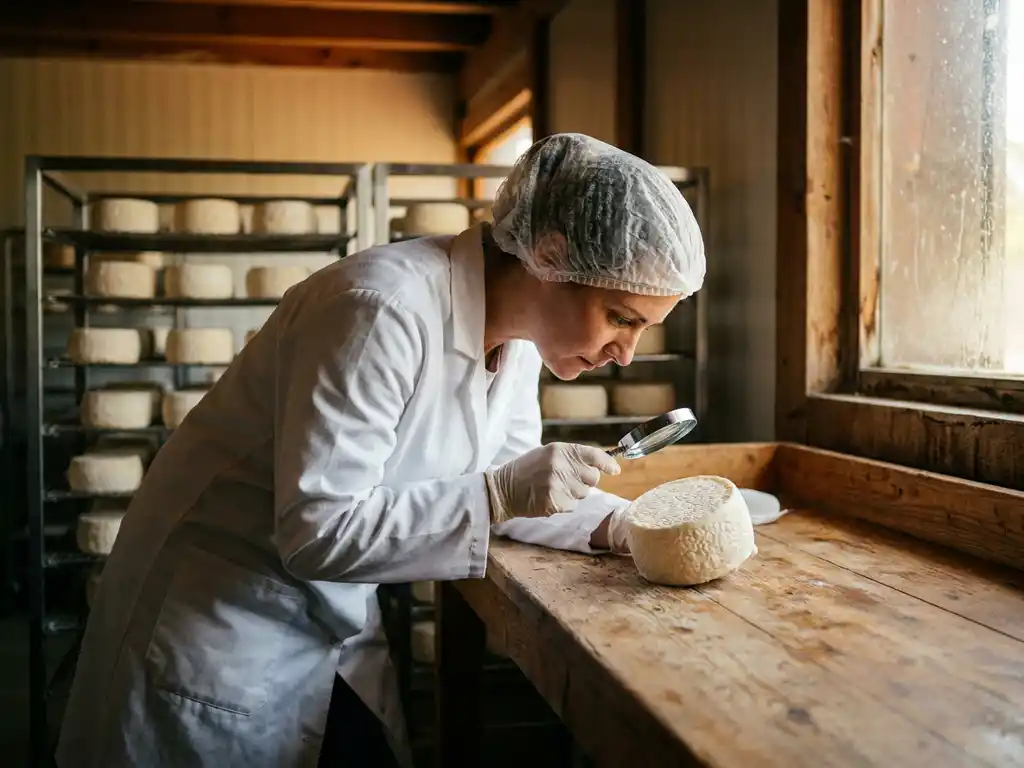
You organize a supplier audit at a goat cheese producer by setting clear criteria in advance, requesting relevant documentation, and conducting the audit in a structured way — covering food safety, production capacity, and quality assurance. For buyers in the food industry, a structured approach is essential to assess whether a cheese producer can deliver reliably, consistently, and in compliance with requirements. In this article, we walk through the key questions you need to ask as a buyer or product developer.
What criteria do you use in a supplier audit of a cheese producer?
In a supplier audit of a cheese producer, you assess at least five core areas: food safety and certifications, production quality and consistency, delivery reliability, raw material traceability, and the financial stability of the supplier. Together, these criteria form the foundation of a reliable supplier relationship in the food industry.
For goat cheese, there are also product-specific criteria that deserve extra attention. Think about fat content and water activity, melting behavior when heated, and microbiological specifications per product type. Buyers sourcing goat cheese for industrial applications such as pizzas or ready meals want to know whether the producer can provide technical data sheets that align with their production process.
Beyond technical criteria, flexibility also matters. Can the producer support private label solutions, custom packaging, or seasonal varieties? For product developers working with innovative flavor combinations, this is a decisive factor alongside purely technical specifications.
How do you prepare for a supplier audit at a goat cheese producer?
Good preparation for a supplier audit at a goat cheese producer starts with drawing up an audit checklist based on your purchasing requirements, followed by a document request to the producer — at least two weeks before the visit. Without solid preparation, you risk the audit staying superficial and missing critical risks.
Follow these steps when preparing:
- Define your audit goals: Is this an initial qualification, a periodic reassessment, or a specific risk audit?
- Determine the audit team: Involve quality management and, where relevant, R&D — not just purchasing.
- Request documentation in advance: Certifications, product specifications, HACCP plans, and recent audit reports.
- Plan the audit day in detail: Allow time for a tour of the production facility, a document review, and a closing meeting with management.
- Prepare a questionnaire: Tailor it to goat cheese as a product type, including questions about raw material sourcing, milk origin, and quality controls.
A preparatory conversation with the producer also helps to align expectations on both sides. That way, the producer knows what you’re coming to assess, and you can gauge upfront whether they’re willing to be open and transparent.
What documents should a goat cheese producer be able to provide?
At a supplier audit, a goat cheese producer should be able to provide at minimum: a valid food safety certificate such as IFS or BRC, up-to-date product specifications per cheese type, a HACCP plan, traceability documentation from goat milk to finished product, and recent microbiological analysis reports.
Depending on your market and application, additional documents may be relevant:
- Allergen declarations and ingredient specifications for labeling purposes
- Sustainability reports or certifications such as organic or animal welfare labels
- Export certificates for international deliveries
- Quality plans per production line
- Supplier assessments of raw material suppliers (the supplier’s suppliers)
When reviewing these documents, don’t just check whether they exist — also check how current they are. Certifications more than a year old without an interim re-audit deserve extra scrutiny. Also ask for the most recent internal audit results and how any non-conformities were followed up.
What are common shortcomings in a cheese producer audit?
The most common shortcomings in a cheese producer audit are incomplete traceability documentation, outdated or missing HACCP analyses, inconsistent product specifications across deliveries, and insufficient evidence of corrective actions following previous non-conformities. These shortcomings signal potential risks in your supply chain.
In practice, auditors at cheese producers also regularly encounter the following issues:
- Temperature control: Inadequate monitoring of cold chains during storage and transport
- Cleaning protocols: Missing or non-compliant cleaning procedures for production equipment
- Personnel hygiene: No documented training records for shop floor employees
- Non-conformity management: Deviations are recorded but corrective actions are not systematically followed up
- Specification deviations: Product specifications in the documentation don’t match the products actually delivered
A shortcoming doesn’t have to be an automatic disqualifier, but the way a producer handles non-conformities says a lot about the maturity of their quality system. A producer who is transparent about past issues and can demonstrate that improvements have been made inspires more confidence than one with no visible non-conformity history at all.
How do you assess production capacity for large volumes of goat cheese?
You assess production capacity for large volumes of goat cheese by asking, during the audit, for insight into the current utilization rate of the production line, the availability of goat milk as a raw material, storage capacity for aging and refrigeration, and the maximum delivery frequency the producer can guarantee. Capacity on paper and capacity in practice can differ significantly.
Ask concrete questions on the audit day:
- What is the maximum weekly production in kilograms per cheese type?
- What percentage of capacity is currently taken up by other customers?
- How are demand peaks handled — for example, in spring when goat milk is more readily available?
- What is the policy when raw materials are scarce or milk production fluctuates seasonally?
Also ask about past delivery reliability. Does the producer have references from comparable industrial customers who purchase large volumes? A tour of the warehouse and aging rooms also gives you a direct picture of actual storage capacity and the state of the infrastructure.
How do you turn the results of a supplier audit into a decision?
After a supplier audit, you process the findings by scoring each one on severity and impact, summarizing them in an audit report with a clear conclusion, and assigning a supplier status based on that: approved, conditionally approved, or rejected. A structured decision matrix prevents subjective impressions from driving the outcome.
Scoring and prioritizing findings
Categorize findings by severity: critical (direct risks to food safety or compliance), major (structural shortcomings affecting the quality system), and minor (areas for improvement without immediate risk). Critical findings typically lead to a conditional or negative assessment, unless the producer can immediately provide evidence of corrective action.
Supplier status and follow-up actions
Based on the overall score, you assign one of the three statuses. For a conditional approval, you draw up an improvement plan with concrete deadlines and schedule a re-audit. Put all agreements in writing in a supplier agreement or quality protocol. This gives you, as a buyer, a documented and repeatable process that can also be justified internally.
How DeJong Cheese supports a smooth supplier audit
As a family business with more than thirty years of experience in goat cheese specialties, we understand what buyers and product developers need to complete a supplier audit successfully. We are fully transparent about our quality system and proactively provide all required documentation — so you, as the auditor, don’t waste time chasing down basic information.
What we offer during a supplier audit:
- Current certifications and product specifications per cheese type, available immediately
- Full traceability from goat milk to finished product, including milk origin
- Technical data sheets covering melting behavior, fat content, and microbiological specifications for industrial applications
- Tours of our production facility in Alphen, with insight into capacity and aging processes
- Flexibility in private label and custom solutions for both retail and foodservice
We believe a supplier audit doesn’t have to be an obstacle — it can be the start of a trusted partnership. Curious about how we can support your audit process? Get in touch with us and we’ll be happy to schedule an introduction or a visit to our production facility in Alphen.
Frequently Asked Questions
How often should you repeat a supplier audit at a goat cheese producer?
The frequency of a supplier audit depends on the risk level of the supplier and the criticality of the product in your supply chain. For approved suppliers with a stable quality system, an annual or biennial re-audit is often sufficient, while conditionally approved suppliers are typically reassessed within three to six months. Also factor in unplanned triggers for an additional audit, such as complaints about product quality, changes to the production facility, or expiring certifications.
What is the difference between IFS and BRC certification at a cheese producer, and which one is more relevant for me?
IFS (International Featured Standards) and BRC (British Retail Consortium) are both internationally recognized food safety certifications, but they have slightly different focuses and are common in different markets. IFS is particularly dominant in German- and French-speaking retail, while BRC is more widely used in English-speaking and British markets. For buyers supplying European retailers, IFS Food is often the most relevant standard — but it's worth checking with your customers which certification they require before making it a hard requirement in your audit criteria.
As a buyer, how do you handle a goat cheese producer that is small-scale but delivers excellent quality, yet has no formal certification?
A missing formal certification doesn't have to be an automatic dealbreaker, but it does call for a more thorough assessment of the quality system. In that case, it's advisable to plan a more extensive document review and a more in-depth production tour, supplemented by microbiological sampling and a thorough evaluation of the HACCP documentation. You might also consider entering into a temporary supplier contract that includes an agreement for the producer to obtain a recognized certification within a set timeframe, so the partnership can meet your compliance requirements in the long run.
What red flags during a tour of a cheese production facility should immediately set off alarm bells?
During a facility tour, there are several immediate warning signs that point to serious food safety risks: visible mold in unintended areas, insufficient separation between raw and processed production streams, employees without proper personal protective equipment, and poor maintenance of production equipment or floors. Less visible but equally important is a defensive or evasive attitude from staff when asked direct questions about procedures and non-conformities. A producer with a mature quality culture answers questions openly and proactively refers to documentation.
How do you account for seasonal fluctuations in goat milk production in your supplier contract?
Goat milk follows a strong seasonal pattern, with a peak in spring and lower availability in late fall and winter — which can directly affect the reliability of goat cheese supply. Include explicit agreements in the supplier contract about minimum delivery volumes per quarter, communication obligations when shortages are expected, and any alternative supply options or buffer stocks. During the audit, also ask about historical delivery reliability by season and whether the producer works with fixed milk suppliers or contracts with goat farmers to ensure continuity.
Can you conduct a supplier audit remotely, or is a physical visit to the production facility unavoidable?
A remote audit — where documentation is submitted digitally and interviews take place via video conference — can be useful as a supplement to a previous physical visit or for an interim reassessment of an already-approved supplier. For an initial qualification or a risk audit, however, a physical visit to the production facility is nearly irreplaceable, because only an on-site visit allows you to directly assess the actual state of the facilities, the hygiene culture, and operational capacity. A combination of both methods — where a remote document review precedes a more focused physical visit — is in practice both efficient and thorough.
How do you best involve internal stakeholders such as R&D and quality management in a supplier audit?
A supplier audit delivers more value when purchasing, quality management, and R&D each contribute from their own area of expertise. Define specific focus areas per discipline in advance: quality management focuses on the HACCP system and certifications, R&D evaluates the technical specifications and product development possibilities, while purchasing monitors the commercial and logistical aspects. A joint debrief immediately after the audit day ensures that all findings are weighed together before the supplier status is assigned.
Related Articles
- What are the consequences of inconsistent cheese quality in a pizza production line?
- How do you recognize a reliable cheese supplier for large-scale production?
- What makes goat cheese suitable for large scale pizza production?
- How to verify animal welfare standards in goat cheese production?
- Is goat cheese anti inflammatory?