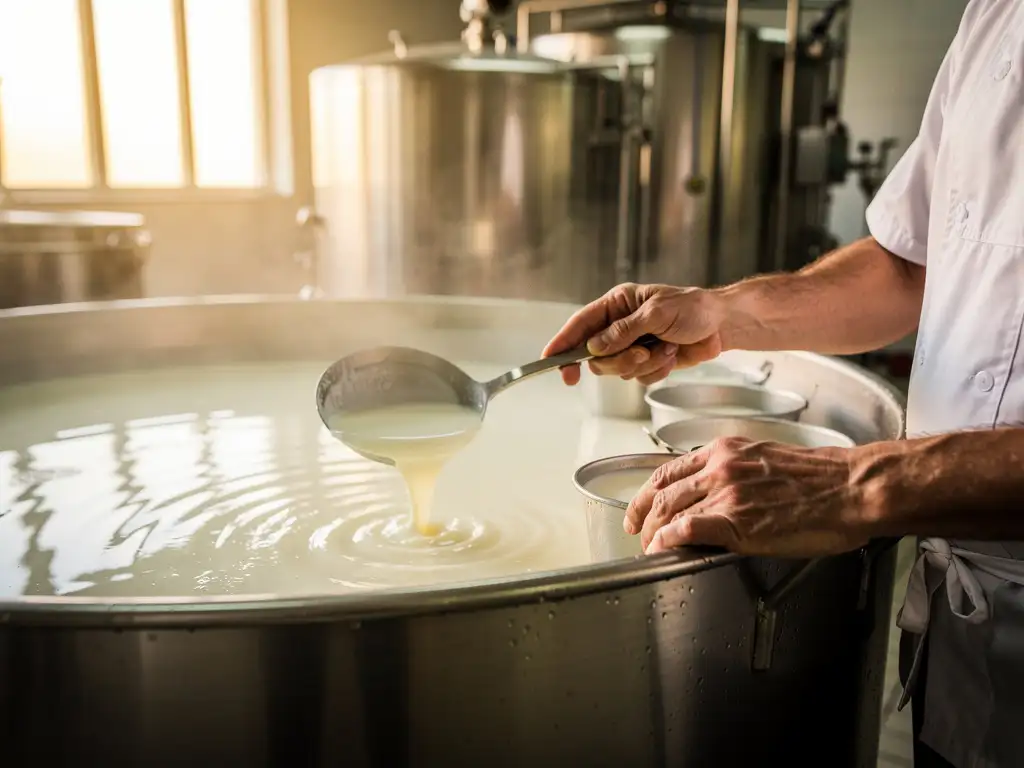
Goat cheese curd is a versatile ingredient in the food industry, but its susceptibility to waste poses a challenge for large-scale processors. As specialists in goat cheese products since 1995, we understand the complexity of curd processing and the impact of waste on production costs. This article provides practical insights for buyers and production managers who want to optimize their curd usage and minimize waste.
What is goat cheese curd and why is it susceptible to waste?
Goat cheese curd is the fresh, unpressed cheese mass that forms after coagulating and cutting goat milk, before it is shaped into cheese. This intermediate product has a short shelf life of 7-14 days when refrigerated and is highly sensitive to temperature fluctuations, making it prone to spoilage with improper storage or processing.
The susceptibility to waste stems from various factors. First, curd contains a high moisture content of approximately 75-80%, making it an ideal breeding ground for microorganisms. The pH value of fresh curd ranges between 4.5 and 5.0, which is acidic enough to inhibit some bacteria but does not prevent all spoilage.
Additionally, curd is mechanically vulnerable. The delicate structure can easily be damaged during transport and processing, leading to moisture loss and quality deterioration. Temperature changes significantly accelerate this process. At temperatures above 8°C, the spoilage rate doubles with every 2-3 degree temperature increase.
For industrial processors, this means that any interruption in the cold chain or delay in production directly impacts the product’s usability. The combination of limited shelf life and strict temperature requirements makes efficient inventory management crucial for preventing waste.
How much goat cheese curd is wasted in the food industry?
In the Dutch food industry, an estimated 8-12% of all goat cheese curd is lost during storage and processing, amounting to thousands of kilograms per year for larger production companies. This waste represents not only product loss but also significant financial damage and environmental burden.
The waste concentrates at various points in the production chain. During receipt and storage, approximately 3-4% loss occurs due to damaged packaging, temperature deviations, or expiration of shelf life. In the processing itself, another 4-5% is lost due to process interruptions, quality rejections, or overproduction.
Seasonal influences play an important role in waste percentages. During summer months, when it is more difficult to guarantee the cold chain, waste percentages can rise to 15-18%. Production companies working with just-in-time deliveries report lower waste percentages of 5-7%, while companies with larger inventories often see higher percentages.
The financial impact is significant. With an average curd price of €4-6 per kilogram, 10% waste for a medium-sized production company that processes 50,000 kilograms annually represents a loss of €20,000-30,000. This is in addition to waste disposal costs and lost production hours.
How do you optimally store goat cheese curd for large-scale use?
Optimal storage of goat cheese curd requires a constant temperature between 2-4°C in specialized cold rooms with humidity of 85-90%. Immediately after receipt, curd must remain in original packaging and be stored according to FIFO principles to ensure rotation.
The cold room setup is crucial for quality preservation. Curd must be placed on stainless steel shelving with sufficient space between packages for good air circulation. Avoid placement directly against cold room walls or near evaporators, where temperature fluctuations are greatest. Install multiple temperature sensors at different heights and locations for accurate monitoring.
Packaging integrity plays an essential role. Check all packages for damage or leaks upon receipt. Damaged packages must immediately be transferred to airtight containers suitable for food contact. For large-scale storage, vacuum-packed portions of 5-10 kilograms are ideal, as they extend shelf life and facilitate portioning.
Implement a digital monitoring system with alarm functions for temperature deviations. Modern systems can send real-time data to responsible personnel and automatically maintain logs for quality control. Train staff in correct handling procedures, including minimizing the time cold room doors remain open and using insulated transport carts for internal movements.
Which processing techniques help prevent curd waste?
Efficient processing techniques such as portioning immediately after receipt, vacuum packaging of daily portions, and using automated dosing systems can reduce curd waste by 40-60%. These methods minimize exposure to air and temperature changes during the production process.
Portioning according to production planning is the first step. Divide large curd batches immediately after receipt into daily portions based on expected production. Use stainless steel portioners with integrated scales for accurate division. Vacuum pack each portion or use modified atmosphere packaging (MAP) with a mixture of CO2 and N2 to extend shelf life.
Automated dosing systems offer significant advantages for continuous production. These systems keep curd at constant temperature and dose exactly the required amount without human contact. Modern systems can even process curd directly from refrigerated storage tanks, where temperature never exceeds 4°C.
Implement buffer zones in the production process. Use refrigerated intermediate buffers of maximum 30 minutes production to handle interruptions without large quantities of curd leaving refrigeration. Combine this with rapid processing techniques like high-speed mixers that reduce mixing times from 15 to 5 minutes.
For batch production, the two-stage method is effective: prepare curd in small batches of maximum 2 hours production and keep a second batch refrigerated on standby. This prevents large quantities of curd from sitting at room temperature for hours during production changes or breakdowns.
How do you plan the purchase of goat cheese curd efficiently?
Efficient purchasing planning for goat cheese curd requires a balance between just-in-time deliveries and sufficient buffer inventory, ideally with deliveries 2-3 times per week. Use historical production data and seasonal patterns to make accurate forecasts and align delivery schedules with production peaks.
Start by analyzing production patterns over at least 12 months. Identify seasonal peaks, such as increased demand for fresh goat cheese products in spring or aged goat cheese during holidays. Calculate average curd requirements per production day and add a safety margin of 15-20% for unexpected orders.
Develop a supplier matrix with at least two reliable curd suppliers to minimize supply chain risks. Evaluate suppliers on consistent quality, delivery reliability, and flexibility in delivery volumes. Make agreements about emergency deliveries within 24 hours for unexpected production peaks.
Implement a rolling forecast system where weekly forecasts for the next 4-6 weeks are adjusted. Share these forecasts with suppliers so they can align their production. For seasonal products like spreadable goat cheese with herbs, plan 3-4 weeks ahead given the longer preparation time for special curd variants.
Optimize order quantities by applying the Economic Order Quantity (EOQ) formula, taking into account storage costs, ordering costs, and waste risk. For most medium-sized producers, the optimal order quantity is between 3-5 days of production, depending on cooling capacity and product mix.
What are the best ways to reuse curd waste streams?
Goat cheese curd waste streams can be effectively reused in secondary products such as spreads, sauces, and fillings, with up to 95% of excess curd still being processed. This reuse strategy not only reduces waste but also creates new product opportunities with added value.
The most direct application is processing curd residues into goat cheese spreads. By mixing curd with cream, herbs, and stabilizers, a durable product with extended shelf life is created. These spreads are ideal for foodservice applications and can be packaged in portions of 125-250 grams for retail or 1-2 kilograms for hospitality.
Curd residues are also excellent for producing cheese sauces. By heating curd with milk or cream and emulsifiers, a stable sauce is created that can be used as pizza topping, pasta sauce, or dip sauce. These sauces can be frozen without quality loss, offering flexibility in production and inventory.
For industrial bakeries, curd offers possibilities as filling for quiches, savory pies, and filled breads. Mix curd with eggs and vegetables for a stable filling that withstands heating well. These applications are especially suitable for fresh goat cheese curd that must be processed within 48 hours.
Develop partnerships with other food producers for selling curd waste streams. Producers of ready-made meals, soup manufacturers, and dairy snack makers can process curd in their products. Ensure clear quality agreements and traceability to guarantee food safety.
How De Jong Cheese helps prevent curd waste
As specialists in goat cheese products since 1995, we at De Jong Cheese offer practical solutions to minimize curd waste in your production process. Our expertise in traditional cheese production combined with modern processing techniques enables us to deliver customized solutions for industrial processors.
Our support for efficient curd usage includes:
- Flexible delivery schedules adapted to your production cycle, with deliveries 2-5 times per week
- Curd in optimal packaging sizes of 5, 10, or 20 kilograms for minimal handling
- Technical support in establishing storage protocols and processing procedures
- Advice on reuse possibilities for curd waste streams in secondary products
- Consistent quality through our IFS Food certification and strict quality controls
Our curd is produced according to traditional recipes with milk from local goat farms within 100 kilometers, ensuring maximum freshness and minimal transport time. Through our EC accreditation and COKZ controls, we guarantee a product that meets all food safety requirements for industrial processing.
Are you looking for a reliable partner for your curd deliveries? Contact us through our contact page for a no-obligation discussion about your specific needs. Visit our foodservice page for more information about our complete range of industrial cheese products. For direct availability, you can also visit our sales points. Discover all possibilities at www.dejongcheese.nl.
Frequently Asked Questions
How can I extend the shelf life of goat cheese curd without compromising quality?
Shelf life can be extended by repackaging curd immediately after receipt into smaller vacuum portions or modified atmosphere packaging (MAP) with CO2/N2 mixture. Additionally, freezing curd at -18°C helps, where texture is preserved if you thaw slowly at 2-4°C. For optimal results, you can also add natural preservatives like lactic acid bacteria.
What are the first signs that curd is spoiling and can still be saved?
Beginning spoilage is recognized by slight discoloration at the edges, a slightly more acidic smell than normal, or minimal moisture separation. At this stage, curd can often still be processed by heating directly to 72°C for pasta sauces or by mixing with fresh curd (maximum 20% old curd) for spreads. Always check the pH value first – at a pH below 4.2, the curd is usually no longer salvageable.
Which equipment investments deliver the greatest savings on curd waste?
The most profitable investments are an automated temperature monitoring system with alarm function (ROI within 6 months), a vacuum machine for repackaging large batches (saves 30-40% waste), and a buffer tank with cooling for continuous production (prevents temperature spikes). For larger companies, a curd dosing system that works directly from refrigerated tanks is also worthwhile.
How do I calculate the actual costs of curd waste including hidden costs?
Calculate not only the purchase value of wasted curd, but also add labor costs for handling (€25-35 per hour), waste processing costs (€150-200 per ton), lost production capacity, and reputational damage from delivery failures. A practical formula: Total waste costs = (kg wasted × purchase price) + (hours extra handling × hourly wage) + waste costs + (lost revenue from production standstill × gross margin).
Can different types of goat cheese curd be used together?
Yes, but with limitations. Curd of comparable ripening degree and fat percentage can be combined, but never mix fresh curd (0-7 days) with older curd (7-14 days) for premium products. For spreads and sauces, mixing is less critical. Note: keep curd with different herb mixtures separate to prevent flavor contamination, and document all mixtures for traceability.
What are common mistakes when starting up a curd processing line?
The biggest mistakes are: preparing batches too large so curd stays outside refrigeration too long, insufficient training of personnel in temperature management, no backup plan for machine breakdowns, and ignoring seasonal influences on shelf life. Therefore always start with small test batches, train at least 2 operators per shift, and always keep 20% of daily production as buffer in refrigeration.
Related Articles
- How do you efficiently compare quotes from multiple goat cheese producers?
- How do you avoid wasting time on unclear communication with suppliers?
- How can goat cheese support exclusive product lines?
- How to maximize goat cheese sales in retail environments?
- How to make goat cheese and sun-dried tomato spread?