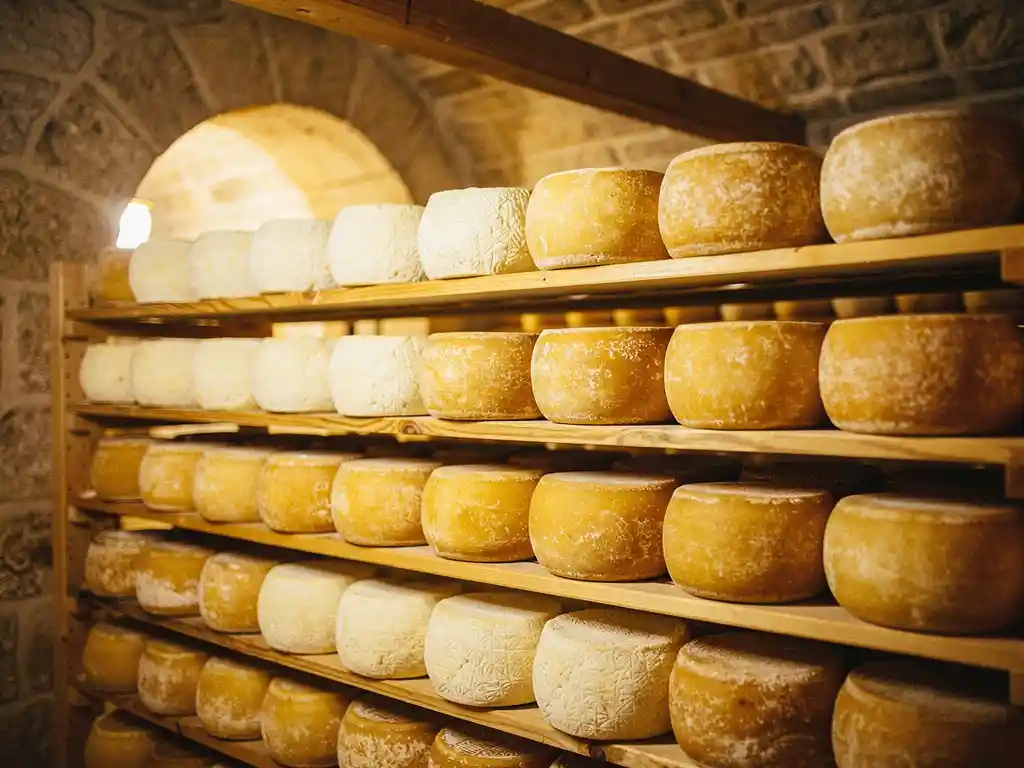
As a buyer in the food industry, you know that scaling production volumes is a complex challenge, especially when it comes to specialized ingredients like aged goat cheese. Whether you’re producing pizzas, ready meals, or other food products, the demand for high-quality goat cheese is growing. But how do you ensure your purchasing scales without compromising on quality, supply reliability, or cost efficiency? In this article, we answer the key questions buyers have when scaling their aged goat cheese procurement.
What are the main challenges when scaling aged goat cheese procurement?
The three main challenges when scaling aged goat cheese procurement are maintaining quality consistency with larger batches, ensuring supply security during seasonal fluctuations, and managing more complex logistics and storage requirements. These challenges require a strategic approach where you need to reconsider suppliers, processes, and contracts.
Quality consistency becomes more difficult as volumes grow. While small batches are easier to control, larger production volumes require standardized processes and stricter quality controls. Aged goat cheese is particularly sensitive to variations in aging conditions, temperature, and humidity. A supplier who can perfectly deliver 100 kilos per week may struggle with 1000 kilos, where each goat cheese ball or slice must have the same flavor and texture.
Seasonal availability poses a second major challenge. Goat milk production has natural peaks and valleys, which directly impacts the availability of fresh goat cheese and aged varieties. During winter months, milk production can be up to 40% lower, complicating planning and inventory management.
Logistics complexity increases exponentially with larger volumes. Aged goat cheese requires specific storage conditions, controlled aging rooms, and refrigerated transport. Coordinating multiple deliveries, managing different aging stages, and ensuring proper FIFO rotation become critical success factors.
How do you evaluate whether a goat cheese supplier can grow with your production volumes?
Evaluate a goat cheese supplier on five core areas: production capacity and flexibility, quality systems and certifications, financial stability, technical expertise in scaling, and a proven track record with similar customers. This evaluation provides insight into their ability to grow without quality loss or delivery problems.
Start by analyzing their current production capacity versus maximum capacity. A supplier already operating at 90% capacity has little room for growth. Ask for concrete figures: how many kilos of aged goat cheese do they produce weekly, what is their maximum capacity, and more importantly, do they have investment plans for expansion? Also look at their flexibility in production planning and their ability to handle peaks.
Quality systems become crucial when scaling. Check not only if they are IFS Food or BRC certified, but ask specifically about their quality controls for larger batches. How do they ensure consistency in flavor, texture, and aging when going from 10 to 100 pallets per week? Ask about their deviation percentages and how these relate to different production volumes.
Technical expertise in scaling distinguishes professional suppliers from artisanal producers. Do they have experience with industrial customers? Do they have technical specifications for melting behavior, pH values, and microbiological stability? A supplier who understands how goat cheese slices behave in a pizza production line or how spreadable goat cheese reacts in ready meals can better anticipate scaling issues.
Always ask for references from customers who have gone through a similar growth trajectory. How did the supplier support them during scaling? What challenges did they encounter and how were these resolved?
When is it time to switch from one to multiple goat cheese suppliers?
The switch to multiple suppliers is necessary when one supplier structurally supplies more than 70% of your needs, when delivery risks increase due to capacity limits, or when price negotiations stall due to lack of alternatives. This diversification reduces risks and improves negotiating position.
The 70% principle is a proven rule of thumb in supply chain management. When one supplier delivers more than 70% of your aged goat cheese, you become vulnerable to production problems, price increases, or quality fluctuations at that one party. This percentage may be lower for critical ingredients where continuity is essential.
Capacity signals indicating the need for diversification include: longer delivery times than before, frequent reports of “sold out” or “limited availability,” quality variations between deliveries, or when your supplier indicates postponing investments. These signals point to a supplier reaching their limits.
Multi-sourcing offers advantages beyond risk spreading. It creates healthy competition between suppliers, provides access to different specialties (for example, one supplier for goat cheese slices and another for goat cheese balls), and offers flexibility during seasonal peaks. Start with a 70-30 distribution and evaluate after six months if further diversification is needed.
However, be aware of the complexity that multi-sourcing brings. Different suppliers mean different specifications, quality levels, and logistics processes. Ensure standardized incoming goods controls and clear specifications that all suppliers must comply with.
What contract agreements are essential when scaling aged goat cheese procurement?
Essential contract agreements when scaling include volume guarantees with a flexibility margin of 20-30%, price agreements linked to raw material indicators, quality specifications with tolerances, supply reliability clauses with penalties, and clear scaling protocols. These agreements protect both parties during growth.
Volume agreements must balance security and flexibility. A typical construction is a minimum purchase of 80% of the contracted volume, with the possibility to purchase up to 130% under the same conditions. For fresh goat cheese with shorter shelf life, these margins can be narrower, while aged goat cheese allows more flexibility.
Pricing mechanisms require transparency and predictability. Link prices to objective indicators such as goat milk price or general dairy indices. Agree on quarterly reviews with clear formulas. For example: base price + (milk price index – 100) x 0.7. This gives both parties certainty while market fluctuations are fairly distributed.
Quality specifications become more detailed with larger volumes. Define not only end product specifications, but also:
- Microbiological parameters with action limits
- Physical properties such as melting behavior and structure
- Sensory characteristics with objective measurement methods
- Packaging specifications including Modified Atmosphere parameters
- Certification requirements and audit rights
Supply reliability must be measurable. Define KPIs such as on-time-in-full delivery (OTIF) with a minimum of 95%, and link consequences to this. A scale where below 95% OTIF applies a 2% discount, and below 90% a 5% discount, creates the right incentives.
How do you maintain consistent quality of aged goat cheese at larger production volumes?
Consistent quality at larger volumes requires standardized incoming controls, continuous monitoring during production, statistical process control (SPC), and close collaboration with suppliers at a technical level. Invest in measuring equipment and train your quality team specifically on goat cheese parameters.
Incoming control becomes the first line of defense. With larger volumes, you can no longer fully control every batch. Implement a statistically sound sampling plan according to ISO 2859. For goat cheese slices, this means checking weight, thickness, and visual characteristics of 13 pieces per pallet at normal inspection levels.
Develop specific quality protocols for scaling together with your supplier. This includes:
- Detailed specifications for each parameter with tolerances
- Measurement methods that both parties use
- Frequency of quality reports (weekly when starting up, later monthly)
- Escalation procedures for deviations
- Joint improvement projects for critical parameters
Technical parameters that require extra attention with aged goat cheese are moisture content (crucial for shelf life), pH development during aging, texture measurements for functional applications, and microbiological stability. Invest in rapid methods such as pH meters, moisture analyzers, and ATP measurements for quick feedback.
Data analysis becomes indispensable with large volumes. Implement SPC charts for critical parameters and train operators in recognizing trends. A gradual increase in moisture content over multiple batches may indicate aging problems that go unnoticed with small volumes.
What are the cost implications of scaling aged goat cheese procurement?
Scaling offers economies of scale of 10-20% on the purchase price when doubling volume, but requires investments in quality systems, inventory financing, and possibly adapted logistics. The total cost impact depends on volume jumps, contract conditions, and operational adjustments.
Direct price advantages arise from more efficient production at suppliers, better utilization of aging cells, and lower handling costs per unit. For spreadable goat cheese in bulk packaging, discounts can reach up to 25% when purchasing full truckloads versus pallet delivery. Goat cheese slices have lower discount percentages due to labor-intensive processing.
Hidden costs often underestimated when scaling:
- Inventory financing costs don’t rise linearly – larger buffers require longer payment terms
- Quality control becomes more complex and requires investments in systems and training
- Storage costs for refrigerated products can rise disproportionately with volume jumps
- Risk of write-offs increases with quality problems in large batches
- Administrative complexity with multi-sourcing increases overhead costs
Optimize total cost of ownership by using volume bundling smartly. For example, combine orders of fresh goat cheese and aged goat cheese for transport advantages. Negotiate longer payment terms with larger volumes to offset financing costs. Consider vendor managed inventory (VMI) constructions where the supplier bears inventory risk for better prices.
Always calculate the break-even between different scaling scenarios. A jump from 500 to 1000 kilos per week delivers different advantages than gradual growth via 600, 700, 800 kilos. The optimal strategy depends on your cash flow, storage capacity, and risk tolerance.
How DeJong Cheese helps with scaling aged goat cheese procurement
As a traditional family business with more than 30 years of experience, we at DeJong Cheese understand the challenges of scaling. Our combination of artisanal quality and industrial capacity makes us the ideal partner for growing food producers. We offer concrete solutions for every scaling challenge:
- Flexible production capacity: From small test batches to full truckloads – our facilities grow with your needs
- Technical expertise: Our team supports with specifications for melting behavior, pH stability, and functional properties
- Quality guarantee: IFS Food certified with extensive tracking of every batch
- Customized volume agreements: Contracts that provide security with room for growth
- Wide range: From fresh to aged goat cheese, from slices to industrial curd – everything under one roof
Our Alphenaer product line offers solutions for every application, whether you’re looking for goat cheese balls for salads or spreadable goat cheese for ready meals. With our private label possibilities, we can even adapt recipes to your specific product requirements.
Are you ready to scale your goat cheese procurement? Contact our team for a no-obligation conversation about your growth opportunities. Visit our foodservice page for more information about our industrial range, or visit our store in Alphen to taste our products. On our homepage you’ll find our complete offering, and via our sales points page you can see where our products are available.
Frequently Asked Questions
How can I optimize the shelf life of large batches of aged goat cheese?
Optimize shelf life through strict temperature control (2-4°C), constant humidity (85-90%), and adequate ventilation in storage areas. Implement a robust FIFO system with barcode tracking and train staff in recognizing aging stages. For longer shelf life, you can consider Modified Atmosphere Packaging (MAP) with a CO2/N2 ratio adapted to your distribution time.
What technical specifications should I request from suppliers for industrial applications?
Ask at minimum for: melting point and flow behavior at different temperatures, pH value and buffer capacity, moisture content and water activity (aw), protein and fat content for functional properties, and microbiological stability under production conditions. For pizza applications, oil separation is crucial, while for ready meals the interaction with other ingredients (salt content, acids) is important.
What are the best strategies to handle seasonal fluctuations in goat cheese supply?
Develop annual planning with predictable peaks and valleys, build strategic inventories during high season (April-September), and consider long-term contracts with fixed volumes. Diversify between suppliers from different regions or countries to minimize local seasonal effects. For critical periods, you can use frozen curd as a buffer for further processing.
How do I prevent quality differences between different suppliers in multi-sourcing?
Standardize incoming specifications to decimal level and conduct blind taste tests with your product development team. Organize supplier meetings where best practices are shared and establish a central quality laboratory for uniform testing methods. Consider a lead-supplier model where one supplier sets the quality standard that others must match.
What investments in own facilities are needed when doubling goat cheese volumes?
Plan investments in expanded cooling capacity (30-40% extra for buffering), automated handling equipment like palletizers, and quality control systems including inline pH meters and NIR scanners. Budget approximately €50,000-100,000 for adjustments when doubling to 2000kg/week. Don’t forget to invest in ERP connections for real-time inventory management and traceability systems.
How do I calculate the optimal order frequency and batch size for aged goat cheese?
Use the Economic Order Quantity (EOQ) formula adapted for perishable goods: EOQ = √(2DS/H × (1-d/p)) where D=annual demand, S=order costs, H=inventory costs, d=daily demand, p=daily production capacity. For aged goat cheese, optimal frequency usually lies between weekly (fresh varieties) and bi-weekly (harder aged types). Factor in 15-20% safety margin for demand fluctuations.