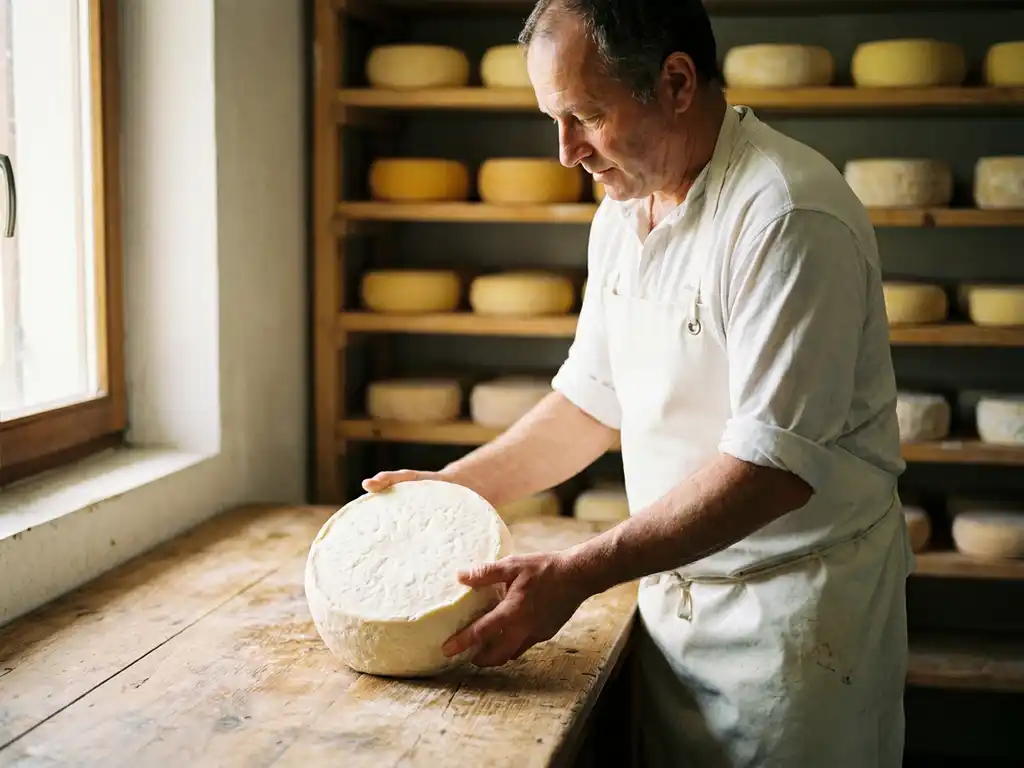
A supplier with its own production facilities gives you — as a buyer or product developer — direct control over quality, flexibility, and lead times. Because the entire production process happens under one roof, there are fewer links in the chain. That means more consistent specs, faster communication, and a shorter path from raw material to finished product. In this article, we answer the most common questions about the benefits of working with a cheese supplier that has its own production facilities.
What does it mean when a cheese producer handles everything in-house?
When a cheese producer handles everything in-house, it means the entire process — from taking in raw materials to packaging and delivery — is done within their own organization. There’s no reliance on outside production partners or contract packers. The producer manages the recipes, aging, quality control, and logistics themselves.
In practice, this means decisions get made faster. If a customer needs a specific fat content or a custom packaging format, the producer doesn’t have to wait for approval from a third party. The knowledge is internal, the lines of communication are short, and responsibility is clear. For buyers in the food industry, that’s a big plus: there’s always one point of contact who oversees the entire process.
Having your own production facilities also means that investments in technology, hygiene, and process improvement go directly toward product quality. There are no shared production lines with other brands, and no rotating production partners each doing things their own way.
How does in-house production guarantee consistent quality?
In-house production guarantees consistent quality because the producer has full control over every stage of the process — from milk selection to the final check before shipment. Because all steps are monitored internally, deviations can be spotted and corrected right away, without involving outside parties.
Consistency in cheese production depends on many variables: milk composition, temperature control during aging, acidity, and moisture levels. When all these parameters are monitored within one integrated system, the chance of batch-to-batch variation is much smaller. That’s exactly what buyers need: confidence that the cheese delivered next month will have the same technical properties as the cheese delivered this month.
In-house production also makes it possible to set standardized product specifications that are maintained from one delivery agreement to the next. That gives you certainty in production planning and prevents costly adjustments on the customer’s end.
Why is customization easier with a supplier that has its own factory?
Customization is easier with a supplier that has its own factory because changes to recipes, packaging, or product composition can be made internally — no outside approval processes needed. The producer can test, adjust, and scale up directly, without depending on a third-party production partner.
For product developers, this is a crucial advantage. When you want to develop a goat cheese with truffle, red onion, or a specific herb blend, it’s essential that the supplier can think along with you on the formulation and immediately assess what’s feasible from a production standpoint. A supplier that produces in-house can run trial batches, incorporate feedback, and refine the concept step by step.
Private label cheese is a great example of how in-house production makes customization possible. The producer can fully tailor flavor profiles, the packaging line, and labeling to the customer’s wishes — without an outside party looking over their shoulder or limiting production turnaround time.
What are the benefits of in-house production for food safety and certification?
In-house production offers significant advantages for food safety because the producer has full authority over hygiene protocols, traceability, and certification processes. There are no gray areas when it comes to responsibility, and audits can be carried out at any time without coordinating with outside production partners.
Certifications like BRC, IFS, or FSSC 22000 are a basic requirement in the food industry. A producer with its own facilities can manage these certifications clearly and demonstrate that the system meets the required standards from raw material to finished product. For buyers dealing with strict retail requirements or export regulations, that’s a real reassurance.
Traceability is another key factor. With in-house production, it’s possible to document exactly which milk batch was used for which production lot, under what conditions the cheese was aged, and which quality checks were carried out. That transparency isn’t just a legal requirement — it’s also commercially valuable for customers who set high standards for documentation.
How does in-house production affect delivery reliability?
In-house production improves delivery reliability because the producer has full control over planning and capacity. There are no outside production partners setting different priorities or passing on capacity problems. The producer can respond directly to changes in demand or unexpected disruptions in the chain.
Supply chain disruptions are a real risk in the food industry. When a supplier depends on outside producers, a problem at that third party can directly cause delays for the end customer. A producer with its own facilities has more tools to handle this: its own inventory management, flexible production planning, and direct communication with the transport partner.
For buyers purchasing large volumes and relying on a steady supply for their production lines, delivery reliability isn’t a nice-to-have — it’s a basic requirement. A supplier that controls the entire chain can agree on realistic lead times and actually stick to them.
When is a supplier with its own facilities the better choice?
A supplier with its own production facilities is the better choice when consistent quality, customization, food safety, and delivery reliability all matter at the same time. The more demands you place on specifications, traceability, and flexibility, the greater the advantage of working with an integrated producer.
In practice, these are the situations where having your own factory makes the difference:
- You work with strict product specifications that need to be guaranteed batch after batch
- You’re looking for a private label cheese supplier with its own packaging line and labeling
- You’re developing new products and need a partner who thinks along with you technically
- You need to demonstrate that your supplier meets international food safety certifications
- You supply retail or foodservice and need certainty about lead times and volumes
A middleman or trader may be sufficient in some cases, but as requirements become more complex, working directly with a producer who controls the entire chain is the most reliable choice.
How DeJong Cheese helps with its own production facilities
As a family business based in Alphen, we at DeJong Cheese produce our Alphenaer goat cheese specialties entirely in-house. That means we are responsible for quality, food safety, and delivery from raw material to finished product. Our customers in the food industry and retail benefit directly from that integrated approach.
Here’s what we offer as a supplier with our own production facilities:
- Consistent quality thanks to fully in-house management of recipes, aging, and quality control
- Customization and private label options for customer-specific flavor profiles, packaging, and labels
- International food safety certifications, so documentation and compliance are never a concern
- Reliable delivery to retail, foodservice, and industry partners worldwide
- Personal collaboration on product development, from first idea to final concept
Whether you’re looking for a reliable goat cheese supplier for large volumes or a partner who thinks along with you on innovative product concepts, we’re ready to talk through the possibilities. Get in touch with us and find out what we can do for your specific situation.
Frequently Asked Questions
How do I start working with a cheese producer that handles everything in-house?
The best way to get started is to request an introductory meeting where you discuss your specifications, volumes, and quality requirements. A producer with its own facilities can then immediately assess what's feasible and put together a concrete proposal. Make sure you know upfront which technical product specifications and certification requirements apply to your organization or customer, so the conversation can get into the details right away.
What are common mistakes when choosing a cheese supplier without its own production?
A common mistake is underestimating how many links there are in the chain when working with a trader or middleman, and what effect that has on consistency and lead times. Buyers sometimes only discover when a quality complaint or delivery issue arises that responsibility is unclear. Another pitfall is not checking whether the supplier can independently meet certification requirements like BRC or IFS, which can cause problems during retail audits.
How flexible is a producer with its own factory when scaling volumes up or down?
A producer with its own production facilities has direct control over capacity planning, which means they can respond to volume changes faster than a party that depends on outside production partners. In practice, it's smart to explicitly include volume flexibility in the supply agreement, including minimum and maximum order quantities and lead times for scaling up. Transparent communication about expected volume fluctuations helps the producer adjust production planning and inventory management in time.
Can smaller buyers also benefit from customization with a producer that has its own facilities?
Yes. While customization is commercially more attractive for both parties at larger volumes, many producers with their own facilities also offer options for smaller runs — for example, during product development or market launches. It's worth asking upfront about minimum production batch sizes and the associated costs for recipe development or packaging adjustments. That way, even as a smaller buyer, you can access custom projects without having to commit to large volumes right away.
How do I verify that a supplier actually delivers on its quality promises?
At the start of the partnership, ask for up-to-date certification documents such as BRC, IFS, or FSSC 22000, and check their validity and the level achieved. Serious producers with their own facilities are also open to customer audits or factory visits, where you can assess the production process and quality controls yourself. It's also useful to include measurable quality parameters and a clear complaints procedure in the contract, so there are concrete agreements in place if a batch doesn't meet the specifications.
What's the difference between sourcing private label cheese from a producer versus a trader?
With a producer that has its own facilities, you have direct influence over the recipe, flavor profile, packaging line, and labeling — without a third party imposing limitations or adding margins. A trader can offer private label cheese, but depends on the producer behind them for any changes, which complicates lead times and communication. For brands that want to stand out on the shelf or in foodservice, working directly with a producer gives you more control over the end result and time-to-market.
What documentation can I expect from a supplier with its own production facilities for export?
A producer with its own facilities can typically provide full traceability documentation, including product specifications, certificates of analysis per lot, declarations of origin, and export documents that meet the requirements of the destination country. For exports outside the EU, additional documents are often required — such as health certificates or country-specific product registrations — which an integrated producer can arrange more quickly because all production data is available internally. Always discuss export requirements with your supplier upfront, so the necessary documentation is built into the delivery process from the start.