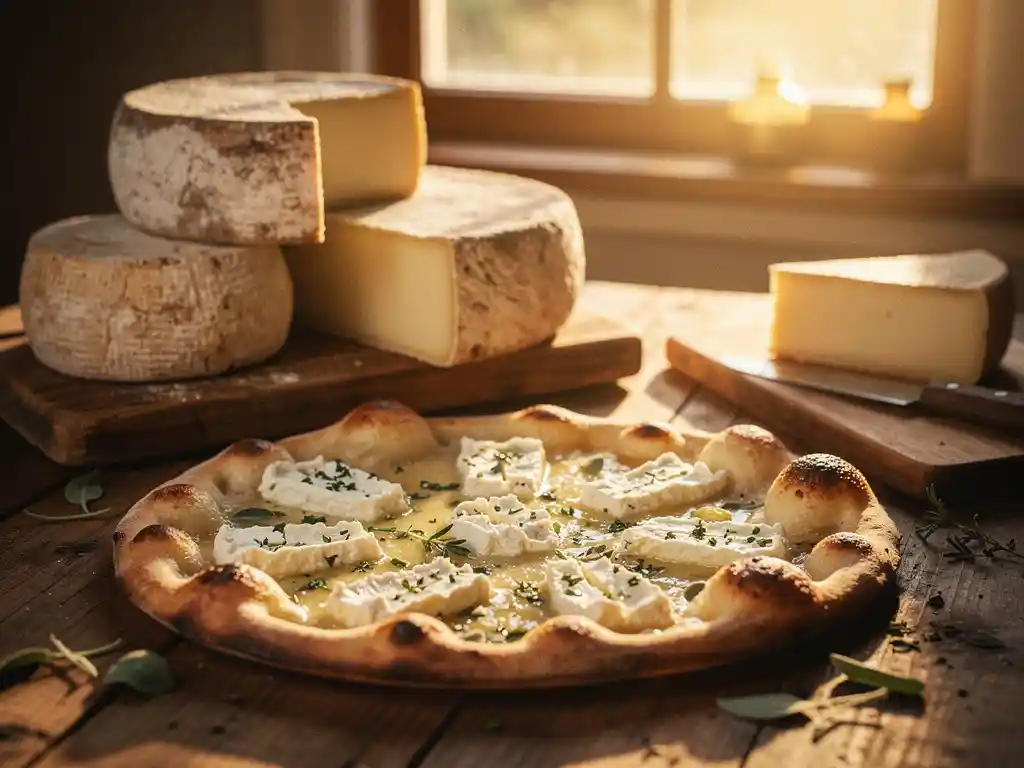
In the food industry, minimum order quantities (MOQs) form a crucial factor when purchasing goat cheese for pizza production. As a buyer in the food industry, you know that the right balance between inventory costs, product quality, and supply security is essential for a smooth production process. For goat cheese in pizza ranges, MOQ requirements play an extra important role due to the specific shelf life, melting characteristics, and seasonal demand fluctuations. This article provides you with concrete insights into MOQ structures for goat cheese products, from fresh to aged varieties, and practical strategies for effective negotiations with suppliers.
What are MOQ requirements and why are they important for industrial cheese purchasing?
MOQ requirements are minimum order quantities that suppliers use to ensure production efficiency and optimize transport costs. For industrial cheese purchasing, MOQs typically mean pallet quantities of 200 to 1200 pieces, depending on product type and packaging size. These requirements ensure cost-effective production runs and stable delivery schedules.
For buyers in the food industry, MOQs offer important advantages. They guarantee consistent product quality because suppliers can produce larger batches with the same specifications. This reduces quality fluctuations between deliveries, a crucial point for automated pizza production lines where every ingredient must perform exactly.
The impact of MOQs extends to inventory management and cash flow. Larger orders mean lower unit prices, but require adequate storage facilities with proper temperature control. For goat cheese with limited shelf life, you must find the balance between cost advantage and the risk of product loss.
MOQ requirements also protect against supply chain disruptions. Suppliers can offer better delivery guarantees for larger orders and give priority to regular customers during peak periods. This reduces the risk of production shutdown due to ingredient shortages.
How do MOQs differ for fresh versus aged goat cheese in pizza production?
Fresh goat cheese typically has MOQs of 266 to 480 pieces per pallet, while aged goat cheese often requires higher MOQs of 1200 pieces. This difference stems from shelf life: fresh goat cheese lasts 10-28 weeks, aged varieties only 7 weeks. The shorter shelf life of aged cheese requires a faster turnover rate.
For pizza production, this brings practical considerations. Fresh goat cheese, such as spreadable varieties with 16% fat content, offers flexibility in processing. The longer shelf life of 28 weeks for certain fresh products allows smaller, more frequent orders without quality loss.
Aged goat cheese develops more complex flavors, but requires more precise planning. The higher MOQs compensate for the shorter shelf life through more efficient production and transport. For pizza applications where melting behavior is crucial, aged varieties often offer superior functionality despite the logistical challenges.
The difference in packaging formats also plays a role. Fresh goat cheese often comes in smaller portions of 100-150 grams, suitable for flexible dosing. Aged varieties are usually available in larger blocks, which facilitates bulk processing in industrial pizza production.
Which factors determine the minimum order quantity for goat cheese specialties?
Production complexity, ingredient costs, and market demand are the primary factors that determine MOQs for goat cheese specialties. Specialties such as truffle or cranberry-cinnamon varieties require MOQs of 1200 pieces with 4 weeks delivery time due to the specific ingredients and customized production processes. These higher thresholds compensate for the extra handling and exclusive raw materials.
Seasonal ingredients significantly influence MOQ structures. Fig varieties, for example, depend on harvest cycles, resulting in larger minimum orders to guarantee year-round availability. Production must anticipate seasonal fluctuations, requiring higher initial volumes.
Technical specifications for industrial processing also dictate MOQ levels. Goat cheese specialties for pizza applications must melt consistently at specific temperatures. This requires controlled production runs where recipe adjustments between small batches are costly.
Packaging requirements form an underestimated factor. Modified Atmosphere Packaging (MAP) for longer shelf life requires minimum production volumes to efficiently utilize the packaging line. Single-use portions for hotel breakfasts or airline meals have different MOQ dynamics than bulk packaging for pizza production.
How do you negotiate flexible MOQs with traditional cheese suppliers?
Successful negotiations about MOQs begin with demonstrating long-term commitment and predictable purchase volumes. Traditional cheese suppliers value stability over incidental large orders. Present annual forecasts and growth scenarios to justify flexibility in initial MOQs. A phased build-up from 266 to 1200 pieces over six months shows realistic growth ambition.
Bundling product lines creates negotiation space. Combine orders for fresh goat cheese with aged varieties to reach total pallet quantities. A mix of natural base products with specialties like fenugreek spreads risks and increases order value without exceeding individual MOQs.
Seasonal planning offers mutual benefits. Accept higher MOQs during low periods in exchange for flexibility during peak months. For pizza producers, this means strategic inventory building during quiet summer months at lower prices, with smaller reorders during busy winter periods.
Technical cooperation strengthens the negotiation position. Share production data about melting behavior and processing results. Suppliers who see their product excel in your application are more willing to adjust MOQs for product development or new varieties. Private label collaborations offer additional leverage for volume agreements.
What are typical MOQ ranges for private label goat cheese products?
Private label goat cheese products typically require MOQs between 1200 and 2400 pieces, depending on packaging complexity and recipe adjustments. These higher volumes compensate for development costs, exclusive production runs, and brand-specific packaging. For standard private label without recipe adjustments, regular MOQs of 266-480 pieces often apply.
Packaging design significantly influences MOQs for private label. Unique labels, customized portion sizes, or special packaging materials increase minimum volumes. A standard 150-gram package with own label has lower MOQs than a custom 125-gram variant that requires new dies.
Exclusivity agreements influence MOQ structures. Regional exclusivity justifies lower initial volumes, while national rights require higher commitments. For pizza chain-specific formulations, progressive MOQ schedules linked to rollout plans often apply.
Certification requirements for private label increase complexity. IFS Food or specific retail audits require separate production runs with full traceability. This administrative overhead translates into MOQ premiums of 20-30% above standard products, but provides certainty about compliance and quality assurance.
How DeJong Cheese helps with flexible MOQ solutions
At DeJong Cheese, we understand the challenges of industrial buyers like Marco Visser. We combine our traditional family values with modern flexibility to offer suitable MOQ solutions for your pizza production. With our expertise since 1995, we have learned that every customer has unique needs.
Our approach for flexible MOQs includes:
- Starting orders from 266 pieces for new customers with fresh goat cheese products
- Phased volume build-up with growing demand
- Combination possibilities between product lines for optimal pallet utilization
- Private label development with realistic initial volumes
- Seasonal flexibility for peak moments in pizza production
Our extensive range for foodservice and industry offers solutions for every production need. From fresh spreadable goat cheese with 28 weeks shelf life to aged specialties with unique melting characteristics – we deliver consistent quality that keeps your production lines running.
Contact us today for a personal conversation about your MOQ requirements. Visit one of our sales points to taste our products, or discover more about our possibilities on our website. Together we will find the perfect balance between your volume needs and our production capacity.
Frequently Asked Questions
How can I as a small pizza producer still benefit from bulk discounts without taking the full MOQ?
Consider cooperation with other local producers to purchase jointly and share MOQs. Many suppliers also accept phased deliveries where you spread the MOQ over several months, or offer seasonal contracts where you commit to an annual volume but receive in smaller partial deliveries.
What are the main pitfalls when negotiating MOQs for goat cheese?
The biggest pitfall is focusing only on the lowest price without considering shelf life and storage costs. Also avoid accepting too high MOQs for new product variants whose sales are uncertain. Always plan buffer for seasonal fluctuations and consider the 7-28 weeks shelf life with your order quantities.
When is it wise to switch from standard to private label goat cheese despite higher MOQs?
Private label becomes profitable when your monthly demand is at least 80% of the MOQ and you seek a unique selling proposition. With a constant sales of 1000+ pieces per month, exclusive recipes for your pizza line, or when brand differentiation is crucial for your market position, the advantages outweigh the higher minimum volumes.
How do I calculate the optimal order quantity between MOQ and maximum storage capacity?
Use the formula: Optimal order quantity = (Daily consumption × Lead time) + Safety stock, where you consider 70% of the shelf life as maximum storage time. For goat cheese with 28 weeks shelf life, this means maximum 20 weeks storage. Also calculate the Total Cost of Ownership including capital costs, storage costs and risk of spoilage.
What documentation and certifications must I provide to negotiate lower MOQs?
Present historical purchase data of at least 12 months, growth figures, production planning and seasonal forecasts. IFS Food or BRC certification of your facility strengthens your position, as well as references from other suppliers. A detailed business plan with realistic volume projections and long-term commitment opens doors for more flexible MOQ agreements.
How do I prevent quality loss with goat cheese when I must purchase larger volumes due to MOQs?
Implement a First-In-First-Out (FIFO) system with clear best-before tracking and temperature monitoring between 2-4°C. Request staggered delivery dates within one order, for example weekly partial deliveries of your MOQ. Invest in Modified Atmosphere storage for fresh varieties and consider freezing grated cheese for longer shelf life without quality loss.
What are alternative purchasing strategies when MOQs are too high for my current production volume?
Start with basic varieties with lower MOQs (266 pieces) and gradually expand. Research spot-buying opportunities for surpluses, or inquire about end-of-line products at reduced MOQs. Some suppliers also offer ‘trial MOQs’ for new customers or test phases, typically 50% of standard MOQs for maximum 3 orders.