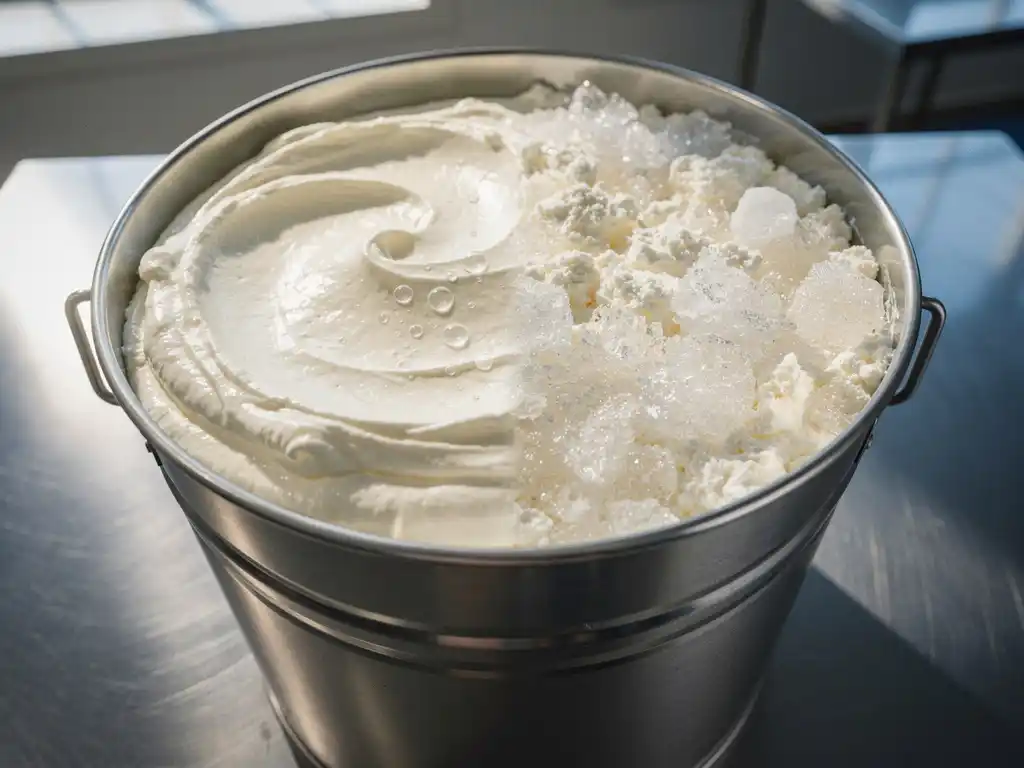
Freezing goat cheese spread in bulk packaging of 10 kilograms is a common practice in the food industry. For producers working with seasonal production or fluctuating demand, freezing offers a practical solution for inventory management. However, this method raises important questions about quality preservation, texture changes, and optimal storage methods. This article examines the impact of freezing on goat cheese spread and provides practical guidelines for industrial processors.
What happens to goat cheese spread during freezing?
During freezing, ice crystals form in the goat cheese spread that disrupt the protein structure and draw moisture from the cheese mass. This process changes the molecular composition, where free water freezes while bound water remains in the protein matrix.
Ice crystal formation occurs gradually and depends on the freezing speed. With slow freezing, larger ice crystals form that cause more structural damage. Quick freezing minimizes this effect by forming smaller, evenly distributed crystals. The fat content in goat cheese spread, which typically ranges between 20-30%, remains stable during the freezing process, but may separate from the aqueous phase.
The emulsion of water, fat, and protein that characterizes fresh goat cheese spread undergoes phase separation. The casein proteins that normally form a network in which fat and moisture are trapped lose their binding force due to ice crystal formation. This explains why the spread often has a different consistency after thawing.
How does the texture of goat cheese spread change after thawing?
After thawing, goat cheese spread often becomes more crumbly and less smooth because the original emulsion structure has been disrupted. The released moisture cannot fully return to its original position in the protein matrix, resulting in a drier texture.
The texture change manifests in various ways. First, syneresis often occurs – the release of moisture from the cheese mass. This moisture collects as a watery layer on the surface or at the edges of the bucket. Second, the spread loses its characteristic creaminess and becomes coarser in structure. The originally smooth, homogeneous mass can change into a granular substance.
For industrial applications where the spread is processed into end products like pizzas or ready meals, these texture changes are not always problematic. During heating, the cheese particles melt together again and the original structure partially restores itself. However, for direct consumption or cold applications like sandwiches, the texture difference remains noticeable.
What influence does freezing have on the flavor of goat cheese spread?
The basic flavor of goat cheese spread remains largely preserved during freezing, but subtle flavor components can be lost. The characteristic fresh, slightly acidic taste remains present, while delicate aromas may flatten due to oxidation during storage.
Flavor changes occur especially during long-term frozen storage. The enzymatic activity that normally continues in fresh cheese is largely halted at freezing temperatures, which stops natural ripening and flavor development. This can result in a less complex flavor experience. Additionally, fats in the spread can oxidize, especially when packaging is not completely airtight, which can lead to a slightly rancid aftertaste.
For goat cheese spread with added ingredients like herbs or honey, these flavorings are more stable during freezing. The basic flavors are better preserved than the subtle undertones of the pure goat cheese itself. This makes varied spreads often more suitable for freezing than natural varieties.
What is the difference between fresh-chilled and frozen goat cheese spread for industrial processing?
For industrial processing, fresh-chilled goat cheese spread performs better in melting behavior and emulsion properties, while frozen spread offers practical advantages like longer shelf life and flexible planning. The main difference lies in processability, where fresh spread doses more easily and melts more evenly.
In production processes where the spread is added to warm products, such as pizzas or casseroles, the differences are less pronounced. Heating restores much of the texture changes caused by freezing. However, the melting behavior of frozen spread can be more irregular, with possibly more fat oil separation during the baking process.
Fresh-chilled spread has predictable behavior in mixing systems and dosing equipment. Viscosity remains constant, which is important for automated production lines. Frozen and thawed spread can show varying consistency within the same batch, requiring adjustments in process parameters. For applications where the spread is processed cold, such as in salads or sandwich production, the quality differences remain most visible.
How long can you store goat cheese spread in a 10 kg bucket in the freezer?
Goat cheese spread in a 10 kg bucket can be safely stored for up to 6 months at a constant temperature of -18°C or lower. After this period, quality gradually decreases, although the product remains microbiologically safe with correct frozen storage.
The optimal storage time depends on various factors. Packaging plays a crucial role – buckets with good sealing and minimal air inclusion maintain quality longer. Temperature stability is essential; fluctuations due to frequent opening of freezers or power outages significantly shorten shelf life.
For industrial users, it is advisable to use a first-in-first-out system and label buckets with a freezing date. After 3 months, texture quality begins to deteriorate noticeably, although the spread still remains suitable for heated applications. For use in cold preparations, a maximum storage time of 3 months is recommended to guarantee optimal quality.
What are the best practices for thawing 10 kg buckets of goat cheese spread?
Always thaw 10 kg buckets of goat cheese spread in refrigeration at 2-4°C for 48-72 hours for even temperature distribution. Avoid thawing at room temperature to prevent bacterial growth and uneven thawing, where the outside becomes soft while the core remains frozen.
The thawing process requires patience and planning. Place the bucket on a rack in the refrigeration so cold air can circulate around it. This promotes even thawing from all sides. Turn the bucket halfway through the process for better temperature distribution. Prevent condensation by wrapping the bucket in plastic during thawing.
After complete thawing, it is important to stir the spread well to reincorporate separated moisture. Use a clean spatula or industrial mixer to make the mass homogeneous. Check the temperature in the center with a thermometer before processing the spread. Once thawed, the spread must be used within 5 days and may not be refrozen.
How DeJong Cheese helps with optimal quality of goat cheese spread
We understand the challenges of industrial processors when it comes to inventory management and quality preservation of goat cheese spread. With our years of expertise since 1995, we offer practical solutions for your specific processing needs.
Our support for industrial customers includes:
- Technical advice on optimal storage and processing methods for large volumes
- Flexible delivery schedules that align with your production cycles
- Consistent quality through our IFS Food-certified production process
- Custom packaging solutions that facilitate freezing and thawing
- Product specifications adapted to your processing temperatures
For more information about our industrial goat cheese products or to discuss your specific needs, please contact us. Also discover where you can find our products through our sales points or visit our homepage for the complete range.
Frequently Asked Questions
Can I use frozen goat cheese spread for cold preparations like wraps or sandwiches?
Technically yes, but the quality is not optimal. Freezing makes the texture more crumbly and less smooth, which is especially noticeable in cold applications. For warm preparations like pizzas or casseroles, frozen spread is suitable because the texture largely restores itself when heated. For premium cold applications, we recommend fresh goat cheese spread.
How do I prevent a water layer from forming after thawing goat cheese spread?
Complete prevention is difficult, but you can minimize it by thawing very slowly at 2-4°C and regularly turning the bucket. After thawing, use an industrial mixer to blend the released moisture back through the mass. Optionally add 1-2% milk powder during mixing to bind excess moisture and improve texture.
Is it possible to freeze goat cheese spread in smaller portions for more flexible use?
Yes, this is even recommended for better quality preservation and ease of use. Divide the 10 kg over several smaller containers of 1-2 kg, freeze these flat for faster freezing and thawing, and pack them airtight in plastic wrap. This way you only need to thaw what you need and the rest remains optimally stored.
What temperature fluctuations are acceptable during frozen storage without quality loss?
Ideally none – constant storage at -18°C or colder is optimal. Brief fluctuations to -15°C are acceptable, but frequent temperature changes cause recrystallization which further damages texture. Invest in temperature monitoring and place goat cheese spread at the back of the freezer where temperature is most stable.
Can I add stabilizers to goat cheese spread to improve freeze resistance?
Yes, certain stabilizers can help. Locust bean gum (0.3-0.5%) or guar gum (0.2-0.3%) help retain moisture during freezing. Cryoprotectants like trehalose or sorbitol (2-3%) protect protein structure. Always test small batches first, as stabilizers can affect taste and processing properties.
How do I recognize if frozen goat cheese spread is still of good quality?
Check after thawing for excessive moisture separation (more than 5% is problematic), discoloration like yellow spots indicating fat oxidation, and sharp or rancid odor. The spread should still become reasonably homogeneous after thorough mixing. When in doubt, test a small amount in your end product before processing the entire batch.