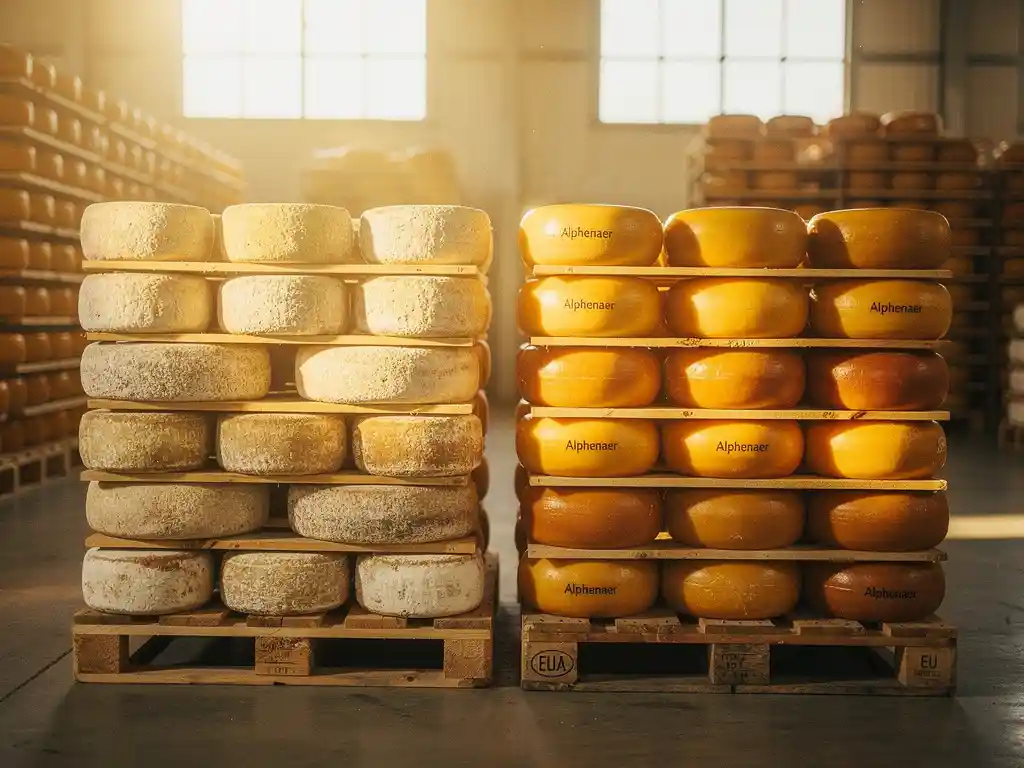
When delivering cheese products, the choice between block pallets and EU pallets plays a crucial role in the logistics chain. For companies in the food industry working with fresh goat cheese, aged goat cheese, or industrial cheese products, the difference between these two pallet types can impact transportation costs, hygiene, and international deliveries. In this article, we discuss the key differences and help you make the right choice for your cheese transport.
What are the key characteristics of a block pallet for cheese transport?
A block pallet is a robust transport platform with nine solid blocks as support points, specially designed for heavy cheese loads up to 1,500 kg. These pallets have dimensions of 120×100 cm and are designed for one-way traffic in the food industry.
Block pallets are distinguished by their sturdy construction with solid wooden or plastic blocks on all corners and in the center. These blocks ensure optimal weight distribution, which is essential when transporting heavy cheese products like our industrial goat curd in 15 kg packages. The pallets can be picked up from four sides by forklifts, which facilitates handling in warehouses.
For cheese transport, block pallets offer specific advantages. They are resistant to moisture, which is important in refrigerated environments where fresh goat cheese is stored. The smooth top surface prevents damage to packaging, while the stable construction prevents products from shifting during transport. With us, for example, 60 boxes of cow and goat cream cheese can be safely stacked on one block pallet.
What are the specific properties of an EU pallet in the cheese industry?
An EU pallet, also called a Europallet, is a standardized wooden platform of 120×80 cm with the EUR mark, specifically designed for efficient transport within Europe. These pallets are interchangeable and have a load capacity of up to 1,000 kg for cheese products.
EU pallets are characterized by their uniform construction with three crossbeams and nine blocks. The EUR brand guarantees quality according to EPAL standards, which means that each pallet meets strict specifications. For the cheese industry, the heat treatment (ISPM-15) is particularly important, making the pallets suitable for international shipments without risk of pests.
In practice, this means that EU pallets are ideal for transporting smaller cheese batches. Our fresh goat cheese slices, for example, are packaged with 48 boxes per EU pallet, ensuring optimal utilization of transport space. The standardized dimensions make it possible to stack pallets efficiently in trucks and containers, with two EU pallets fitting exactly side by side in a standard truck.
The pooling system of EU pallets offers additional advantages for the cheese industry. Pallets can be exchanged upon delivery, simplifying return logistics and reducing storage costs.
What is the difference in hygiene between block pallets and EU pallets for cheese products?
Block pallets offer superior hygiene for cheese transport through their closed top surface and possibility of plastic construction, while EU pallets with open structure present more cleaning challenges but meet HACCP standards when properly maintained.
With block pallets, the solid construction prevents dirt and moisture from accumulating in cracks and crevices. Plastic block pallets can be completely cleaned with high-pressure sprayers and disinfectants, which is crucial for transporting unpackaged cheese products or products in buckets like our goat cheese spread. The smooth surfaces are resistant to mold and bacteria, ensuring food safety.
EU pallets, on the other hand, have an open structure with gaps between the boards where food residue and moisture can accumulate. This requires more intensive cleaning and regular inspection. For sealed products like our MAP-packaged cream cheese, this poses less risk, but contamination can occur in case of leaks. Wooden EU pallets also absorb moisture, which can lead to mold formation in humid refrigerated environments.
For optimal hygiene in the cheese industry, plastic interlayers or pallet covers are often used, regardless of the pallet type. This prevents direct contact between product and pallet and simplifies cleaning after use.
Which pallet is most cost-effective for cheese transport?
EU pallets are generally 30-40% cheaper to purchase and offer lower total costs through the pooling system, while block pallets have higher initial costs but offer advantages for heavy transport and one-way traffic to distant destinations.
The purchase price of a new EU pallet ranges between 12-18 euros, while block pallets cost 20-30 euros. For companies that regularly transport cheese products within Europe, the EU pallet pooling system offers significant savings. You only pay a small rental fee per use and don’t need to organize return shipments. This is ideal for our deliveries of fresh goat cheese to retail and foodservice within the EU.
Block pallets are more cost-effective for specific situations. When exporting outside Europe, you avoid complex return logistics, and the higher loading capacity means fewer pallets per shipment. For our industrial customers who purchase large volumes of goat curd, the 60 boxes per block pallet versus 48 per EU pallet can make a difference in transport costs.
Other cost factors include:
- Storage space: EU pallets take up 20% less space
- Handling: Block pallets require less repackaging for heavy loads
- Lifespan: Plastic block pallets last 5-10 years versus 2-3 years for wooden EU pallets
- Insurance: Lower damage risks with block pallets can reduce premiums
How do you choose the right pallet for international cheese delivery?
For international cheese delivery within Europe, the EU pallet is the standard choice due to universal acceptance and pooling systems, while block pallets are better suited for intercontinental shipments and markets without established pallet standards.
Within the European Union, EU pallets make cross-border transport easy. They are accepted by all distribution centers and can be exchanged upon delivery. For our export of spreadable goat cheese to Germany or France, EU pallets are ideal because recipients are familiar with the system and can immediately distribute to their customers.
For export to North America, Asia, or the Middle East, block pallets are often more practical. These markets don’t have an EU pallet pooling system, making return logistics complex. Block pallets can be sold or recycled in the destination country after delivery. Additionally, ISPM-15-treated block pallets meet all international phytosanitary requirements.
Product-specific factors also play a role in the choice:
- Refrigerated transport: Block pallets offer better insulation from the ground
- Long transit times: The robust construction of block pallets prevents sagging
- Customs inspection: EU pallets are recognized and approved faster within Europe
- Final destination: Retail in Europe prefers EU pallets, industry worldwide accepts both
How DeJong Cheese helps with the right pallet choice for your cheese delivery
At DeJong Cheese, we understand that the right pallet choice is crucial for efficient and safe delivery of our cheese products. With more than 25 years of experience in worldwide deliveries of goat cheese specialties, we are happy to advise you on the optimal transport solution for your specific situation.
Our expertise includes:
- Advice on pallet choice based on your destination and order size
- Optimal stacking for maximum product safety during transport
- Adaptation of packaging units to your preferred pallet type
- Support with international shipping documentation
- Flexible delivery options for both small and large volumes
Whether you choose our fresh goat cheese for retail, industrial curd for further processing, or our complete foodservice range, we ensure the right packaging and palletizing. Contact us for personal advice on your transport needs. Also visit our sales points page for local availability or discover more about our complete range on our homepage.
Frequently Asked Questions
How can I determine how many boxes of cheese can safely fit on one pallet?
The number of boxes depends on the weight per box, stacking height, and pallet type. For EU pallets, a maximum of 1,000 kg applies and for block pallets 1,500 kg. First calculate the total weight and account for a maximum stacking height of 1.80 meters for stability. Always use shrink film or stretch film for extra security and stack heavier boxes at the bottom.
What are the best practices for cleaning used pallets before reusing them for cheese transport?
Start by removing all visible contamination with a brush or high-pressure cleaner. Disinfect wooden pallets with a food-safe disinfectant and let them dry completely to prevent mold formation. Plastic pallets can be cleaned at 80°C in an industrial pallet washer. Always inspect for splinters, broken parts, or mold before reuse and document cleaning according to HACCP guidelines.
What insurance coverage do I need for international cheese transport and does this differ per pallet type?
For international transport, you need at least CMR insurance that covers transport damage. Consider additional goods insurance for the full invoice value plus 10% for additional costs. The pallet type indirectly affects the premium: block pallets often have lower damage risks which can result in lower premiums. Discuss with your insurer specific coverage for temperature fluctuations and delays in refrigerated transport.
How do I prevent condensation on cheese products during the transition from refrigerated transport to ambient temperature?
Let pallets with cheese products gradually acclimatize by first placing them for 2-4 hours in an intermediate space with a temperature halfway between cooling and ambient. Use moisture-absorbing interlayers or silica gel bags in the packaging. Ensure adequate ventilation around the pallets and avoid direct sunlight. With MAP-packaged products, the risk is smaller, but always check packaging integrity after temperature changes.
Can I combine block pallets and EU pallets in one shipment?
Technically this is possible, but not recommended due to different dimensions (block: 120×100 cm, EU: 120×80 cm) that cause inefficient loading patterns. This leads to instability during transport and higher freight costs due to suboptimal space utilization. Choose one pallet type per shipment or divide the load over separate compartments. With LTL transport (Less Than Truckload), different pallet types can be combined provided they are properly secured.
What are the consequences for my CO2 footprint when choosing between wooden and plastic pallets?
Plastic pallets have a higher initial CO2 footprint during production but compensate for this through their longer lifespan (5-10 years versus 2-3 years for wood) and recyclability. Wooden pallets bind CO2 during their lifespan but require more frequent replacement. For the best environmental choice: use plastic pallets for fixed routes with return logistics and wooden pallets for one-time international shipments. Also consider pallets made from recycled material for extra sustainability.
Related Articles
- How do you compare domestic versus foreign goat cheese producers on reliability?
- What are the benefits of goat cheese in catering solutions?
- What are portion sizes for different goat cheese applications?
- How to streamline goat cheese ordering processes?
- What are the benefits of goat cheese for foodservice?