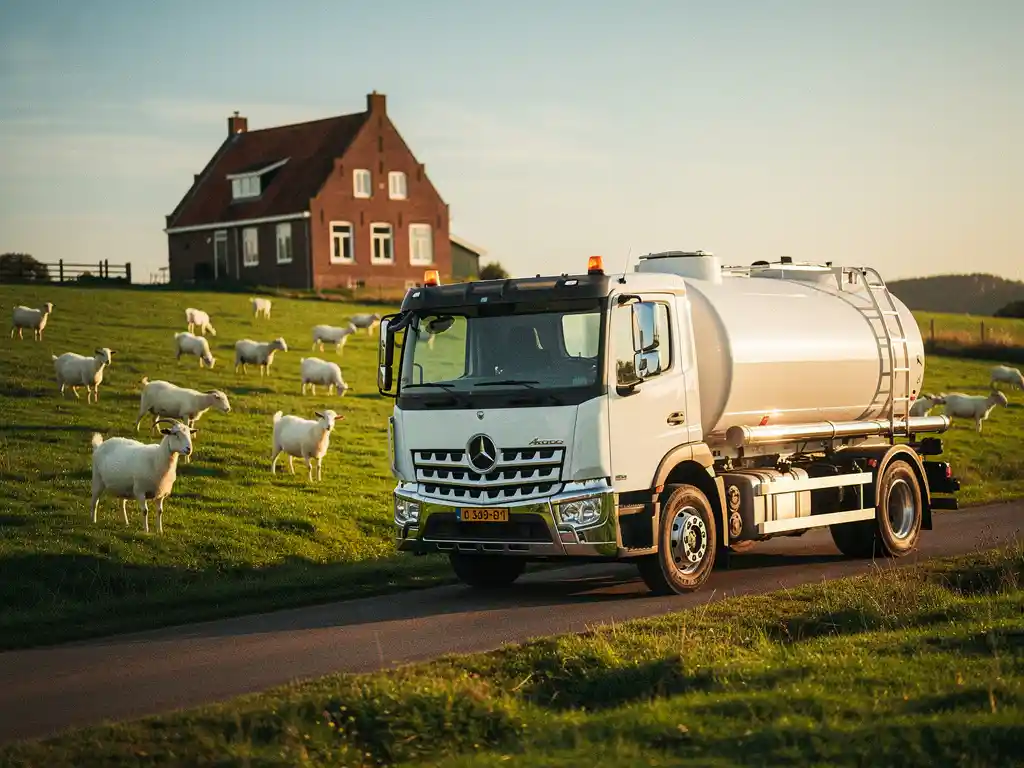
For industrial food producers, the reliability of their cheese supplier is crucial. A disruption in the supply chain can halt production and lead to costly delays. But did you know that the distance between your supplier and their milk sources has a direct impact on delivery reliability and quality consistency? In this article, we explore why suppliers with their own milk sources within 100 kilometers offer a significant advantage for industrial customers.
What does a supplier with their own milk sources within 100 km mean?
A supplier with their own milk sources within 100 kilometers has direct control over milk deliveries from farms in the nearby area. This means shorter transport times, personal relationships with dairy farmers, and complete transparency about the origin and quality of the most important raw material for cheese production.
This geographical proximity creates a closed chain where the cheese supplier works closely with local farmers. Instead of depending on milk from different regions or even countries, such a supplier works with a fixed network of trusted milk producers. This model stands in stark contrast to large industrial players who purchase milk through international traders or cooperatives.
For a traditional family business like ours, this means we have been working with the same families of dairy farmers in the region since 1995. These long-term partnerships ensure mutual understanding of quality requirements and delivery agreements. Our milk suppliers know exactly the specifications needed for our fresh goat cheese, aged specialties, and industrial applications such as goat cheese crumbles or spread.
Why is the distance to milk sources crucial for quality?
Short transport distances mean that milk can be processed within a few hours after milking, resulting in superior freshness and preservation of natural properties. Each additional transport hour reduces milk quality through temperature fluctuations, movement, and time passage, which directly affects the end product.
The microbiological quality of milk begins to decline as soon as it leaves the milk tank. During transport over long distances, milk must be extra cooled and stabilizers are often added to ensure quality. Local milk, on the other hand, retains its natural composition and flavor profile.
For industrial applications, this quality consistency is essential. When you use goat cheese pucks for pizzas or goat cheese spread for ready meals, the melting behavior and texture must be identical every time. Fresh milk from nearby sources gives a more predictable result because the composition shows less variation.
Furthermore, suppliers with local milk sources can respond faster to specific quality requirements. Do you need a customized fat content for your production line? Or a specific protein profile for optimal melting behavior? With direct communication lines to milk producers, these adjustments can be realized much more efficiently.
How do local milk sources ensure more reliable deliveries?
Local milk sources within 100 kilometers eliminate many supply chain risks because transport is minimal, direct communication is possible, and there is no dependence on international logistics. This results in consistently available raw materials and thus guaranteed production deliveries to industrial customers.
When milk has to come from far away, the supply chain is vulnerable to disruptions such as:
- Border controls and customs procedures
- Weather conditions affecting long transport routes
- Strikes in the transport sector
- Fuel shortages or price fluctuations
- Technical failures in refrigerated transport over long distances
A supplier with local sources can largely avoid these risks. Our milk transports, for example, cover a maximum of 100 kilometers, often even less. This means that even under unexpected circumstances, the milk can still be processed the same day. For products like our goat curd for industrial processing or the new lactose-free goat milk, this freshness is crucial for shelf life and quality.
Additionally, local sourcing creates flexibility in delivery schedules. Do you suddenly need extra volume for a large order? With milk farmers nearby, we can quickly scale up without having to plan transport weeks in advance.
What is the difference between local and international milk chains?
Local milk chains are characterized by direct relationships, short lines, and complete transparency, while international chains work through intermediaries, long transport routes, and complex trading structures. This fundamental difference significantly affects both product quality and delivery security.
Local milk chains offer:
- Direct communication between cheese producer and dairy farmer
- Traceability to individual farms
- Consistent quality profile through stable feeding and management
- Quick adjustments possible with changing specifications
- Lower CO2 footprint through minimal transport
International milk chains, on the other hand:
- Work through milk traders and cooperatives
- Mix milk from different regions and countries
- Have longer lead times from milk to end product
- Are subject to currency fluctuations and trade barriers
- Offer less flexibility in specifications
For industrial processors like Marco Visser, who prioritize consistent quality and reliable deliveries, these differences matter. A batch of goat cheese crumbles made from local milk will perform more consistently in your production line than a batch made from international milk mixtures. The natural variation in milk composition between regions can affect melting behavior, texture, and even shelf life.
What benefits does this offer for industrial food producers?
Industrial food producers benefit from lower supply chain risks, more consistent product quality, more flexible delivery schedules, and often sharper prices through elimination of intermediary trade. These benefits translate directly into more reliable production and better margins.
The main benefits for your production are:
1. Predictable quality for your production line Do you suddenly need to scale up for a large order? Or do you need a customized specification such as higher dry matter content for your application? With direct lines to milk producers, adjustments can be realized quickly.
3. Better shelf life of end products Without international transport, customs costs, and multiple intermediaries, sharp prices can be offered. This is especially important given the current volatility in milk prices.
5. Sustainability benefits More and more end consumers appreciate local sourcing. With a supplier who sources locally, you can carry this sustainability claim through to your own products.
How do you recognize a reliable supplier with local milk sources?
A reliable supplier with local milk sources can name specific farms, has long-term cooperation contracts, offers complete traceability, and can provide consistent quality certificates. Always ask for concrete evidence of local sourcing and direct relationships with milk producers.
Look for these characteristics in your selection:
- Transparency about origin: Can the supplier indicate exactly which farms the milk comes from?
- Long-term partnerships: Has the supplier been working with the same dairy farmers for years?
- Geographical proximity: Is the production location actually within 100 km of the milk sources?
- Quality certification: Do both the supplier and the milk producers have relevant certifications such as IFS Food?
- Flexibility: Can the supplier quickly respond to volume changes or specific quality requirements?
Also ask for references from other industrial customers. A reliable supplier will gladly share how they help other food producers with consistent deliveries. Test responsiveness by asking specific questions about your applications, whether it involves pizza cheese with specific melting behavior or spread for sandwich production.
A final important indicator is the willingness to receive you on location. A supplier who truly works locally will be proud of this approach and gladly give you a tour of both the production location and some partner companies.
How DeJong Cheese helps with reliable deliveries through local milk sources
As a traditional family business since 1995, we at DeJong Cheese have consciously chosen to collaborate with dairy farmers within 100 kilometers of our production location in Alphen. This strategy enables us to provide industrial customers like you with consistent quality and reliable deliveries, even during times of supply chain disruptions.
Our local approach offers you concrete benefits:
- Guaranteed availability: Through direct contracts with regional milk producers, we can guarantee volumes, even during shortages
- Consistent specifications: Our goat cheese crumbles, pucks, and spread always have the same technical properties thanks to stable milk quality
- Quick response: Specific wishes for your production line? We connect directly with our milk suppliers
- Complete traceability: For every batch, we can indicate exactly which farm the milk comes from
- Flexible volumes: Whether you need 5 kg bags of crumbles or 10 kg buckets of spread, we can quickly scale up or down
Would you like to experience how local milk sources make the difference for your production? Contact our team through our contact page for a non-binding conversation about your specific needs. Also visit our foodservice page for more information about our complete industrial range.
For a personal introduction, we gladly invite you to our Alphen Experience Centre in Alphen, where you can not only taste our products but also learn more about our local approach. Check the opening hours and directions or schedule an appointment directly with your account manager through our homepage.
Frequently Asked Questions
How can I as an industrial customer verify that my cheese supplier actually uses local milk?
Ask for concrete documentation such as milk receipts, transport registrations, and certificates of origin. A reliable supplier can provide exact farm names, addresses, and transport distances. Also ask for a tour of both the production location and some milk suppliers – transparent suppliers will gladly facilitate this.
What are typical cost savings when working with a supplier with local milk sources?
While exact savings vary, industrial customers often see 5-15% lower total costs through elimination of international transport costs, customs costs, and intermediary trade. Additionally, there are indirect savings through less production downtime, lower inventory costs due to more reliable deliveries, and less quality rejection due to more consistent raw materials.
How quickly can a supplier with local milk sources scale up with sudden volume demand?
With direct relationships with dairy farmers within 100 km, scaling can often be realized within 48-72 hours, depending on the requested volume. This is significantly faster than international chains that need 2-4 weeks. For structural volume increases, about a week of preparation time is realistic to optimally coordinate milk production and transport.
What technical specifications can I get better guaranteed with local milk sourcing?
Local sourcing offers superior control over fat content (±0.1% deviation), protein composition, pH value (crucial for melting behavior), bacteriological quality, and absence of antibiotics. Also specific wishes such as seasonal adjustments in feeding for flavor profile or adjusted calcium-phosphate ratios for optimal melting behavior are achievable through direct communication with milk producers.
What happens to delivery security during seasonal fluctuations in milk production?
Suppliers with local milk sources anticipate seasonal patterns through long-term contracts with multiple regional farmers. During lower production periods (winter) they have priority with their regular suppliers, while international players must compete on the world market. This guarantees stable deliveries for industrial customers, regardless of the season.
How does the 100 km radius affect the shelf life of industrial cheese products?
Milk that is processed within 4-6 hours after milking (possible within 100 km) results in 20-30% longer shelf life of the end product. For frozen products like cheese crumbles, this means up to 6 months extra quality retention. For refrigerated products like spread, shelf life can be extended by 2-4 weeks, providing crucial inventory flexibility.
What certifications should I minimally expect from a supplier with local milk sources?
At minimum IFS Food or BRC certification for the cheese supplier itself, plus KKM (Chain Quality Milk) or comparable certification for all milk suppliers. For export, additional certifications such as EU recognition and HACCP are often required. Also ask for animal welfare certificates and sustainability labels that are becoming increasingly important for end consumers.