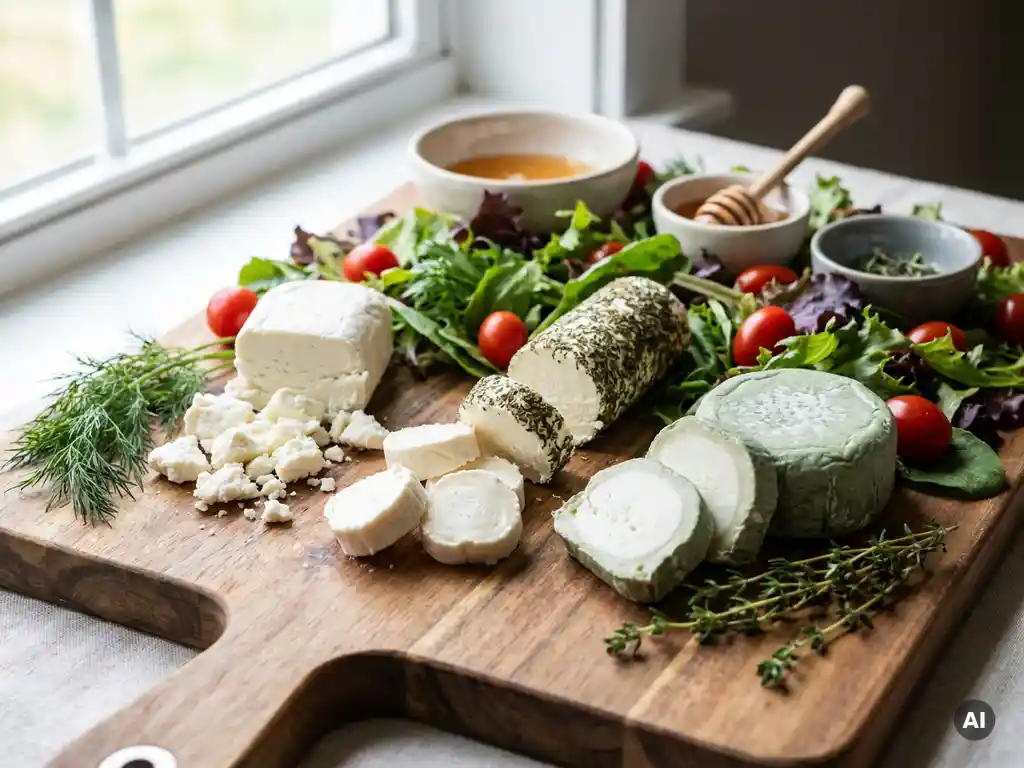
For salad producers, the most commonly used goat cheese forms are crumbled fresh goat cheese, soft goat cheese cubes, and thin slices of aged goat cheese. The choice depends on the desired texture, shelf life, and processability in industrial operations. In this article, we answer the most frequently asked questions about goat cheese forms, textures, and flavor combinations for salad recipes.
What textures and consistencies are available in goat cheese?
Goat cheese is available in a wide range of textures, from creamy and spreadable to firm and sliceable. For salad producers, the most relevant consistencies are: fresh soft goat cheese with a light, crumbly structure, semi-hard goat cheese that cuts easily into cubes, and aged goat cheese with a drier, more pronounced rind. The right texture determines how the ingredient behaves during production and in the final product.
Fresh goat cheese has a high moisture content and a soft, creamy consistency. This makes it ideal for salad dressings, pureed applications, or as a creamy component in a mixed salad. Soft goat cheese holds its shape better when portioning, but melts slightly when in contact with heat or moist ingredients.
Semi-hard and aged varieties have a firmer structure and hold their shape better in a salad, even after mixing with other ingredients. They are less sensitive to moisture loss or structural changes during storage. For producers working with longer shelf-life requirements or products that are mechanically mixed, a firmer goat cheese offers more process reliability.
Which packaging and portion format suits industrial salad processing?
For industrial salad processing, pre-crumbled goat cheese in bulk packaging, cut cubes in modified atmosphere, and frozen portions are the most suitable formats. These formats connect seamlessly to automated production lines, reduce manual handling, and ensure consistent portioning per batch.
Pre-crumbled goat cheese saves time and ensures even distribution throughout the salad without an extra processing step. Cubes in modified atmosphere have a longer shelf life and are ready to use immediately. For producers working with seasonal or fluctuating volumes, frozen goat cheese offers flexibility in inventory management without sacrificing quality.
When choosing a packaging format, logistical factors also play a role, such as storage at refrigerated or frozen temperatures, transport time, and hygienic processability on the production line. A supplier that thinks along with you on custom packaging formats and portion weights makes a real difference for efficient production.
How does the ripening stage affect flavor in salad recipes?
The ripening stage of goat cheese has a direct impact on flavor intensity and the way the cheese influences other ingredients in a salad. Fresh goat cheese tastes mild, slightly tangy, and creamy, while aged goat cheese develops a stronger, sometimes nutty or earthy flavor. This difference determines the flavor balance of the final product.
For salad recipes with delicate ingredients such as young leafy greens, cucumber, or light vinaigrettes, a fresh or lightly aged goat cheese is a better fit. The mild tanginess enhances fresh flavors without overpowering them. In salad recipes with more robust ingredients, such as roasted vegetables, walnuts, or bold dressings, a more aged goat cheese adds depth and complexity.
Product developers are well advised to test the ripening stage in combination with the other ingredients and the intended shelf life of the final product. A lightly aged goat cheese may continue to ripen during the shelf life of a salad, which affects the flavor. This is a technical point that needs careful consideration during product development.
Which goat cheese forms are suitable for clean-label salad recipes?
For clean-label salad recipes, fresh goat cheese and minimally processed soft goat cheese are the most suitable forms. They naturally contain few ingredients: goat’s milk, starter culture, and rennet, with no need for preservatives, colorings, or flavorings. This makes them immediately usable in products with a short, transparent ingredient list.
Clean-label is one of the strongest drivers in product development for retail and foodservice in 2026. Consumers read labels more critically than ever and expect ingredients to be recognizable and honest. Goat cheese fits naturally into this trend, as long as production takes place without unnecessary additives.
Key considerations for clean-label goat cheese as an ingredient:
- Simple ingredient list on the cheese itself, without artificial additives or synthetic ingredients
- Traceability of the milk, preferably with regional or local origin
- Artisanal production method that aligns with the brand identity of the salad producer
- No unnecessary preservation through additives, but through controlled refrigeration or packaging technology
A goat cheese that meets these criteria not only strengthens the clean-label claim of the salad, but also adds an authentic story that can be communicated on the packaging.
What are popular flavor combinations with goat cheese in salad recipes?
The most popular flavor combinations with goat cheese in salad recipes are beet with walnut, fig with arugula, truffle with young spinach, and red onion with honey. The mild tanginess of goat cheese acts as a flavor bridge between sweet, bitter, and savory ingredients, making it a versatile goat cheese ingredient in seasonal and premium salad lines.
Some proven combinations that work well in industrial salad recipes:
- Goat cheese and beet: a classic combination where the earthy sweetness of beet balances the tanginess of goat cheese
- Goat cheese and truffle: a premium positioning that fits well with high-end retail concepts and foodservice
- Goat cheese and red onion: the mild sharpness of red onion enhances the flavor depth of soft goat cheese
- Goat cheese and honey: a sweet-savory combination that is widely appreciated and works well in seasonal concepts
- Goat cheese and herbs: thyme, rosemary, or basil add a Mediterranean dimension to goat cheese salad
For product developers working with trendy concepts, goat cheese also offers room for less obvious combinations, such as goat cheese with miso dressing, fermented vegetables, or smoked nuts. The mild base structure of fresh goat cheese makes it an ideal neutral canvas for experimental flavor development.
How we help you find the right goat cheese forms for salad recipes
As a family business with over thirty years of experience in goat cheese specialties, we are happy to work alongside product developers looking for the right goat cheese forms for salad producers. Through our brand Alphenaer, we offer a wide range of fresh and soft goat cheese specialties, produced according to traditional recipes with a focus on quality and traceability.
What we can offer for salad recipe development:
- Custom portioning and packaging, tailored to your production line and volume requirements
- Choice of ripening stages, from fresh and mild to lightly aged with more character
- Clean-label goat cheese without unnecessary additives, suitable for transparent ingredient lists
- Private label options for retail and foodservice
- Technical support in developing new product concepts and flavor combinations
Whether you are developing a new salad line for the retail market or looking for a reliable partner for a foodservice concept, we are happy to think along with you. Get in touch and tell us about your product development challenge, and together we will look at which goat cheese specialties best suit your recipe.
Frequently Asked Questions
How long does goat cheese last as an ingredient in a finished salad?
The shelf life of goat cheese in a finished salad depends strongly on the type of cheese and the packaging technology. Fresh goat cheese typically has a shorter shelf life of 3 to 7 days in a refrigerated salad, while semi-hard varieties in modified atmosphere can extend this to 10 to 14 days. It is strongly recommended to conduct shelf-life trials with the specific cheese type and the other salad ingredients, so you can be sure that the texture and flavor remain stable until the end of the best-before date.
Can goat cheese be used in warm or heated salad concepts?
Yes, but the choice of cheese type is crucial here. Fresh and soft goat cheese melts quickly with heat and can lose its structure, causing unwanted clumping or moisture leakage. For warm applications, such as salad bowls with grilled vegetables or warm grain components, semi-hard or lightly aged varieties are a better choice because they hold their shape better at higher temperatures.
What are the most common mistakes when processing goat cheese in industrial salad lines?
A common mistake is adding goat cheese too early in the mixing process, causing the cheese to break down too finely or lose its structure due to mechanical stress. In addition, producers sometimes underestimate the moisture-releasing effect of fresh goat cheese, which can lead to a waterier dressing or shorter shelf life of the salad. It is advisable to add goat cheese as late as possible in the production process and to carefully align the portioning with the process conditions.
How do I choose the right ripening stage for my specific salad concept?
Start by determining the flavor intensity you are aiming for and the other ingredients in your recipe. For fresh, light salads with leafy greens and light vinaigrettes, a fresh or milder goat cheese is the safest choice, while more robust concepts with roasted vegetables or bold dressings benefit from a lightly aged variety. Also keep in mind that goat cheese may continue to ripen during the shelf life of the salad, which affects the final flavor — this makes taste testing at T0 én at the end of the best-before date essential.
Is frozen goat cheese as suitable as fresh goat cheese for salad recipes?
Frozen goat cheese is an excellent option for producers who need flexibility in inventory management or work with seasonal volumes, but there are some points to consider. After thawing, the texture may become slightly softer or more crumbly than fresh cheese, which can be an advantage in some applications but less desirable in others. Always test the thawed cheese for texture, moisture content, and flavor before incorporating it definitively into your recipe, and ensure a controlled thawing process to minimize quality loss.
Which certifications or quality marks are relevant when sourcing goat cheese for clean-label products?
For clean-label salad recipes, certifications such as BRC, IFS, or FSSC 22000 are a basic requirement from a food safety perspective. In addition, an origin certification or regional product label can strengthen the clean-label claim of your product and add an authentic story for the consumer. Also ask your supplier about the availability of a full ingredient declaration and traceability documentation for the goat’s milk used, so you can communicate transparently on the packaging.
How can I as a product developer quickly test which goat cheese variant best suits my recipe?
The most efficient approach is to set up a structured taste comparison with two to three goat cheese types side by side — preferably a fresh, a lightly aged, and a semi-hard variety — combined with the core components of your salad. Evaluate not only the flavor on day één, but also the texture and flavor evolution at the end of the intended shelf life. A supplier with technical support can guide you through this with custom samples and advice on the most suitable portioning and packaging format for your production line.
Related Articles
- How do you research which target audience is the best fit for a new goat cheese concept?
- What role does texture play in choosing goat cheese for snack concepts?
- How do you prevent food waste when using goat cheese curds on a large scale?
- How can goat cheese support menu innovation?
- How to handle goat cheese during peak seasons?