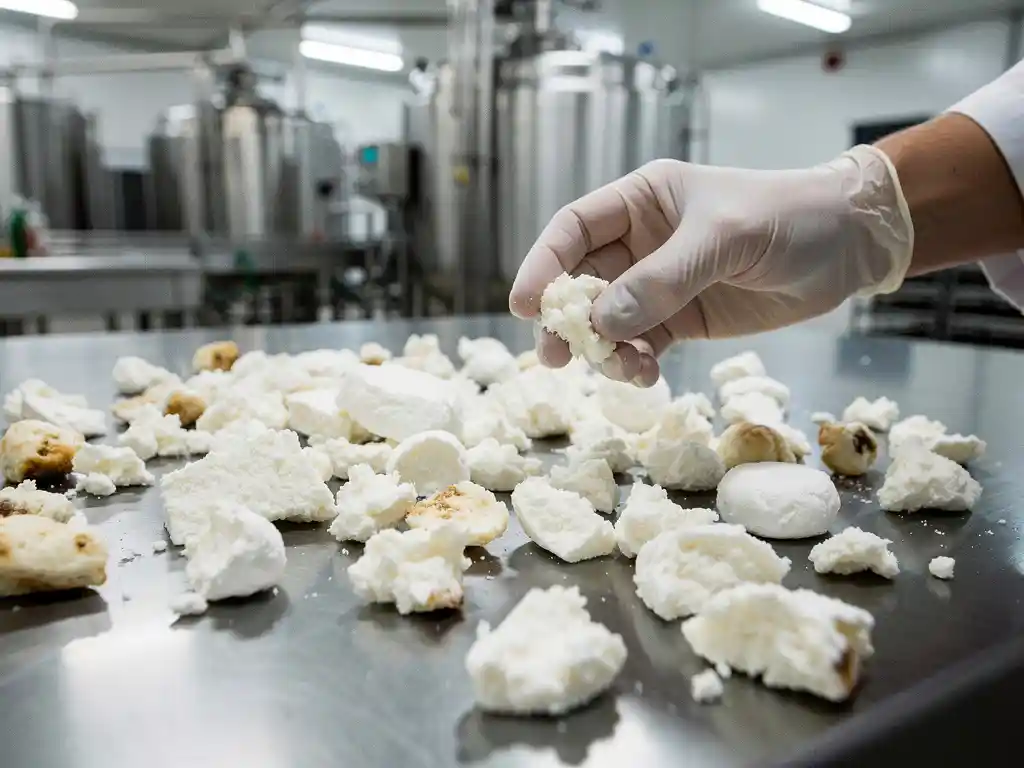
As a buyer in the food industry, you know that the shelf life of goat cheese crumbles is crucial for efficient production. Whether you’re producing pizzas, salads, or ready-to-eat meals, properly planning your goat cheese inventory prevents waste and guarantees consistent product quality. At DeJong Cheese, we understand the specific challenges of industrial processing and are happy to share our expertise on the shelf life of goat cheese crumbles.
What is the shelf life of goat cheese crumbles in industrial applications?
Fresh goat cheese crumbles have a shelf life of 8 to 12 weeks from production date when stored refrigerated (2-4°C), while frozen crumbles remain fresh for up to 12 months at -18°C. This shelf life applies to unopened packages in Modified Atmosphere Packaging (MAP), where the natural moisture and fat content of the goat cheese is optimally preserved.
The exact shelf life depends on various factors, such as moisture content, pH value, and production process. Goat cheese crumbles with lower moisture content (approximately 45-50%) typically have a longer shelf life than variants with higher moisture content. For industrial applications involving heating, such as pizzas or gratins, the functional properties of the crumbles remain stable throughout the entire shelf life period.
It’s important to know that shelf life is calculated from the production date, not from delivery. Therefore, we advise industrial processors to consider the remaining shelf life needed for their production process and distribution chain when placing orders.
How do storage conditions affect the shelf life of goat cheese crumbles?
Temperature is the most important factor affecting shelf life: each degree above the recommended 2-4°C shortens shelf life by approximately 10%, while temperature fluctuations cause quality to deteriorate faster due to condensation and microbial growth. A constant cold chain is therefore essential for maintaining product quality and maximum shelf life.
Besides temperature, humidity and packaging also play a crucial role. The ideal relative humidity is between 75-85% to prevent dehydration without promoting mold growth. MAP packaging with controlled gas composition (typically 30% CO2 and 70% N2) significantly extends shelf life by inhibiting the growth of undesirable microorganisms.
Light exposure can accelerate oxidation, especially in crumbles with added herbs or spices. Dark storage or UV-protective packaging helps preserve the flavor and color of the goat cheese. Cross-contamination must also be prevented by storing goat cheese crumbles separately from products with strong odors or potentially pathogenic microorganisms.
What are the quality indicators of goat cheese crumbles during storage?
The main quality indicators are texture (crumbles should remain loose and crumbly), color (white to light ivory without discoloration), odor (fresh and characteristic without sour or ammonia-like smells), and taste (mild and creamy without bitterness). Deviations in these characteristics indicate quality loss or spoilage.
Visual inspection is the first step in quality control. Fresh goat cheese crumbles have a uniform, white to light cream-colored appearance. Yellow discoloration, visible mold, or wet spots are signs of spoilage. The texture should feel dry and crumbly without clumping or hardening at the edges.
Microbiological indicators are especially important for food safety. Regular monitoring of total plate count, lactic acid bacteria, yeasts, and molds provides insight into microbiological stability. An increase in pH value (normal 4.5-5.0 for fresh goat cheese) may indicate unwanted bacterial activity. For industrial processors, it’s essential to monitor these parameters according to an established quality control program.
How do you extend the shelf life of goat cheese crumbles for industrial processing?
Extending shelf life begins with strict temperature control (constant 2-4°C), optimal packaging (MAP with proper gas composition), minimal handling to prevent cross-contamination, and the first-in-first-out principle for inventory management. These measures combined can extend the usable period by 20-30%.
Freezing is an effective method to drastically extend shelf life. Goat cheese crumbles can be stored at -18°C for up to 12 months without significant quality loss. It’s important to freeze quickly to prevent large ice crystals that can damage texture. When thawing, this should be done gradually in refrigeration to minimize moisture loss.
Additional preservation techniques include using natural antioxidants like rosemary extract or tocopherols, which slow oxidation without affecting flavor. For specific industrial applications, post-packaging pasteurization may also be considered, although this can affect texture. Optimizing pH value and salt content within acceptable flavor limits also contributes to longer shelf life.
What is the difference between fresh and frozen goat cheese crumbles in terms of shelf life?
Fresh goat cheese crumbles have a shelf life of 8-12 weeks at 2-4°C with optimal texture and flavor, while frozen crumbles are shelf-stable for up to 12 months at -18°C but may undergo minor texture changes after thawing. Both variants are suitable for applications involving heating.
The main advantage of fresh crumbles is superior texture and preservation of delicate flavor profiles. They are ready to use without thawing time, which is efficient for just-in-time production processes. However, the shorter shelf life requires more precise inventory management and more frequent deliveries.
Frozen crumbles offer flexibility in planning and inventory control. They retain their nutritional value completely and are microbiologically more stable. After thawing, they may release slightly more moisture, which can even be beneficial for some applications like pizza toppings. For cold applications like salads, the texture after freezing may be slightly less crumbly, but for hot preparations this difference is negligible.
How do you plan inventory of goat cheese crumbles for continuous production?
Effective inventory planning requires analysis of production cycles, lead times (typically 1-4 weeks), expiration dates, and seasonal fluctuations, maintaining a safety stock of 20-30% and working with a rotating inventory system based on the first-in-first-out principle.
Start by mapping your average consumption per production period and identify peaks and valleys in demand. For goat cheese crumbles with a shelf life of 8-12 weeks, we recommend maintaining a maximum of 6 weeks of inventory, ensuring you always process products with sufficient remaining shelf life. This gives your end products maximum shelf life in the market.
Implement an inventory management system that automatically alerts when products have reached 70% of their shelf life. Work with your supplier to make flexible delivery arrangements, for example weekly partial deliveries instead of large monthly orders. For seasonal products like salads in summer or gratins in winter, proactively adjust your inventory levels. Consider a combination of fresh and frozen crumbles to maintain maximum flexibility without compromising quality.
How DeJong Cheese helps with shelf life optimization for industrial processors
As a family business with more than 25 years of experience in producing goat cheese specialties, we understand the challenges of industrial processors. Our expertise in shelf life optimization helps you minimize waste and guarantee consistent product quality.
We offer concrete solutions for your shelf life challenges:
- Custom packaging sizes adapted to your production volumes
- Flexible delivery frequencies to keep your inventory levels optimal
- Technical support in determining ideal storage conditions for your specific application
- Products with snowflake icon that are suitable for freezing for extended shelf life
- IFS Food-certified production that meets the highest food safety standards
Our goat cheese crumbles are produced according to traditional recipes with milk from local farms within 100 km, ensuring maximum freshness upon arrival. With our EC-accredited cheese dairy and complete traceability, we guarantee consistent quality and shelf life.
Are you looking for a reliable partner for goat cheese crumbles with optimal shelf life? Contact our team for personalized advice on the best solution for your industrial application. Visit our foodservice page for more information about our complete range, or contact us directly here. Would you like to taste our products first? Check our retail locations or visit our website for more information about our family business and our passion for artisanal goat cheese.
Frequently Asked Questions
How can I determine how much safety stock of goat cheese crumbles I should maintain?
The ideal safety stock depends on your delivery reliability, seasonal fluctuations, and production continuity. First calculate your average weekly consumption and multiply this by the lead time plus one week buffer. For critical production lines we recommend 30% extra stock, while for flexible productions 20% is often sufficient. Monitor your consumption patterns for 3 months to refine these percentages.
What mistakes do you often see when thawing frozen goat cheese crumbles?
The most common mistake is thawing too quickly at room temperature, which leads to condensation and texture loss. Always thaw in refrigeration at 2-4°C for 24-48 hours. Also avoid repeatedly freezing after thawing, and never use the microwave for faster thawing. Plan thawing well in advance in your production process to prevent quality problems.
Can I mix different batches of goat cheese crumbles in my production?
Yes, but always consider the shortest shelf life when determining the best-before date of your end product. Document which batches you mix for traceability. Preferably mix batches with comparable remaining shelf life (maximum 2 weeks difference) to ensure consistent quality. Test beforehand whether there are any flavor or texture differences between batches that could affect your end product.
What is the best way to test goat cheese crumbles for quality without opening the entire package?
Invest in packages with a resealable opening or ask your supplier for test samples per batch. For MAP packages you can prick a small hole for odor and visual control, but then use this package immediately. Implement a rotating test system where you designate one package per delivery for quality control throughout the shelf life period.
How do I prevent cross-contamination when working with goat cheese crumbles in a production environment with allergens?
Use dedicated storage areas, equipment, and work surfaces for goat cheese crumbles. Plan goat cheese production at the beginning of the day or after thorough cleaning. Implement color-coded materials (for example blue containers for dairy) and train staff in allergen management. Always store goat cheese crumbles in closed packages and use FIFO labels with clear allergen marking.
What documentation should I maintain for optimal shelf life management of goat cheese crumbles?
Document at minimum: incoming batches with production and expiration date, storage temperatures (daily logging), quantities used per production run, and any quality deviations. Use a digital inventory management system that automatically alerts for approaching expiration dates. Keep this data for at least one year after expiration for traceability and trend analysis.
Are there seasonal differences in the shelf life of goat cheese crumbles?
The production quality of goat cheese crumbles remains consistent year-round, but do watch for seasonal influences in your supply chain. In hot summer months, extra attention to cold chain management is crucial, especially during transport. In winter, milk composition may vary slightly due to changed feed, but this has minimal impact on shelf life. Plan shorter inventory cycles in summer and increase the frequency of temperature checks.
Related Articles
- What are the sustainability benefits of choosing a local cheese supplier?
- How do you protect your purchasing budget against price fluctuations in goat milk?
- How do you collaborate with a goat cheese producer on developing new pizza ingredients?
- How do you build a long-term relationship with a specialized goat cheese producer?
- What are EU requirements for imported goat cheese?