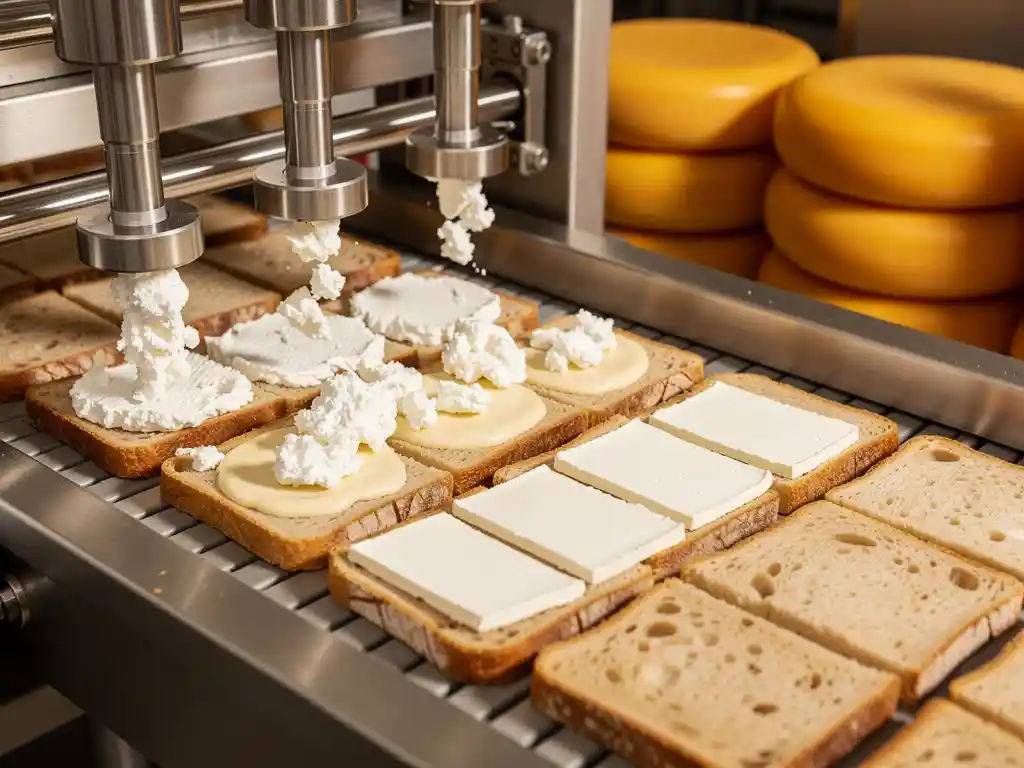
Choosing the right goat cheese forms for an automated sandwich concept requires insight into product specifications, processability, and shelf life. For producers in the food industry working with automatic production systems, it is essential to select goat cheese that performs consistently in both cold and warm applications. From spreadable spreads to pre-portioned slices, each form has specific properties that affect the efficiency and quality of your sandwich production.
What are the different forms of goat cheese for sandwich production?
For sandwich production, five main forms of goat cheese are available: spread (spreadable), slices, crumbles, pearls, and grated. Spread is most suitable for automatic dosing systems due to its pumpable consistency, while slices are ideal for controlled placement on sandwiches.
The most commonly used form in automated sandwich concepts is goat cheese spread, which is smoother and silkier than regular fresh goat cheese. With a fat content of only 16%, this form remains easily spreadable without taste compromises. For industrial applications, spread is available in 10-kilogram buckets, which works efficiently with automatic dosing systems.
Goat cheese slices of 17 grams are specially developed for sandwich applications and offer uniform portioning. These pre-portioned slices guarantee consistent product quality and simplify ingredient cost calculations. For more texture in premium sandwiches, 13-gram crumbles are available, which can be delivered both fresh and frozen.
Pearls of 78 grams form a unique option for artisanal sandwich concepts where visual presentation is important. These larger pieces maintain their shape during processing and offer a distinctive texture. Grated goat cheese, although currently still in the testing phase, promises new possibilities for quick and even distribution over sandwich surfaces.
How does the form of goat cheese affect melting behavior in warm sandwiches?
The form of goat cheese directly determines melting behavior: spread melts evenly and quickly, slices maintain their structure longer, while crumbles and pearls create a varied melting pattern. High-melt variants are specially developed to maintain shape when heated to 200°C, ideal for grilled cheese and paninis.
Goat cheese spread has the most predictable melting behavior due to its homogeneous structure and lower fat content. When heated, the spread becomes liquid without fat separation occurring, resulting in even distribution throughout the sandwich. Stirrability and pumpability are maintained, even after freezing and thawing, guaranteeing consistent results in production environments.
Slices and pearls show a slower melting process where the outside first becomes soft while the core remains firm longer. This creates interesting texture variation in warm sandwiches. For applications where shape retention is crucial, such as in open sandwiches or as toppings, high-melt variants are available that are specifically developed to maintain their structure during heating.
Crumbles offer the most diverse melting behavior because the small pieces melt at different speeds depending on their position in the sandwich. This results in a combination of melted and semi-melted textures that contribute to a premium eating experience. The choice between fresh and frozen crumbles has minimal impact on melting behavior after thawing.
Which goat cheese forms work best with automatic dosing and placement systems?
Goat cheese spread works optimally with automatic dosing systems due to its pumpable consistency, while pre-portioned slices of 17 grams are perfect for pick-and-place robots. Crumbles in bags of 5 or 10 kilograms function excellently in volumetric dosing systems for even distribution.
For liquid dosing systems, spread is the most efficient choice. The consistency remains stable between 4°C and 20°C, meaning production environments can work flexibly without constant temperature adjustments. The spread is available in Modified Atmosphere Packaging (MAP) or buckets, with bucket packaging directly connecting to industrial pump systems without transfer.
Slices require vacuum pick-and-place systems or mechanical grippers for accurate placement. The uniformity of 17 grams per slice makes robot programming simple and prevents production variations. These slices are freeze-stable, meaning they can be processed directly from the freezer without thawing time, simplifying production planning.
Crumbles work excellently with vibrating chutes and volumetric fillers that are common in the food industry. The free-flowing properties of crumbles enable precise dosing without blockages. For maximum efficiency, crumbles can be combined with checkweighers to guarantee consistent portions. Availability in both fresh and frozen form offers flexibility in inventory management and production planning.
What are the shelf life advantages of different goat cheese forms?
Frozen goat cheese forms offer a shelf life up to 2 years, while fresh variants vary from 4 weeks for curd to 23 weeks for crumbles and slices. After thawing, frozen products maintain the same shelf life as their fresh equivalent, offering flexibility in inventory planning.
The longest shelf life in fresh form is achieved with crumbles and pucks, which remain fresh up to 23 weeks from delivery. This extended shelf life is possible through specific production processes and packaging methods that ensure microbiological stability. For high-volume production environments, this means less frequent deliveries and lower inventory risks.
Spread has a shelf life of 10 weeks fresh but can be frozen for long-term storage up to 2 years. What’s special about spread is that after thawing it retains exactly the same processing properties, including pumpability and spreadability. This makes it possible to handle seasonal fluctuations in demand without quality loss.
For just-in-time production concepts, the different shelf life profiles offer strategic advantages. Fresh slices with 23 weeks shelf life can serve as buffer inventory, while curd with 4 weeks shelf life is suitable for frequent, smaller deliveries. The ability to freeze all forms without quality loss creates maximum flexibility in supply chain management.
How do you choose the right goat cheese specifications for your sandwich concept?
The choice of goat cheese specifications depends on four factors: processing temperature, production system, desired texture, and shelf life requirement. For cold sandwiches with automatic spread systems, pumpable spread is ideal, while warm concepts benefit from high-melt slices that maintain their shape.
Start by evaluating your production system. If you have dosing pumps, spread with an adjustable dry matter content between 35% and 45% is the logical choice. For pick-and-place systems, pre-portioned slices are more efficient. Also consider the possibility of customization: spread can be adapted with additions like herbs or spices for unique flavor profiles.
Temperature resistance is crucial for warm sandwich concepts. High-melt variants are specifically developed for applications up to 200°C and maintain their structure during grilling or toasting. For cold applications, standard fresh variants suffice. Always test melting behavior in your specific production environment, as oven types and processing times affect the end result.
Shelf life and logistics often determine the final choice. For daily fresh production with short lead times, fresh products with 4-10 weeks shelf life suffice. For export-oriented concepts or seasonal production, frozen variants with 2 years shelf life offer more flexibility. Calculate the total cost of ownership including inventory costs, depreciation, and handling to determine the most economical option.
How DeJong Cheese helps with your automated sandwich concept
We understand the complexity of automated sandwich production and therefore offer not only high-quality goat cheese products but complete support for your production concept. With our years of experience since 1995, we help you select the right cheese form that perfectly matches your production systems and quality requirements.
Our industrial support includes:
- Free product testing with your specific equipment and recipes
- Technical specifications adapted to your dosing systems
- Flexible packaging options from 5 to 15 kilograms
- Customization in dry matter content and flavor profiles
- Consistent quality guaranteed by IFS Food certification
As a traditional family business, we combine artisanal quality with modern production technology. Our extensive product selection offers solutions for every sandwich concept, from artisanal to fully automated. We deliver worldwide to the industry and understand the importance of reliable deliveries and consistent specifications.
Are you ready to discover the perfect goat cheese solution for your sandwich concept? Contact our specialists for a no-obligation consultation and product testing. Also visit our homepage for more information about our complete range or find a sales point near you to taste our products first.
Frequently Asked Questions
How can I determine the right viscosity of goat cheese spread for my specific dosing system?
Measure flow rate at different temperatures (4-20°C) and compare this with your pump system specifications. DeJong Cheese can deliver customized viscosity profiles by adjusting dry matter content between 35-45%. Request test samples with different viscosities to determine the optimal consistency for your equipment.
What are the cost and efficiency differences between fresh and frozen goat cheese forms in large-scale production?
Frozen variants have lower inventory costs due to 2-year shelf life and offer better purchasing flexibility with volume discounts. Fresh products require 20-30% less energy costs (no thawing) but have higher inventory turnover. For productions above 1000 sandwiches per day, frozen is usually more cost-effective due to lower depreciation and better seasonal planning.
What adjustments are needed to existing production systems when switching from regular cheese to goat cheese?
Minimal adjustments are usually sufficient: possibly lower temperature settings (goat cheese melts at lower temperature), adjust dosing programs for lower specific weight, and intensify cleaning cycles due to softer texture. Test first with small batches to optimize machine settings before fully switching.
How do I prevent cross-contamination when processing goat cheese alongside other cheese types?
Implement a strict allergen separation protocol: process goat cheese first in the production cycle, use dedicated equipment where possible, and perform intermediate rinse cycles with hot water (>70°C). Clearly mark goat cheese production lines and train personnel in allergen management according to HACCP guidelines.
What is the maximum storage time for goat cheese spread in dosing systems during production?
Goat cheese spread can remain in dosing systems for a maximum of 4 hours at room temperature (20°C) without quality loss. With cooled systems (4-8°C) this extends to 8 hours. Implement a first-in-first-out system and clean dosing lines daily to minimize microbiological risks.
Can different goat cheese forms be combined in one sandwich for texture variation?
Yes, combinations work excellently: use spread as a base for adhesion, add crumbles for texture, and top with a slice for visual appeal. Watch the total cheese mass (maximum 60-80 grams per sandwich) and adjust processing times because different forms have different melting speeds.
Related Articles
- Which laboratory tests are relevant for verifying the quality of goat cheese?
- What are the options for private label goat cheese concepts for retail partners?
- Why do salad manufacturers prefer goat cheese for differentiation?
- What vitamins are in goat cheese?
- What is the best way to melt goat cheese for recipes?